
As of November 2026, you can use Alipay and WeChat Pay without a Chinese bank card: simply register with an overseas phone number and link a Visa, Mastercard, American Express, JCB, Diners Club, Discover, or UnionPay card issued outside mainland China to start paying. Transactions of ¥200 or less generally incur no platform service fee, while amounts over ¥200 may be charged a 3% fee on the full transaction amount. The limit is about USD 5,000 per transaction and roughly USD 50,000 per year—check the limits displayed in the app for exact figures.

This guide is written for readers from Taiwan, Hong Kong, and overseas visiting East China for the first time. It covers how to set up both wallets at home before your trip, exactly how fees are calculated, what to do if linking your card fails, and the smoothest ways to ride the metro, hail a taxi, and pay at small shops once you arrive in Shanghai, Hangzhou, or Nanjing. The policies and figures here are based on official information available as of November 10, 2026. Payment platforms update their rules frequently, so always follow the prompts shown in the app when making a payment.
First things first: Can you use them without a Chinese bank card?
Yes. China's relevant authorities made it clear in the 2026 edition of the Guide for Foreign Business Professionals Working and Living in China: download WeChat, Alipay or UnionPay QuickPass, follow the app instructions to register with a foreign or Chinese phone number, then follow the on-screen prompts to link a bank card bearing the Visa, Mastercard, UnionPay, American Express, JCB, Diners Club or Discover logo. You can then scan a merchant's QR code or show your payment code to pay. You don't need to open a bank account first, nor do you need a Chinese phone number.
It helps to distinguish three types of cards. First, credit and debit cards issued by overseas banks—what most readers have—which can be linked directly. Second, UnionPay cards issued overseas, which can also be linked, and some platforms offer fee discounts for them. Third, cards issued by mainland Chinese banks, which only those who have opened an account on the mainland possess; this article doesn't cover them. Cards issued by banks in Taiwan and Hong Kong are treated as overseas cards in both Alipay and WeChat.
Alipay and WeChat are two separate systems, and balances can't be transferred directly between them. For short-term travelers, instead of worrying about "how to transfer from Alipay to WeChat," just install both apps and link a card to each: the vast majority of merchants in East China accept both QR codes, and while a few small stalls display only one, having both ready means you'll never get stuck.
Do this at home before you leave: register, link your card, verify
It's best to set everything up a week before departure, because linking a card requires verification by the issuing bank. You may need to receive an SMS code or confirm in your banking app, which is easiest to handle while still at home.
Alipay: Download either the international or standard version from your app store. On the login page, select the country or region code for your overseas phone number, enter the number, receive the verification code and complete registration. Go to "Me" or the bank card entry on the home screen, and add your card number, expiration date, security code and billing address; some cards will redirect you to the issuing bank for 3D Secure verification. The system may ask you to upload your passport information page and fill in your name, nationality and other details. Completing this real-name verification as prompted gives you fuller transaction limits.
WeChat: First register a WeChat account with your overseas phone number. New accounts sometimes require an existing WeChat user to scan a QR code to help verify you, so it's best to ask friends or family for help before you leave. Then go to "Me" > "Services" > "Wallet," add a bank card, and enter the card number and cardholder information. WeChat uses tiered verification for overseas users opening an account for the first time: you can make small payments right away, and provide your passport details later when you need higher limits.
Check three things at the same time: First, whether your phone number can receive SMS messages in China—enable international roaming or use a dual-SIM phone to keep your original number active. Second, notify your issuing bank in advance that you're traveling to mainland China so transactions aren't blocked by fraud controls. Third, confirm that your card is enabled for overseas online transactions. Many "card linking failures" actually come down to these three issues.

How are the fees calculated?
The payment guide for overseas bank cards released by the Shanghai municipal government in September 2026 states: transactions of ¥200 or less are generally free of platform service fees; transactions over ¥200 may be charged a 3% fee on the entire amount. Note that it applies to the whole transaction, not just the portion above ¥200. For example, if you buy a ¥500 jacket on Nanjing Road and pay with an overseas card, the service fee is ¥15. Splitting it into two ¥250 payments doesn't help—both exceed ¥200, so each is still charged 3%.
WeChat Pay offers an additional limited-time promotion. According to Tencent's announcement in late May 2026, from the announcement date until December 31, 2026, users linking an international bank card to WeChat for the first time will have the 3% service fee waived on daily transactions up to ¥1,000 for 90 consecutive calendar days starting from their first purchase. Transactions of ¥200 or less remain free year-round for all international card users. This promotion has an end date, and whether it will be extended next year depends on future announcements. For Alipay, we haven't found a similar official waiver notice, but the payment page shows whether a fee applies and how much it is—just take a look before confirming.
Besides the platform service fee, your issuing bank may charge a foreign transaction fee or currency conversion fee. This is up to the bank and varies by institution, so check your bank's app before you travel. If your card already waives foreign transaction fees, your overall costs will be much lower. For big expenses like hotels, private car services, or pricey tickets, swiping your physical card or paying with a credit card on a booking platform is often cheaper than using a mobile wallet.
Fees can also be refunded: according to the Shanghai municipal government's guidelines, if you request a refund, any service fee already charged will be returned proportionally.

Limits and identity verification
Officially, once you link a foreign bank card to Alipay or WeChat, the limit is USD 5,000 per transaction and USD 50,000 per year. These are the higher thresholds pushed by the People's Bank of China starting in 2024, and the Shanghai municipal government still cited these figures in its 2026 guidelines. Your actual limit will vary depending on whether you've completed passport verification, how long you've had the account, and your issuing bank's own restrictions.
Typically, a newly registered account without a passport uploaded may only allow small payments; limits increase noticeably after verification. Some debit cards also have per-transaction caps for third-party payments set by the bank, so your wallet shows enough balance but the payment gets declined. If that happens, try a different credit card or use a physical card at a POS terminal instead.
In reality, foreign tourists rarely make large purchases: hotels are usually paid when booked, attraction tickets mostly cost ¥100–200, and high-speed train tickets range from tens to a few hundred yuan. As long as you know there's a 3% fee over ¥200, you're fine—no need to keep every transaction under ¥200 just to save on fees.

Why linking your card might fail
Declined by your bank: The most common reason. Banks often flag card-linking requests from Chinese payment platforms as suspicious transactions. Call your bank or confirm it was you in your banking app, and it usually goes through.
Card type not supported: Some prepaid cards, virtual cards, and domestic-only debit cards can't be linked. Carrying an extra credit card from a major network is your safest bet.
Mismatched information: Your registered name must match your passport and the name on the card exactly, including the order of your English name and any middle names. Enter the billing address exactly as registered with your bank.
Can't receive the verification code: Your overseas phone number doesn't have roaming enabled, or your original number was deactivated after you switched to a local SIM. Testing this before you leave is the easiest fix.
The 2026 official guide also recommends: if linking your card fails, contact the payment app's customer service or your card issuer first. Both Alipay and WeChat offer English customer service options in their apps.
You can use wallets from Hong Kong, Macau, Taiwan and other regions directly
If you live in Hong Kong or Macau, the simplest option is often to just use the wallet already on your phone. The 2026 official guide lists AlipayHK, WeChat Pay HK, Macau's MPay, South Korea's Kakao Pay, Naver Pay and Toss Pay, Malaysia's Touch 'n Go eWallet, Singapore's Changi Pay and OCBC, Thailand's TrueMoney, the Philippines' GCash and other e-wallets. Users can scan QR codes to pay directly in mainland China without registering a separate mainland wallet. Payments are charged to your original wallet balance or linked local card, at the exchange rate shown in the app.
PayPal users in the US now have another option: Tencent announced in May 2026 that it has integrated with PayPal, allowing US PayPal users to scan WeChat Pay merchant QR codes or present a payment code within the PayPal app. Other regions will be rolled out in phases as planned. Readers in Taiwan currently mostly link Visa or Mastercard cards issued by Taiwanese banks to Alipay and WeChat, and are charged under overseas card rules.
Another backup is UnionPay's Cloud QuickPass: after applying for a "Travel Pass" in the app and topping it up, you can use it for everyday purchases. This suits readers who prefer not to link a credit card to a third-party wallet.

How to pay in different situations once you're in Shanghai, Hangzhou or Nanjing
Subway: Shanghai is one of the cities where you can tap a bank card directly at the turnstile. Just tap a physical card with a Visa, Mastercard, American Express or UnionPay QuickPass logo on the gate to enter—no ticket needed. The 2026 official guide lists Beijing, Shanghai, Guangzhou and Chengdu as tap-to-ride cities; Hangzhou and Nanjing were not on the list at that time, so double-check with the local subway's official channels before you go. In those two cities, open "Transport" in Alipay, select your city, complete identity verification to get a subway QR code, then scan it to enter and exit. You can also buy single-ride tickets at station vending machines, which accept cash and mobile payments.

Buses: You can also claim a bus QR code in "Transport" on Alipay and scan it when boarding. Cash works too, but bring exact change—buses generally don't give change.

Taxis: Use the ride-hailing feature in Alipay or WeChat to book a car; payment is deducted automatically after the trip—the easiest option. Many taxis in Shanghai have POS terminals that accept foreign cards, and payment QR codes are posted inside. Check the signs in the cab for details.
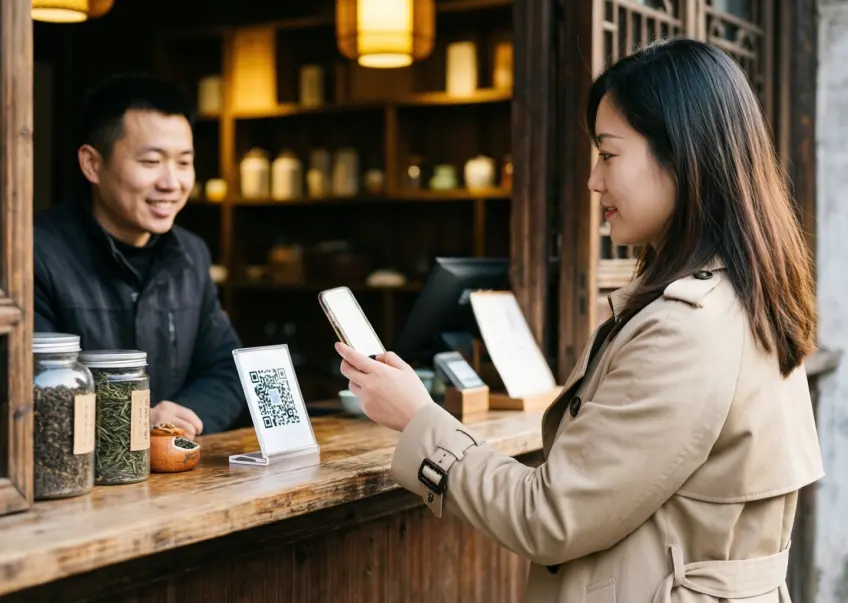
Small shops, breakfast stalls and attractions: QR code payments work almost everywhere in East China's cities. Popular sites like Lingyin Temple and Yu Garden mostly use mini programs for reservations and tickets, with payment handled through your wallet app. Shops along old streets such as Confucius Temple, Hefang Street and Nanjing Road all accept mobile payments, and some heritage brand counters take cards too.

Hotels: Most mid-range and upscale hotel front desks accept Visa and Mastercard directly, though they may pre-authorize a deposit at check-in. When booking on platforms like Trip.com or Tongcheng International, you can pay directly with an international credit card.
Shopping tax refunds: If you spend ¥200 or more on the same day at a single tax-refund store, you can apply for a departure tax refund. The refund rate is 11% or 8% (including the agency service fee), and it's processed at the airport when you leave. We covered the refund and payment details for Nanjing Road in our article Foreign visitors exploring Nanjing Road Pedestrian Street, which is worth checking out.

Keep cash and physical cards as a backup
RMB cash is legal tender in mainland China, and merchants cannot refuse it. We recommend carrying a few hundred yuan in your wallet — it comes in handy if your phone dies, you lose your connection, or your digital wallet gets flagged by risk controls. Each person can bring up to ¥20,000 in RMB per entry. Once you arrive, you can exchange currency at the airport or bank branches, or withdraw cash from ATMs with the corresponding logo using an international bank card. In Shanghai, ATMs usually allow a maximum of ¥3,000 per transaction, though your issuing bank may have its own limits.
Commercial bank branches also offer change services. You can exchange bills for smaller denominations at the counter, or simply ask for a pre-packed "change pouch" with mixed denominations. This small change is very useful on buses, at wet markets, or in village shops.
Don't leave your physical credit cards at home either. Major malls, chain hotels, airports, and train station counters in Shanghai, Hangzhou, and Nanjing widely accept Visa and Mastercard, while overseas cards with the UnionPay logo are accepted at even more locations.

Safety and a few tips
Check the payee's name before confirming a payment, especially when scanning a QR code stuck to a table. If a shopkeeper asks you to "add them on WeChat and transfer money," it's safer to scan their merchant QR code instead. Accounts linked to foreign cards are mainly for purchases; features like personal transfers and red packets are limited—check the app for details.
Your phone is your gateway to everything, so bring a power bank and set a lock screen password. If your wallet account is temporarily frozen, follow the app's prompts to add your passport info, or switch to another wallet or use a physical card. In cities like Hangzhou and Nanjing, you can call the local government hotline 12345 if you run into trouble; Shanghai's 12345 offers English service.
When traveling with family, not everyone needs to link a card: one person can handle payments while others carry a little cash and a physical card. Traveling with parents? Set up small contactless payments in advance to avoid fumbling at the counter. If you'd rather leave the whole trip to someone who knows the area, airport transfers, private car services, tickets and meals can all be arranged through our East China Private Custom Tours, so you can just enjoy the scenery along the way.


Shanghai day tour: Shanghai, Oriental Pearl Tower
Private day tour with Shanghai airport transfers: walk the 259-meter glass corridor on the second sphere of the Oriental Pearl Tower, visit the Former Residence of Soong Ching Ling, and explore Yu Garden. Ideal for layovers or short stays in Shanghai. Includes vehicle, guide and admission tickets. English-speaking and other foreign-language guides available on request.

Suzhou, Hangzhou and Shanghai 5 days 4 nights: Leifeng Pagoda - West Lake cruise - Hefang Street - Songcheng - Lion Grove Garden - Shantang Street - Nanjing Road pedestrian street - The Bund night view - Disneyland
A 5-day, 4-night private tour with airport transfers in Shanghai: Leifeng Pagoda, a West Lake cruise, Hefang Street and the Romance of the Song Dynasty show in Hangzhou; Lion Grove Garden and Shantang Street in Suzhou, returning to Shanghai in the evening for The Bund; a full day at Shanghai Disneyland on day four. Includes transport, guide, 4 nights' hotel and admission tickets. English-speaking guide available.

8-day Jiangnan private car tour | 9-seat vehicle with guide-driver
Start and end in Shanghai on this 8-day exclusive Jiangnan private car tour. Your guide doubles as the driver, so you and your family or friends can travel at your own pace without joining strangers. The route links West Lake, Wuxi, Nanjing, Yangzhou, Suzhou and Puyuan in Wuzhen, showcasing lakes and mountains, ancient towns and Shanghai's cityscape. Itinerary and stops can be arranged in advance. This is a private car service only — hotels, attraction tickets and meals are not included, so you can choose accommodation and activities to suit your preferences.
Related preparation: What to prepare for your first trip to China, How foreigners can buy China high-speed train tickets, and How to take a taxi in China; for city info, see the Shanghai city page.
FAQs
Can I link a foreign bank card to Alipay?
Yes. As of November 2026, Alipay supports Visa, Mastercard, American Express, JCB, Diners Club, Discover and UnionPay cards issued overseas. You can register with a foreign phone number—no Chinese bank card required. Transactions of ¥200 or less are usually fee-free; for amounts over ¥200, a 3% fee may apply to the full transaction amount.
How do I use WeChat Pay without a Chinese bank card?
Register WeChat with an overseas phone number, add a foreign bank card under "Me > Services > Wallet," and follow the prompts to complete verification. Then you can scan QR codes to pay. Users linking a card for the first time before December 31, 2026, are exempt from the 3% service fee on daily spending up to ¥1,000 for 90 days starting from their first transaction.
How much is the fee for linking a Visa credit card to Alipay?
Alipay generally doesn't charge a fee for single transactions of ¥200 or less; amounts over ¥200 may incur a 3% fee on the full amount. Your card issuer may also charge a foreign transaction fee. The payment page shows whether a fee applies, so check it before confirming.
Can I use the international version of Alipay in China?
Yes. Alipay downloaded from overseas app stores works normally for QR code payments in mainland China. It functions just like the domestic version, and the interface can be switched to English.
Can Hong Kong's AlipayHK and WeChat Pay HK be used directly in mainland China?
Yes. Official guidelines state that users of both wallets can scan and pay directly in mainland China. Charges are deducted from your wallet balance or a linked local Hong Kong card, with no need to register a separate mainland account.