
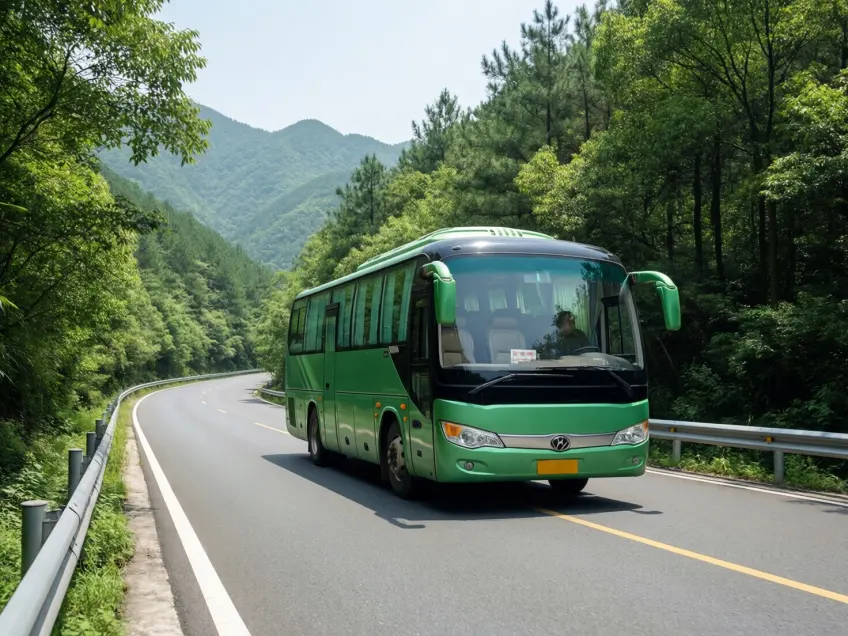
Xuedou Mountain lies northwest of Xikou Town in Fenghua, Ningbo. Private cars and taxis are not allowed up the mountain, so all visitors must transfer to the scenic area's sightseeing buses at the visitor center. This ride is included in your admission ticket. The smoothest route is "up first, then down": take the sightseeing bus to Sanyin Pool (Three Hidden Pools) and view the three pools from top to bottom; then ride the mini train to Qianzhang Rock and take the cable car up to Miaogao Terrace. From Miaogao Terrace, hike down past Zhang Xueliang's Former Residence to Xuedou Temple and the Giant Maitreya Buddha, and finally catch a bus back to the visitor center from Xuedou Temple. The mini train and cable car require separate tickets, and the Miaogao Terrace cable car stops running around 4:00 PM, so it's best to head up before 1:30 PM.
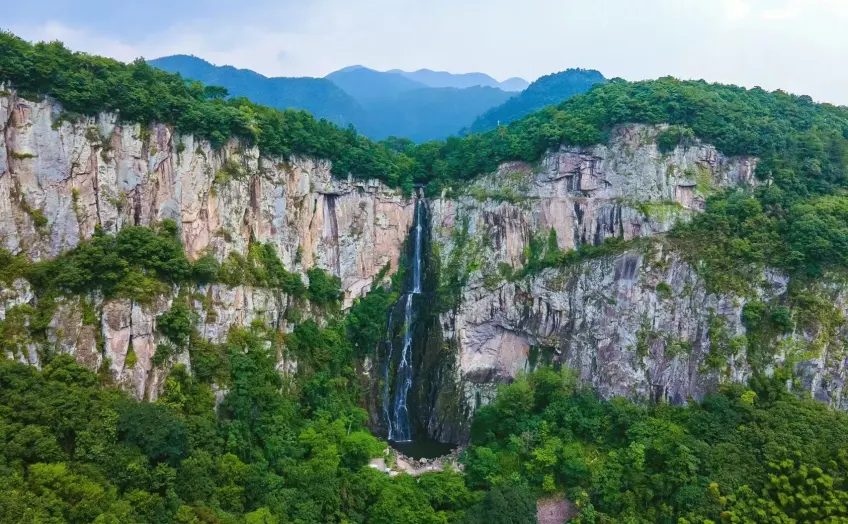
Xuedou Mountain is a branch of the Siming Mountains. Its main peak rises about 800 meters above sea level, and over 90% of the area is covered in forest, making it noticeably cooler than downtown Ningbo in summer. It has been famous for centuries: as early as the Han Dynasty, it was called "Penglai on the Sea." During the Song Dynasty, Emperor Lizong inscribed the words "Dream-Fulfilling Famous Mountain," spreading its reputation far and wide. The mountain's name comes from the "Snow Cave" (Xuedou) on Rufeng Peak, where spring water gushes out white as snow or milk. Today, Xuedou Mountain combines waterfall gorges, summit viewing platforms, and Buddhist temples all in one place—what sets it apart from typical hiking spots.
Understand the two types of transport on Mount Xuedou
The attractions on Mount Xuedou are spread across a large area. Sanyin Pools, Qianzhangyan Cliff, Miaogao Terrace, and Xuedou Temple are several kilometers of mountain road apart, so you can't walk the whole way. That means the first thing to figure out when visiting Mount Xuedou is how the two types of transport work.
Part one: the scenic shuttle bus. Visitors arriving by car or taxi park and get off at the Xuedoushan Visitor Center (also called the tourist hub), then transfer to the green scenic shuttle bus to go up the mountain. The shuttle stops at Sanyin Pools, Xufuyan, Xuedou Temple, and other stations. You can ride it multiple times while your ticket is valid, and the fare is already included in your admission ticket—no need to buy a separate one.
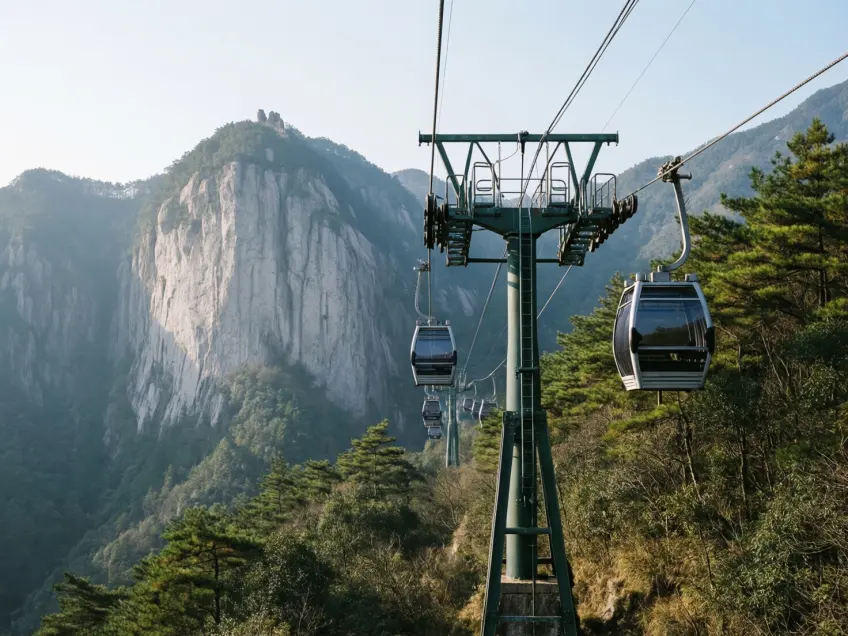
Part two: the mini train and cable car. To get from the Sanyin Pools area to Qianzhangyan Cliff, you'll take the sightseeing mini train; to go from Qianzhangyan Cliff up to Miaogao Terrace, you'll take the cable car. These two rides require separate tickets. You can also hike up the trails, but they're steep and time-consuming, so we don't recommend them if you're not in great shape.
Watch out for three common pitfalls. First, the mini train and cable car undergo routine maintenance one day each month and don't run that day—check with the attraction or our customer service before you go. Second, the Miaogao Terrace cable car stops running around 4 pm, so if you head up the mountain after noon, you might miss it. Third, shuttle bus lines can be long on weekends during peak season; arriving at the visitor center before 9 am makes things much easier.
Recommended route: start at Sanyin Pools and walk down
The classic way to hike Mount Xuedou is to "ride up and walk down," which avoids backtracking and saves energy. Here's the route:
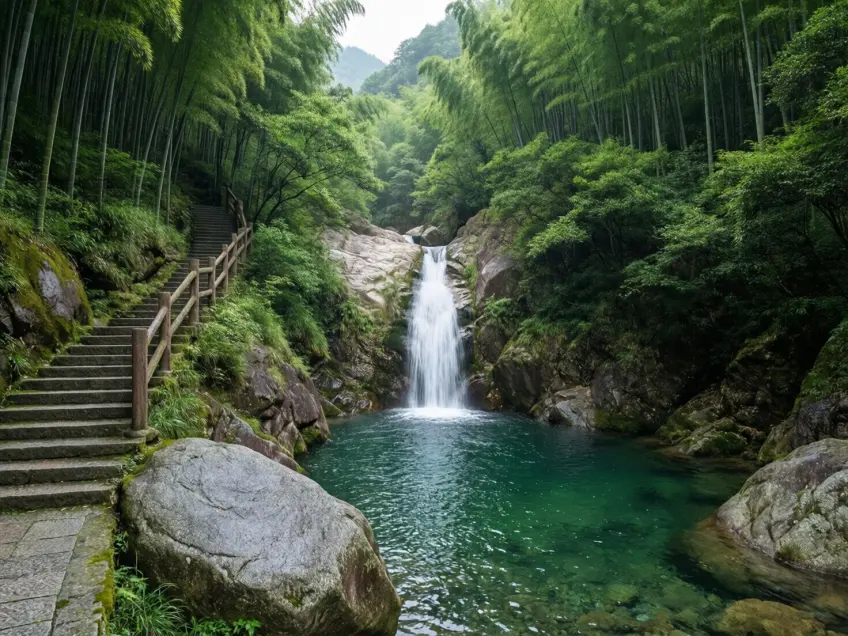
Stop 1: Sanyin Pools. Take the shuttle bus from the visitor center directly to the Sanyin Pools stop. The three pools—Upper, Middle, and Lower—are connected by stone steps built along the mountainside, with a waterfall cascading into each emerald-green pool. Walking downhill from the Upper Pool takes about 1 to 1.5 hours, accompanied by the sound of rushing water. There are many steps on the descent, so older visitors with knee issues should hold the railings and take it slow.
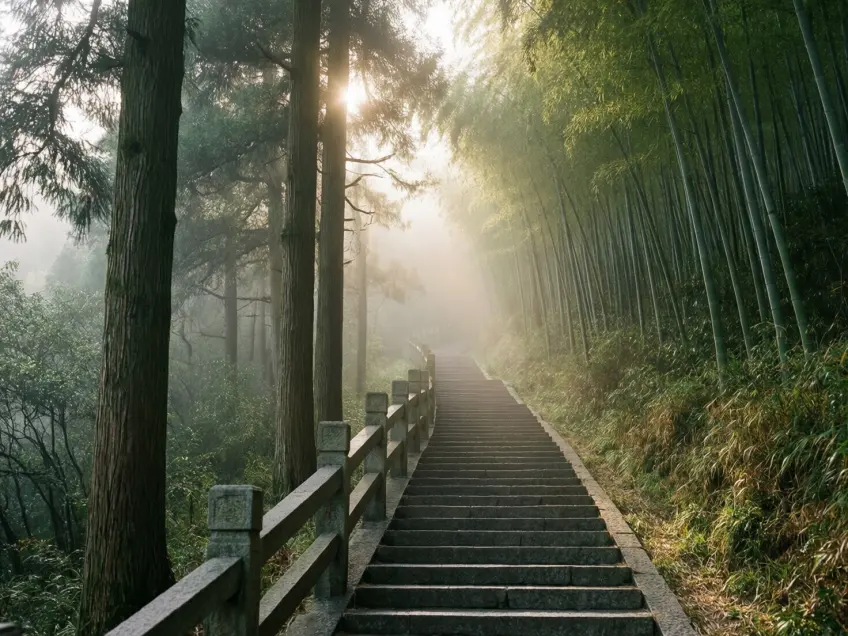
Stop 2: Mini train to Qianzhangyan Cliff. Walk to the West Shuttle Station near the Lower Pool and transfer to the mini train heading to Qianzhangyan Cliff. The open-air train runs along a mountain road, offering views of bamboo groves and valleys on both sides—a scenic ride in itself.
Qianzhangyan Cliff and Miaogao Terrace: the most spectacular stretch of Mount Xuedou
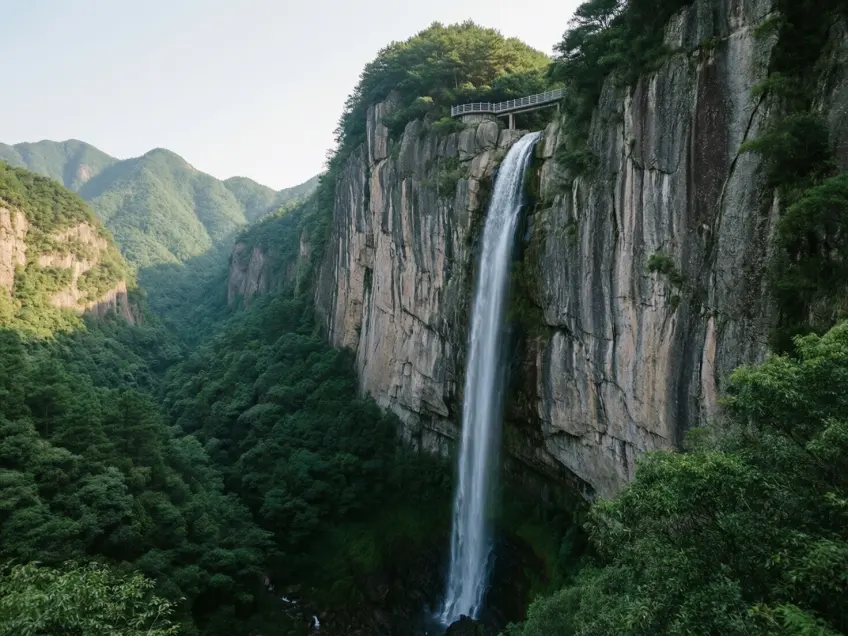
Qianzhangyan Cliff is the signature sight of Mount Xuedou. A waterfall plunges straight down from the cliff edge with a drop of about 186 meters, earning it the title "No. 1 Waterfall in Eastern Zhejiang." During the wet season, the cascade scatters into white mist mid-air, and you can feel the cool spray from the viewing platform. In the dry season the flow is lighter, but the pale gray cliffs remain impressive.
From Qianzhangyan Cliff, take the cable car up to Miaogao Terrace. This platform sits on the edge of a summit cliff, covering about 350 square meters. From the edge, you can look down on the narrow Tingxia Lake in the valley and layers of green mountains—the widest view on Mount Xuedou. A Republican-era villa stands on the terrace, sharing its history with the Chiang family residences in Xikou Town below.
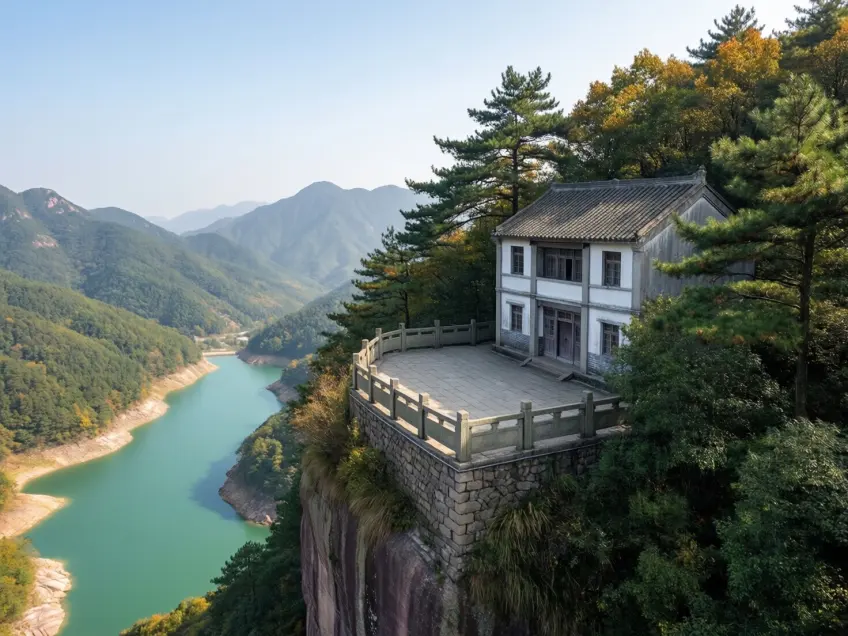
There's no need to rush at Miaogao Terrace. It's a great spot to sit down, rest, drink some water, and take a few wide-angle shots. On clear days, the lake and mountains show distinct layers; on foggy days, clouds often roll through, creating a "mountains floating above the clouds" effect—each has its own charm. When shooting landscapes, include the terrace railing or pine branches in a corner as foreground for more depth than just an open lake. In the backlit afternoon, the lake reflects a bright band of light, perfect for silhouettes.
Xuedou Temple and the Maitreya Buddha: The final stop
Walking down the path behind Miaogao Terrace, you'll pass the former residence where Zhang Xueliang was once confined on Mount Xuedou. Another ten minutes brings you to Xuedou Temple. This downhill stretch is easy, well shaded by trees, and the most relaxing part of the route—families with older members can slow down here and rest along the way.
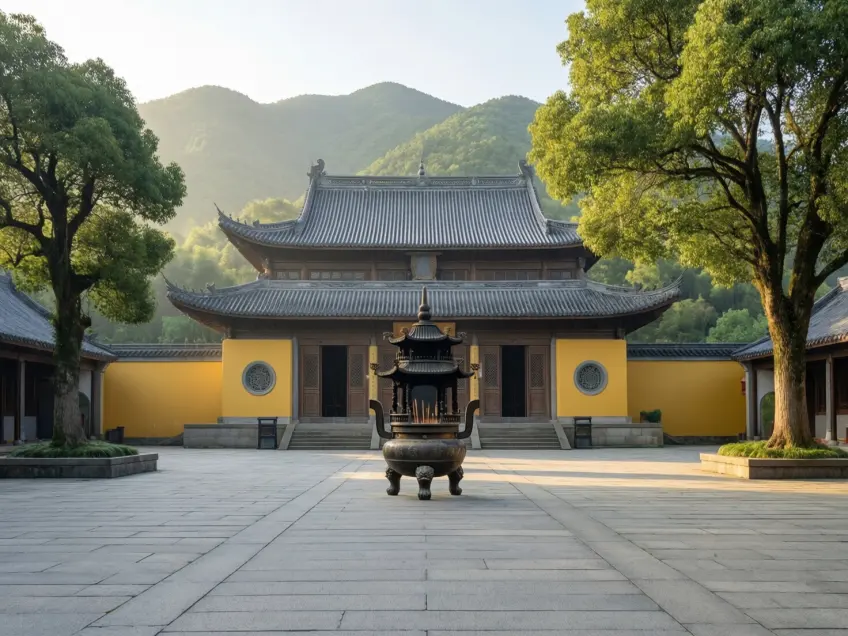
Xuedou Temple has a long history: founded during the Jin Dynasty, it was granted the name "Xuedou Zisheng Zen Temple" by Emperor Zhenzong of the Northern Song, and ranked among the "Five Mountains and Ten Temples" in the Southern Song. Emperor Lizong of the Song once inscribed "Famous Mountain of Answered Dreams" for Mount Xuedou, and these four characters remain its signature today. Mount Xuedou is also known as a sacred site of Maitreya, holding its own place among famous Buddhist mountains.
The open-air Maitreya Buddha stands on the hillside next to Xuedou Temple. According to the scenic area, the statue itself is 33 meters tall with a 9-meter lotus pedestal, reaching a total height of 56.74 meters including the base. Cast in tin bronze, it was consecrated in November 2008. There are 332 steps from the foot of the hill to the pedestal, and many visitors climb them all at once to "embrace the Buddha's feet." If you don't have the stamina, viewing it from the plaza below is still impressive.
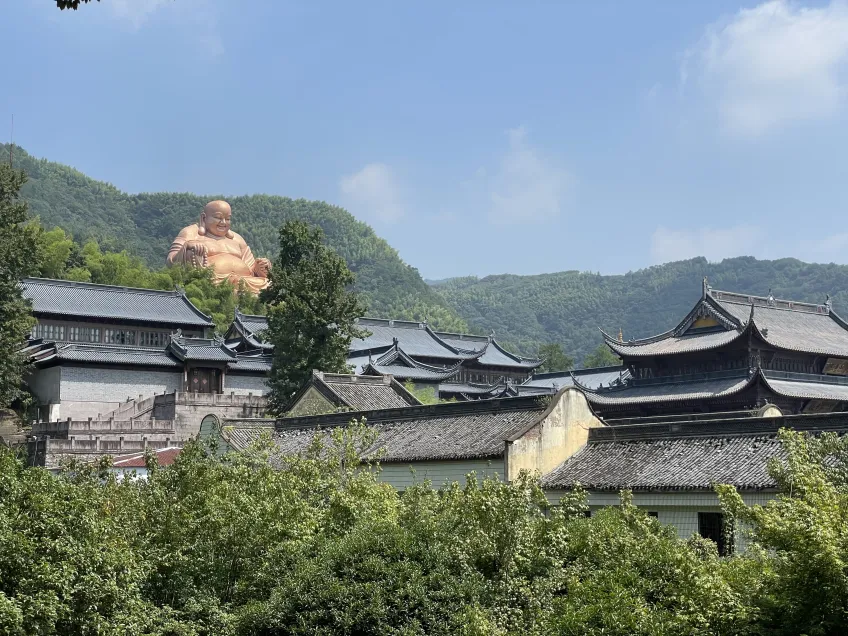
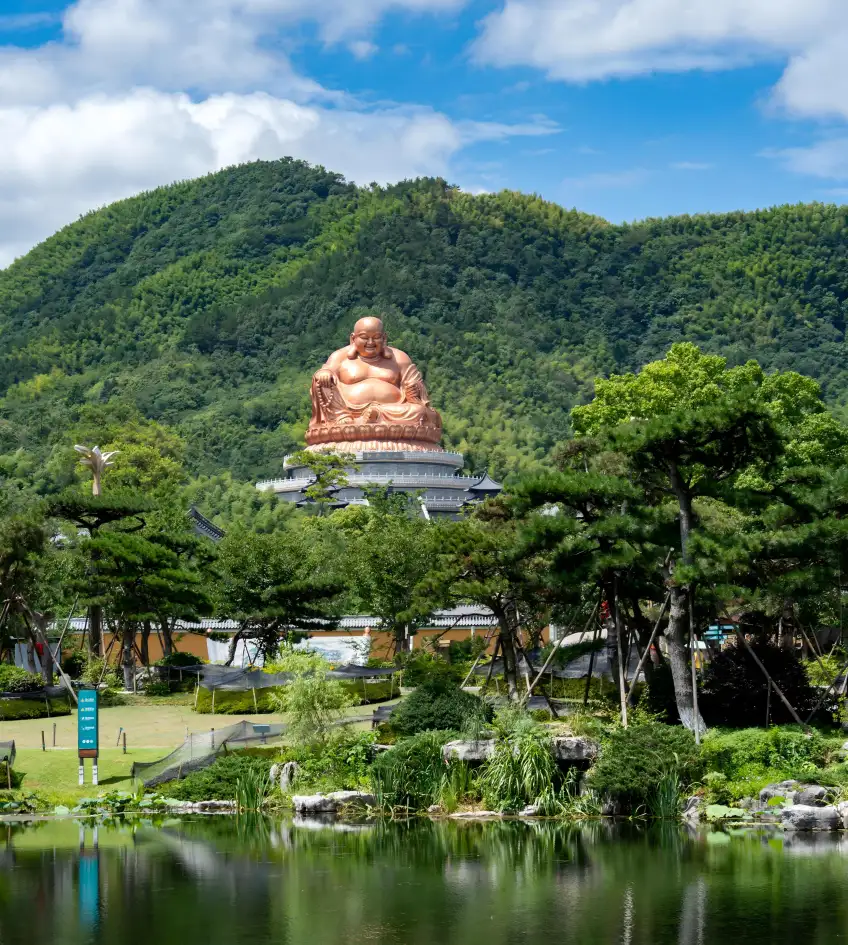
After seeing the giant Buddha, take the sightseeing bus back to the visitor center from the stop at the entrance of Xuedou Temple. Following this route at a normal pace takes five to six hours. If you take lots of photos or spend more time in the temple, allow seven hours to be safe.
Near the giant Buddha are the Maitreya Altar and the Maitreya Museum. The altar was built in an abandoned quarry and features immersive attractions like the Prayer Echo Valley and the Time Corridor; the museum displays artifacts using holographic projections and other methods. If you're interested in Buddhist culture and have time to spare, set aside an hour for them. If you're in a hurry, heading straight down the mountain after seeing the giant Buddha won't make you miss the main highlights.
Xuedou Temple has two easily overlooked sights: a pair of thousand-year-old ginkgo trees known as the "Couple Trees," and the "General's Nanmu Tree" planted by Zhang Xueliang during his stay on Mount Xuedou. Zhang was placed under house arrest here after the Xi'an Incident. His former residence, which you pass on the way down from Miaogao Terrace, and this nanmu tree in the temple neatly tie together this chapter of history.
Here's a sample schedule for first-time visitors: arrive at the visitor center at 8:30 to catch the bus, start hiking Sanyin Pools at 9:00, take the mini train to Qianzhangyan Cliff around 10:30, ride the cable car up to Miaogao Terrace before 11:30, rest there and eat some snacks you brought along, begin walking down the mountain around 13:00, reach Xuedou Temple around 13:30, see the giant Buddha at 14:30, and take the bus back to the visitor center between 15:30 and 16:00. Adjust the timing based on your fitness level, but try to take the cable car section before noon.
Is Xufuyan worth visiting?
Xufuyan is on the other side of the sightseeing bus route. It also features a waterfall plunging off a high cliff with a drop of about 116 meters, plus rock climbing and walkway activities nearby. Its style is similar to Qianzhangyan Cliff, so if you only have one day, prioritize the main route of Sanyin Pools, Qianzhangyan Cliff, Miaogao Terrace, and Xuedou Temple. Add Xufuyan only if you're fit, start early in the morning, or have two days planned.
Getting to Mount Xuedou and planning your time
Public transit: Buses 987 and 988 run from the south square of Ningbo Railway Station to Xikou. From Xikou, transfer to the Xuedoushan Visitor Center; the one-way trip takes about 1.5 hours. If you take the high-speed train to Fenghua Station, it's closer to take a taxi or bus from there to Xikou. Driving from Ningbo Lishe International Airport to the scenic area takes about an hour. Bus schedules and stops change occasionally, so double-check on a map app on the day you travel.
Driving: Set your navigation to "Xuedoushan Visitor Center," park in the visitor center lot, then transfer to a sightseeing bus up the mountain.
What to wear and bring: There are plenty of steps and mountain paths, so comfortable, non-slip sneakers are essential. The weather changes quickly on the mountain—bring a light jacket in spring and fall, and a raincoat is handier than an umbrella during the rainy season. Rocks near waterfalls and deep pools are slippery, so don't climb over the railings for photos. Food options on the mountain are limited, so bring your own drinking water and snacks.
Tips for international visitors: Ticket offices, sightseeing buses, and small shops on the mountain generally accept Alipay or WeChat Pay. International travelers can link an overseas credit card in Alipay. Cell signal can be spotty in some areas, so screenshot your ticket QR code and return details before setting out. When taking a taxi or booking a private car, use "Xuedoushan Visitor Center" as your destination—it's the most accurate, and drivers will drop you right where you transfer to the sightseeing bus.
Mount Xuedou and the Chiang Kai-shek Former Residence in Xikou at the foot of the mountain are both part of the Xikou–Tengtou Scenic Area, and you can buy a combo ticket to visit both. How you plan it depends on your energy and schedule:
Mount Xuedou only (one day): Arrive at the visitor center before 9:00 AM, follow the route above, head down around 4:00 or 5:00 PM, and return to downtown Ningbo or stay in Xikou for the night.
Mount Xuedou plus Chiang Kai-shek's Former Residence: If you want to see both, split them over two days: one day for the mountain, one day in Xikou Town for Chiang Kai-shek's Former Residence and a walk along Shanxi Stream. This spreads out the physical effort. If you only have one day but want to do both, skip Three Pools Gorge or Xufuyan. For a sample itinerary, see Xikou to Mount Xuedou day tour.
Traveling with seniors: Three Pools Gorge has many steps. You can just visit Upper Pool and turn back, or take the shuttle directly to Qianzhangyan Cliff. The mini train and cable car cost extra, but they save you from the steepest climbs—well worth it.
Stay in Ningbo or Xikou? Downtown Ningbo is about an hour's drive from Xikou, longer by bus. If you're only doing Mount Xuedou for a day and heading to another city the next day, staying in downtown Ningbo is more convenient. If you're splitting Mount Xuedou and Chiang Kai-shek's Former Residence over two days, stay in Xikou Town the first night so you can head out early the next morning, saving two to three hours of round-trip travel.
Rainy days and winter: In light rain, the waterfalls are fuller and mist drifts through the mountains, making the scenery even better—but the steps get slippery, so at Three Pools Gorge you may want to stick to Upper Pool. In heavy rain, thunderstorms, or strong winds, the mini train and cable car may close and Miaogao Terrace becomes inaccessible; focus on Xuedou Temple and the Giant Buddha instead. Winter days are short, so start up the mountain before 9:00 AM and head down before 4:00 PM.
Private car from downtown Ningbo: Mount Xuedou is over an hour outside the city, buses require transfers, and return times are hard to control. For families or trips with seniors, booking a private car round trip with the driver waiting at the visitor center is the most stress-free option.

FAQs
Can I drive my own car up Mount Xuedou?
No. Both self-driving cars and taxis can only go as far as the Xuedoushan Visitor Center, after which you must transfer to the scenic area shuttle bus. The shuttle bus fee is included in the admission ticket, and you can ride it multiple times while your ticket is valid.
Do the mini train and cable car run every day?
They operate daily, but close one day each month for routine maintenance, and may also shut down temporarily in bad weather. The Miaogao Terrace Cable Car stops running around 4:00 PM. Check with the scenic area or our customer service before you go to confirm that day's operating status and avoid a wasted trip.
How long does it take to explore Mount Xuedou?
The main route covering Sanyin Pools, Qianzhangyan Cliff, Miaogao Terrace, Xuedou Temple and the Maitreya Buddha statue normally takes five to seven hours—basically a full day. If you add Xufuyan or Chiang Kai-shek's Former Residence, plan for two days.
What is the best season to visit Mount Xuedou?
Spring and fall are the most comfortable. In spring, mountain flowers bloom and the waterfalls grow stronger; in fall, the skies are clear with great visibility, making Miaogao Terrace the best spot for distant views. Summer on the mountain is cooler than in the city, and the waterfalls are most spectacular after rain, but watch out for heat and slippery paths. Winter brings fewer visitors and occasional snow scenery, but some trails may be icy, so check the scenic area's announcements.