
Moon Lake in Ningbo lies in the southwest of Haishu Old Town. It's a city lake park open free all day, and together with Tianyi Pavilion it forms a single national 5A tourist attraction — the two are just a few minutes' walk apart. On your first visit, follow the loop "Yanyue Embankment at the north end – east bank – Liuting Islet in the lake – west bank"; without entering the exhibition halls it takes about 1.5 to 2 hours. If you'd like to explore the Yintai Di Official Mansion Museum and He Mijian Memorial Hall, add another hour. The lakeside paths are flat, so it's easy to stroll slowly even with older family members. Early morning and dusk bring fewer crowds and softer light, making them the most pleasant times to visit.

Where is Moon Lake: A long, narrow lake in the old town
Moon Lake is in Haishu District, Ningbo, right next to the old town's shopping streets and residential neighborhoods. There are no walls around the lake—you can reach the water from any alley. It's long and narrow from north to south, with Yanyue Causeway at the northern end and the old southern lanes near the south. Many locals come here every morning for a walk or tai chi, and bring their kids to feed the fish in the evening. This everyday feel is what sets Moon Lake apart from ticketed attractions.
Moon Lake's history dates back to the Tang Dynasty. Most records say it was dug during the Zhenguan era, around 636 AD, even before the Sanjiangkou area later took shape as Ningbo's prefectural center. From the Song Dynasty onward, academies, libraries, official residences and temples were built on and around the lake. Scholars and officials settled here, which is why locals often say, "Half of Ningbo's history lies in Moon Lake."
Today, Moon Lake and Tianyi Pavilion to its northwest together form the most concentrated historic district in old Ningbo. For overseas visitors coming to Ningbo for the first time, the best part is that you don't have to rush: you can see the lake, the library and a few old houses in one morning, then head to the old streets to the south in the afternoon at a relaxed pace.

If you've just come from Hangzhou, think of Moon Lake as a smaller, more lived-in West Lake: no noisy boat docks or traffic along a lakeside boulevard. You can see the far shore at a glance, and walking the whole loop won't wear you out. The appeal isn't grand scenery but the traces left by old houses, ancestral halls and libraries along the shore. So take your time and read the info boards as you walk—it's far more rewarding than rushing to check off photo spots.
First, get familiar with the "Ten Islets" and "Three Causeways and Seven Bridges"
The phrase you'll hear most about Moon Lake is the "Scenic Ten Islets." These are ten islets in and around the lake, divided into three groups: East Lake has Zhuyu, Yuedao and Juhua; the middle of the lake has Huayu, Zhuzhou, Liuting and Fangcao; West Lake has Yanyu, Xueting and Furong. Today some islets have merged with the shore, and their names survive mainly on info boards and old street signs, but if you walk around the lake you can still roughly match them to their locations.
The Ten Islets took shape largely thanks to a Northern Song local official. When the poet Qian Gongfu served as prefect of Mingzhou, he built Yanyue Causeway at the north end of the lake and Zhongle Pavilion on Liuting Islet in the middle, meaning "sharing joy with the people." After that, the islets were continually landscaped. By the Song and Yuan dynasties, the name "Ten Islets of Moon Lake" had spread, and scholars came here to write poetry, teach and collect books, making Moon Lake the cultural heart of Ningbo.
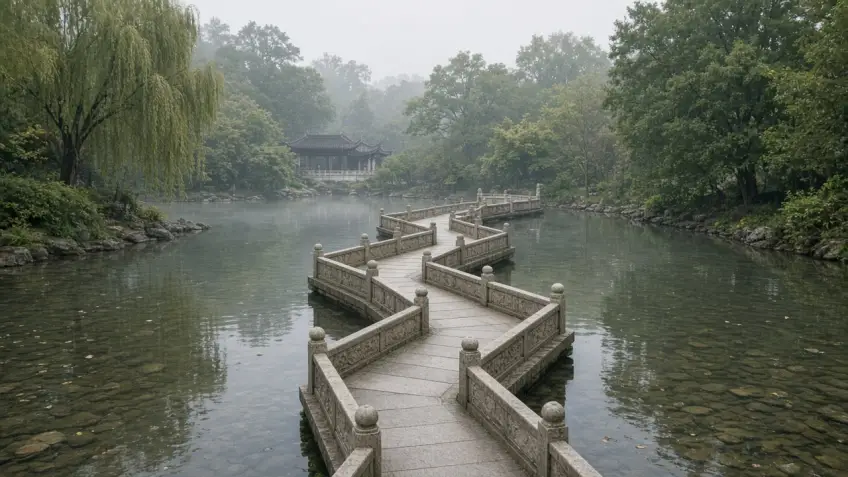
The "Three Causeways and Seven Bridges" refers to the causeways and stone bridges linking the islets. You don't need to memorize every bridge's name—just know that Liuting Islet in the middle divides the lake into north and south sections, and the east and west shores are connected by causeways and bridges, so you won't get lost. There are map boards along the shore every so often; snap a photo with your phone to check against as you walk.
The easiest way to remember the layout is by direction: the east bank has the most concentrated scenery, Liuting Islet in the lake holds a memorial hall, the west bank is the quietest, and the north end features an official's mansion. Follow this route and you'll pass nearly everything worth seeing among the Ten Islets.

A two-hour loop around the lake
The route below avoids backtracking while covering all the highlights—perfect for first-time visitors with just half a day. It's mostly flat, with plenty of benches and pavilions to rest along the way. Times are based on a normal walking pace; if you stop for photos or sit in a pavilion, add about 30 minutes. If you're traveling with older family members, treat each section as a casual stroll rather than trying to finish the whole loop at once.
Section 1: Start at Yanyue Causeway on the north end. If you arrive by metro, head southwest from the Gulou area and you'll reach the north end of the lake first. The Yintaidi Mansion Museum sits right beside Yanyue Causeway and is usually open from 8:00 to 17:00. If you'd like to go inside, visit it at the start of your trip so you don't have to double back later in the afternoon.
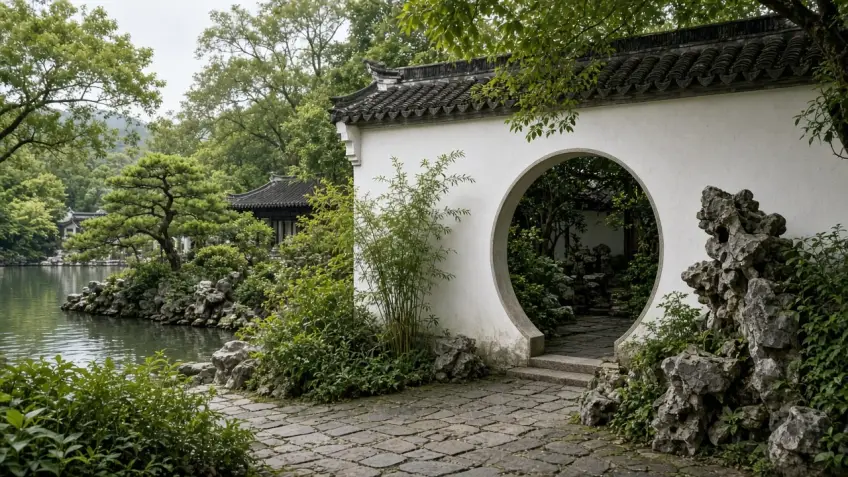
Section 2: Head south along the east bank. The east bank runs past Zhuyu, Yue Island, and Juhua Islet. Willows line the shore, with wooden corridors and small pavilions over the water—this is the most photogenic stretch of the lake. In the morning, sunlight comes from the east and brightens the surface; if you want reflections of the opposite bank, come here in the late afternoon instead.

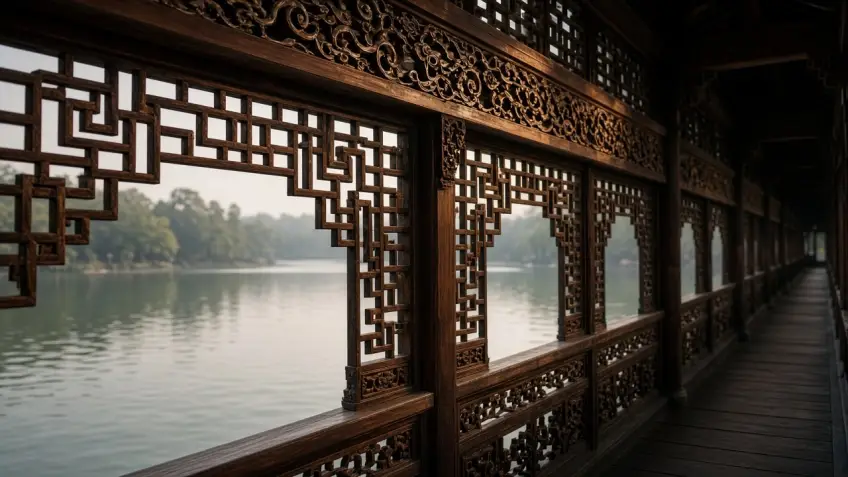
This stretch along the east bank is also the most photogenic spot. A few useful angles: stand inside the covered corridor and use the wooden lattice windows as a foreground frame for the lake; crouch lower under a willow tree so the hanging branches press against the top edge of your shot; walk directly opposite the stone arch bridge and, when the water is calm, capture the bridge and its reflection forming a perfect circle. When it's crowded, don't squeeze onto the bridge—step back to the opposite bank instead, where you can actually photograph the whole structure.
Section 3: Turn toward Liuting Islet in the middle of the lake. Liuting Islet is the most centrally located of the ten islets, and He Mijian Shrine is right here. The shrine isn't large—10-odd minutes is enough to see the main hall and courtyard—but it's a great place to understand Moon Lake's scholarly character (more on that below). Looking south from Liuting Islet, the lake narrows, the banks are lined with homes and old lanes, and there are noticeably fewer visitors.
Section 4: Head back along the west bank and leave the lake for Tianyi Pavilion. The Yanyu, Xueting and Furongzhou areas on the west bank are quieter than the east bank, with denser shade—perfect for a leisurely stroll. Walk north back to the northwest corner of the lake, then continue west for a few minutes to reach Tianyi Pavilion. Tianyi Pavilion requires a separate ticket. If you plan to visit the same day, go an hour or two before closing time in the afternoon.
Yintaidi and He Mijian Shrine: Two places worth going inside
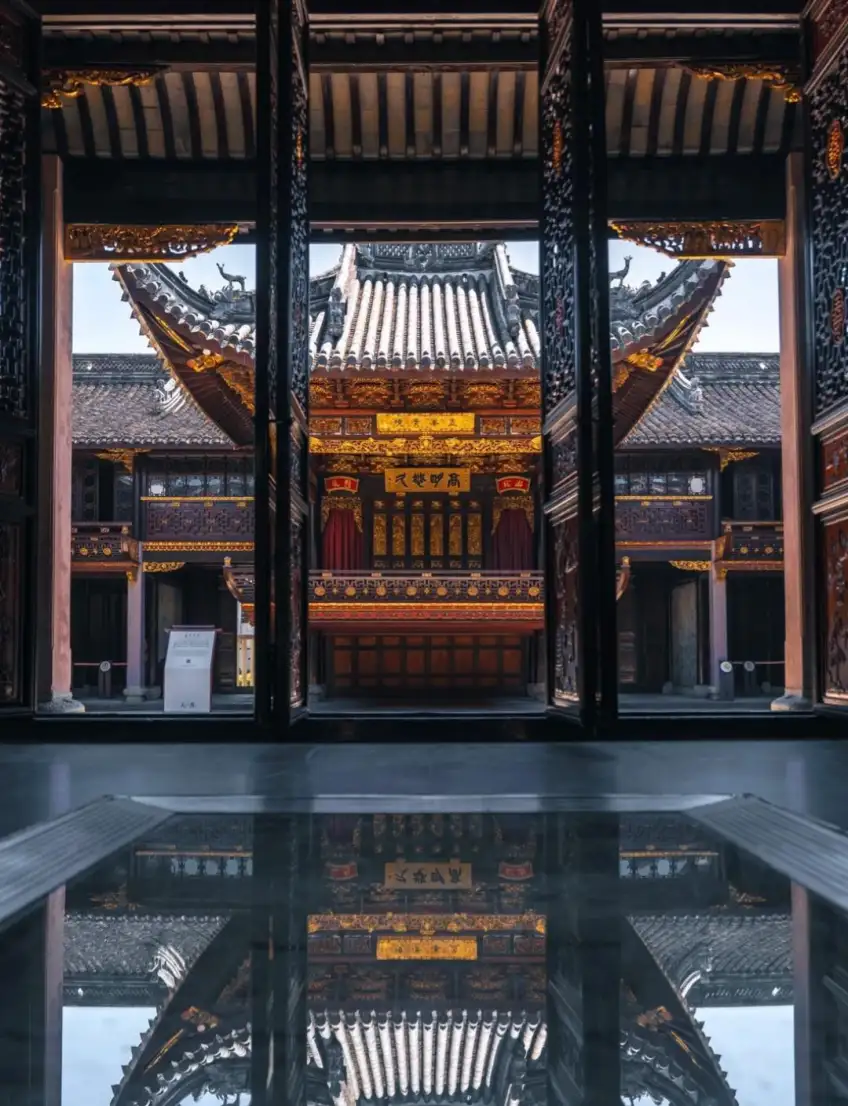
Yintaidi Mansion Museum. This was the home of Tong Huai, deputy director of the Office of Transmission during the Qing dynasty, built in the third year of the Daoguang reign, or 1823. In the Ming and Qing dynasties, the Office of Transmission was also known as "Yintai," which gave the residence its name. The compound covers about 2,300 square meters and is now a Ningbo municipal cultural heritage site. Inside, rooms such as Shengwu Hall, the study and the meeting hall are furnished as they originally were, giving you a clear look at the layout and furnishings of a Qing official's household.
When visiting Yintaidi, note two things: first, the front-to-back relationship between the halls, side rooms and courtyards—grand Jiangnan residences emphasize layer upon layer of progression, growing more private the deeper you go; second, the wood carvings and plaques, with many details concentrated on the beams and window lattices, so looking up reveals more than looking straight ahead. Allow about 30 to 40 minutes for the whole visit.
For overseas travelers, Yintaidi is easier to grasp than many large museums: instead of placing artifacts behind glass, it displays a family's halls, study and living spaces exactly as they were. By the end, you'll understand how a Qing-era scholar-official family lived day to day. Families with kids can treat it as a "step into an ancient home" experience.
He Mijian Shrine. This shrine commemorates He Zhizhang, a Tang dynasty poet. In his later years he served as Director of the Palace Library, so people called him "He Mijian." He wrote the famous poem "A Casual Poem on Returning Home," which includes the line "I left home young and return old." Locals in Ningbo usually call this shrine "Huting Temple." The building you see today was rebuilt in 1865, the fourth year of the Tongzhi reign of the Qing dynasty.
Besides these two spots, the scenic area also has remains such as the site of the Northern Song Goryeo Embassy. During the Song dynasty, Mingzhou was an important port for trade with Goryeo, and this site highlights Ningbo's history as a port city. If you have time, follow the guide signs to find it, then head back to the lakeside.

When to visit and how to get there
Time of day: The public areas of Moon Lake are open all day, while the exhibition halls follow their own posted hours. For photos or a quiet stroll, 7–9 am or after 4:30 pm is best. Around midday, both tourists and locals out for a walk fill the area, making lakeside benches hard to find. Mosquitoes are common by the lake in summer, so bring insect repellent if you visit in the evening.
Seasons: Spring, when willows bud and flowers bloom along the shore, gives Moon Lake its strongest Jiangnan charm. Autumn brings crisp skies and yellowing leaves, perfect for walking without the heat. Winter sees the fewest visitors—damp and chilly but quiet, ideal if you just want to explore the old houses without the crowds. During the plum rain season, paths get slippery, so watch your step on the stone bridges and stairs.

Getting there: Transfer between Metro Lines 1 and 2 at Gulou Station, then walk southwest for about 10 minutes to reach the north end of the lake. You can also walk over from the Chenghuangmiao Station area on Line 2. From Ningbo Railway Station, a taxi usually takes about 10 minutes. If you're driving, set your navigation to the Yuehu Shengyuan parking lot or the Tianyi Pavilion parking lot. Parking spots are tight on weekends, and fees are posted on site.
Boats: Pedal boats and electric boats are available for rent by the hour; prices are posted at the dock. The lake isn't large, so taking a boat is mostly about seeing the banks from a different angle. It's worth considering if you have kids, but if you're short on time, walking is plenty.
Tips for international visitors: The Ningbo metro, buses, and small shops in the old town all accept QR code payments via Alipay and WeChat. International travelers can link an overseas credit card in Alipay. When hailing a taxi, show the driver “月湖景区” (Moon Lake Scenic Area) or “天一阁” (Tianyi Pavilion)—they'll know both. If you're staying at a hotel, keep a copy of its Chinese address to show the driver on the way back.

How to combine it with Tianyi Pavilion and Nantang Old Street
It's easy to see why Tianyi Pavilion sits beside Moon Lake. Built during the Jiajing era of the Ming Dynasty, it was the private library of Fan Qin, a vice minister of war, and is the oldest surviving private library in China. Its name comes from the phrase "heaven gives birth to water," expressing a wish to ward off fire—a pond was even dug in front of the building to store water. Fan Qin chose the west bank of Moon Lake because scholars had gathered and academies flourished here since the Song Dynasty. Visiting Moon Lake before entering Tianyi Pavilion ties this story together.
Moon Lake, Tianyi Pavilion, and Nantang Old Street are all in the old town, less than 10 minutes apart by taxi, making them easy to fit into one day. How you plan it depends on your schedule and who you're traveling with:
Half a day: Walk the loop around Moon Lake and visit Tianyi Pavilion. Arrive at the lake before 9 am and finish at Tianyi Pavilion by noon—the pace works out perfectly.
If you have a full day: Visit Tianyi Pavilion and Moon Lake in the morning, rest in the afternoon, then head to Nantang Old Street at dusk to see the lights. For a detailed route, see How to explore Nantang Old Street.
Traveling with seniors or kids: Stick to the east bank and the Liuting section. Pick either Yintaidi or He Mijian Shrine to visit, and spend more time sitting in the covered walkways and pavilions—it's far more relaxing than rushing through every attraction. The lakeside path is flat and stroller-friendly, and you can take the level detour around the stone arch bridges.
To understand the stories behind it all: Without context, the connections between the Ten Islets, the library, the official residences, and the ancestral halls are easy to miss, and it just looks like "a pretty lake." Hire a Chinese- or English-speaking guide, or include Moon Lake in a Ningbo day tour with transfers arranged for you—it saves a lot of hassle.

FAQs
Do I need a ticket for Moon Lake?
No. The lakeshore and public gardens of Moon Lake are open all day for free. Exhibitions such as the Yintaidi Mansion Museum and He Mijian Shrine are generally open from 8:00 to 17:00—check each venue's notice for exact hours. Tianyi Pavilion next door requires a separate ticket.
How long does it take to explore Moon Lake?
Just walking around the lake takes 1.5 to 2 hours; adding Yintaidi and He Mijian Shrine brings it to about 3 hours. If you also visit Tianyi Pavilion, set aside half a day.
Are Moon Lake and Tianyi Pavilion the same place?
The two are right next to each other and part of the same national 5A tourist attraction, but they have separate entrances and tickets: Moon Lake is an open lakeside park, while Tianyi Pavilion is a walled library garden that requires a ticket. It's just a few minutes' walk from the northwest corner of the lake to Tianyi Pavilion.
Is Moon Lake good to visit on a rainy day?
Sure. On drizzly days, mist rises off the lake and there are fewer visitors, making for atmospheric photos. The covered corridors, pavilions, and exhibition halls all offer shelter from the rain. Watch out for slippery stone bridge steps and flagstone paths—wear non-slip shoes, and if you're traveling with older adults, stick to the flat sections.