
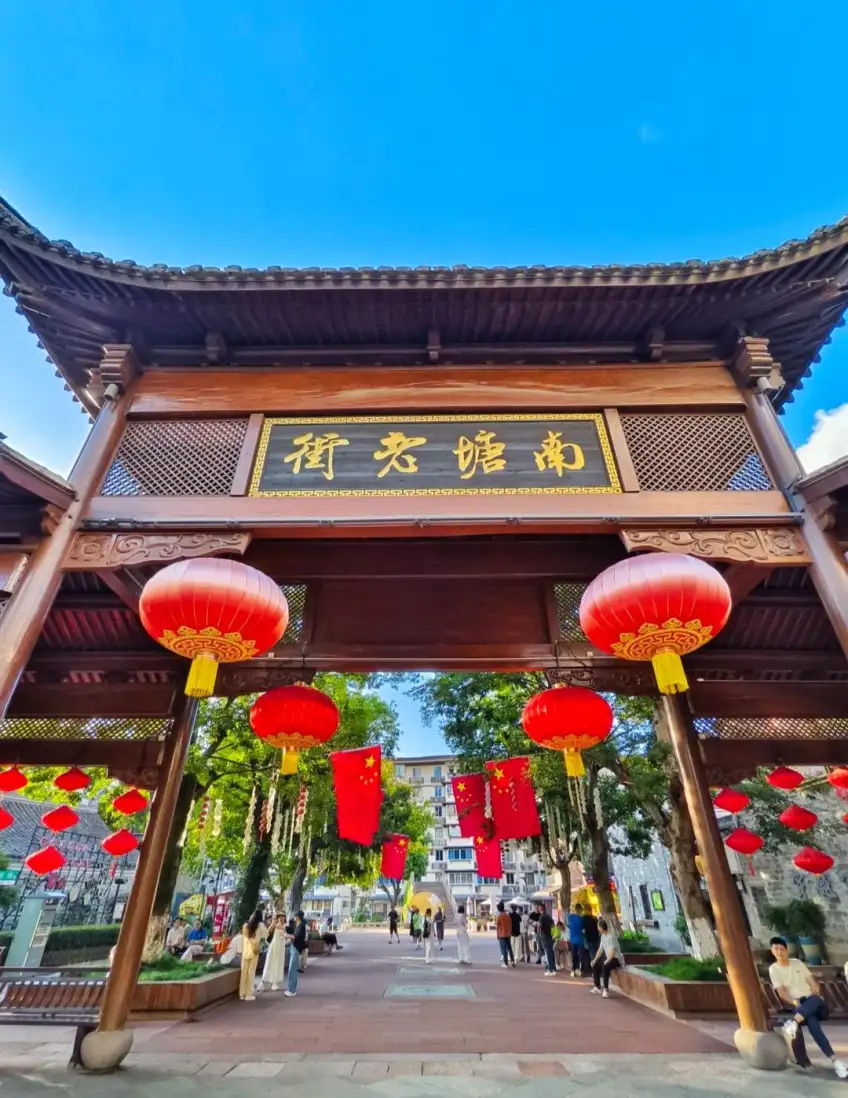
Nantang Old Street is located just outside the south gate of Ningbo's old town, along the Nantang River. It is free and open 24 hours, with most shops operating from around 9:00 to 21:00. The street is divided by Zuguanshan Road into a north section and a south section: the north is livelier, packed with time-honored brands and traditional streetscapes, while the south is quieter, home mostly to creative boutiques and tea houses. On your first visit, enter through the archway at the north end, walk all the way south, then loop back along the river—the whole stroll takes about one to one and a half hours. If you want to see the lanterns and night views, arriving after 5:00 PM is best.
What is Nantang Old Street: the old market outside the South Gate
Nantang Old Street is one of Ningbo's eight officially designated historic districts. It runs along the Nantang River. In the past, this area was the gateway for water and land traffic into the southern city—merchant boats arrived via the river, goods were traded here, and locals called the cluster of markets outside the South Gate the "Three Markets of the South Gate." The district you see today was restored on the site of those old markets.
The restoration was completed in two phases. Phase one opened on January 15, 2012, focusing on time-honored brands and bringing back many old names familiar to Ningbo locals. Phase two opened on September 26, 2015 after three years of planning and construction, covering about 50,000 square meters with roughly 900 meters of street frontage—about three times the size of phase one. So the Nantang Old Street you walk today is a mix of "old district + new restoration": some original residences and heritage buildings preserved in place, and others newly built or rebuilt in the style of Ming and Qing Jiangnan homes.
Knowing this, you won't get hung up on whether everything is an authentic antique. The genuinely old structures are concentrated in a few heritage buildings listed below; the rest of the street feels more like a comfortable, cohesive pedestrian zone—great for strolling, taking photos, or sitting down for a cup of tea.
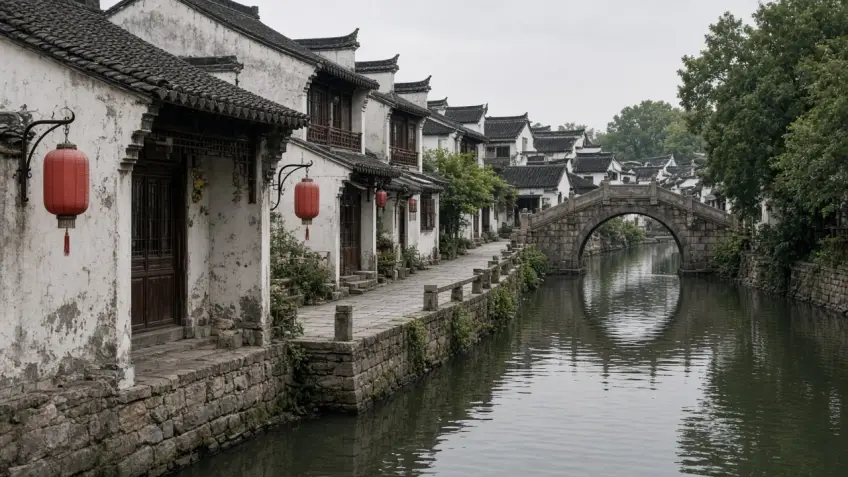
Nantang River itself has a story. Its upper reaches connect to the Tashan Weir, a water project from the Tang Dynasty: in 833 AD, county magistrate Wang Yuanwei oversaw its construction after taking office, and it was completed three years later. The weir channeled fresh water from Zhangxi Stream into the Nantang River network to irrigate farmland and supply the town. The deeper channel also made boat travel easier, and this ancient weir is still in use today. Standing by the old street and looking at this narrow river, it's hard to imagine it was once the "lifeline" of the southern city. But it was precisely because of this river that a market gathered outside the South Gate, eventually becoming today's Nantang Old Street.
It's also worth clarifying what it isn't: Nantang Old Street is not a water town surrounded by canals like Wuzhen or Xitang. It's a historic district within the city, flanked by apartment buildings and roads. If you're expecting an entire water town of "small bridges, flowing streams, and riverside homes," it may feel small. But if you treat it as a neighborhood in old Ningbo where you can stroll slowly past old houses and canals, it feels just right.
First, tell North Street from South Street
Zuguanshan Road cuts through the district, dividing Nantang Old Street into north and south sections with very different vibes.
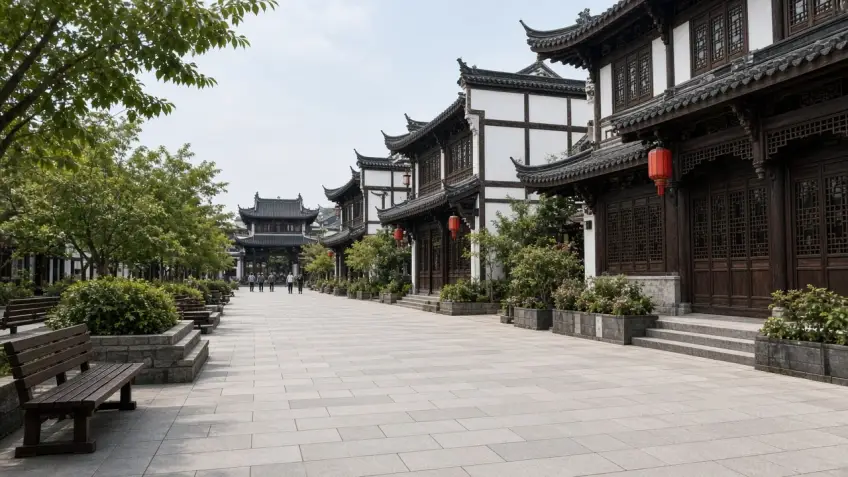
North Street: More traditional and commercial. Time-honored brands, craft shops, and snack stalls are concentrated here. It's busiest during the day, especially on weekend afternoons. Both sides of the street are lined with two-story wooden shops, lanterns hanging under the eaves and signboards placed one after another—making it the easiest spot to photograph a classic Jiangnan old street scene. Several of Ningbo's heritage pastry shops are also here, so grab a bite as you pass by; there's no need to wait in line.
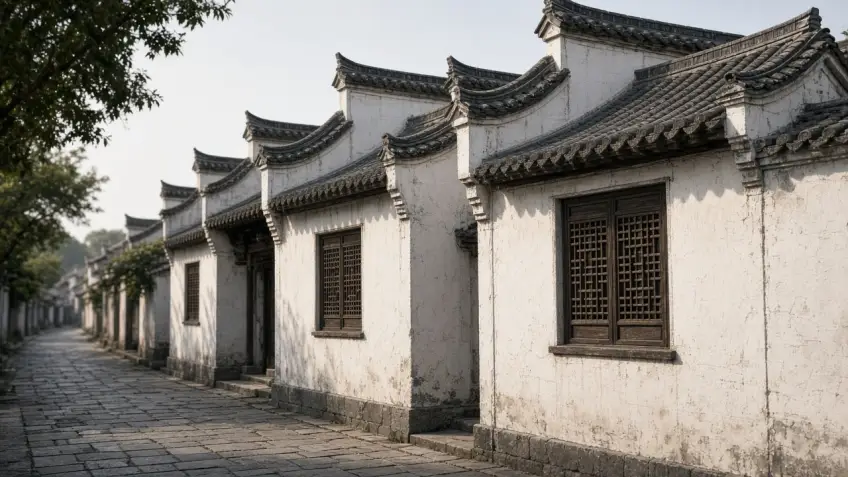
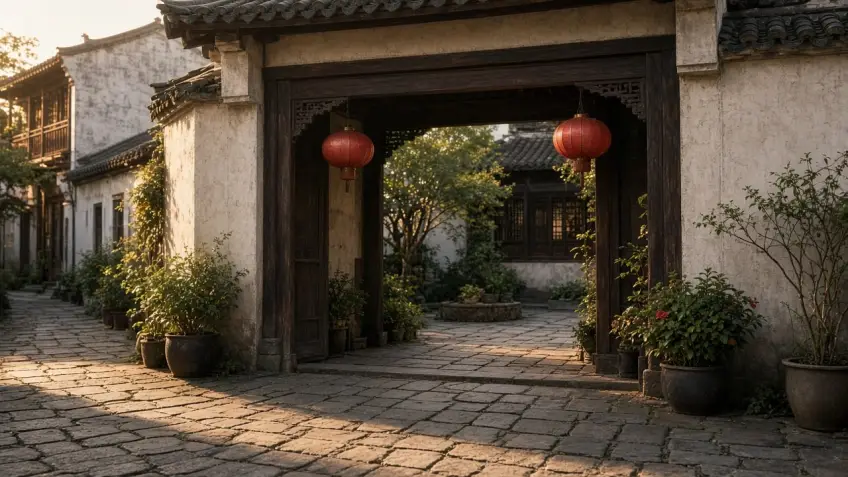
South Street: Focused on urban leisure with a slower pace, featuring creative boutiques, bookstores, tea houses, and small cafes. There are noticeably fewer tourists here, the lanes are narrower, and small courtyards are tucked between white walls and horse-head walls. It's perfect if you want to escape the crowds and find a place to sit. If you'd like to take home a souvenir, the creative shops on South Street have more character than the chain stalls on North Street—postcards, stamps, and handmade trinkets all pack easily into your luggage.
If you only have an hour, walking the full length of North Street and half of South Street is enough. If you've come specifically for a stroll, do the opposite and spend more time on South Street. When crossing Zuguanshan Road between the two sections, watch out for traffic—it's a regular city road open to vehicles.
Rainy days work too. The eaves along the old street extend quite far out, so you'll mostly stay dry while walking. The octagonal pavilion, covered corridors, and shops all offer shelter from the rain. After the rain, the stone paths glisten, and once the lanterns light up, the photos have even more atmosphere than on sunny days. Just wear non-slip shoes, and slow down if you're traveling with older family members.

Historic buildings worth a closer look
The protected heritage sites on Nantang Old Street include the Yuan Family Residences, Yongshui Bridge, Yongshan Pavilion, and Guansheng Temple. They're all fairly small and easy to miss while strolling, so it's worth pausing for a closer look when you spot them.
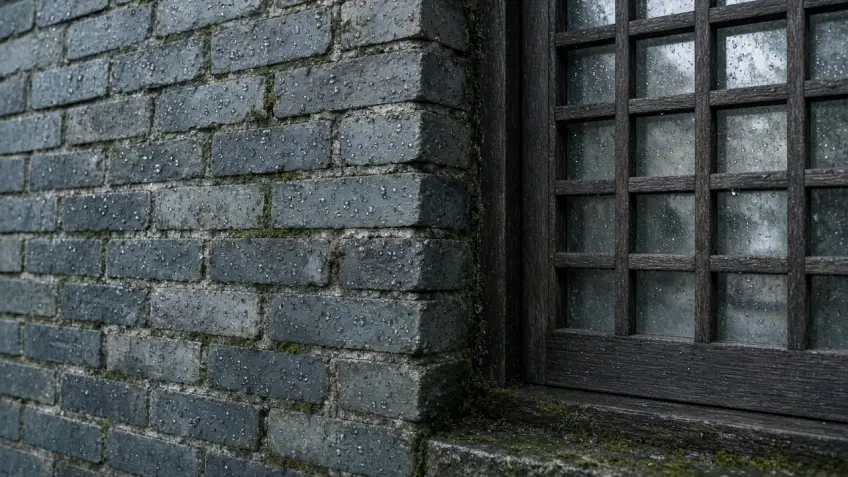
How to recognize them: Heritage buildings usually have a protection marker at the entrance or bridgehead showing the name and designation level. Compared with the newer shops on either side, the brick and stone of the old structures are darker, the wooden elements show clear signs of age, and the steps and thresholds are worn down. Look for these details and you won't mistake rebuilt storefronts for genuine historic homes.
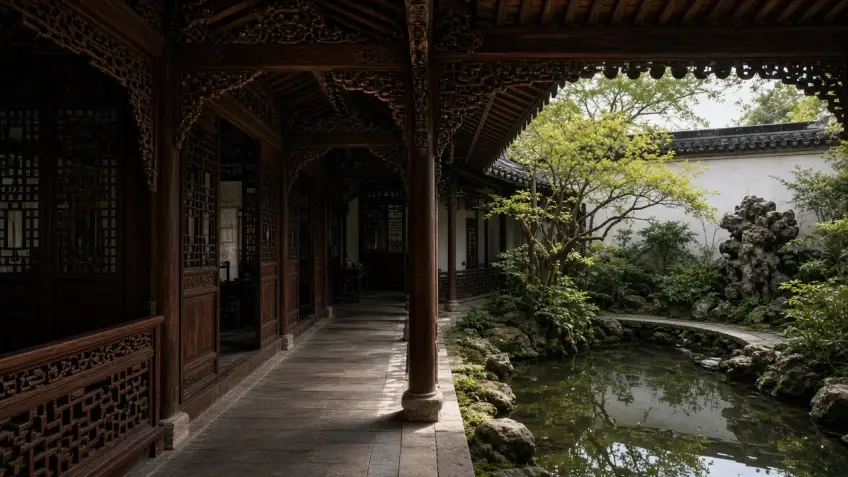
Yuan Family Residences: A preserved cluster of old courtyard homes in the district, showcasing the traditional Ningbo layout of multiple successive halls connected by courtyards. When visiting homes like this, focus on the gate towers, courtyards, and wooden beams. The deeper you go, the quieter it gets—it feels like a different world from the busy commercial street outside.
Yongshui Bridge: An old stone bridge spanning the Nantang River. Standing on it and looking both ways, you'll see the restored neighborhood on one side and the river stretching out on the other, making it easy to understand why this street thrived thanks to the waterway. The stone slabs are polished smooth, so take it slow on rainy days.
Yongshan Pavilion and Guansheng Temple: The pavilion was once a resting spot for passersby, while Guansheng Temple is dedicated to Guan Gong—both common public buildings in old market towns. They're a reminder that this place wasn't just about shops; it was also where locals from the southern part of the city gathered, worshipped, and rested.

The newly built section of Phase II mainly features Ming and Qing dynasty Jiangnan residential architecture, interspersed with a few Republic of China-style buildings, plus a stage, an octagonal pavilion, and a covered corridor. Folk performances and intangible cultural heritage craft activities are often held here on holidays—check the street's notice boards for details. On regular days, the octagonal pavilion and corridor are the best spots to rest, and they also offer shelter from the rain.
How to explore in one hour: suggested route
The route below follows a "bustling first, quiet next, river views last" sequence, ideal for daytime visitors.
Here's how to divide your time: 20–30 minutes on North Street, about 20 minutes total for the heritage buildings, half an hour sitting down on South Street, and 15 minutes walking back along the river. Take a break at the octagonal pavilion or covered corridor along the way, and you won't get tired.
Step 1: Enter through the memorial archway at the north end. The archway is the landmark of Nantang Old Street, so snap a photo here first. Walking further in brings you to North Street. Stroll past the facades and signs of the time-honored shops—you don't need to go into every one, just pick a couple of craft stores that catch your eye.
Step 2: Look for heritage buildings on North Street. As you walk, keep an eye out for signs pointing to the Yuan Family Residences and Guansheng Temple, and spend about ten minutes inside. The old houses are cooler than the street, making them a great place to escape the sun in summer.
Step 3: Cross Zuguanshan Road and head down South Street. South Street has a slower pace, perfect for spending half an hour at a teahouse or small shop. It's also easier to get photos of empty streets here.
Step 4: Walk back along the river to see Yongshui Bridge and Yongshan Pavilion. From South Street, head toward the river and walk north along Nantang River, passing Yongshui Bridge and Yongshan Pavilion. This completes the "born from the river" side of the neighborhood. Walking back to the northern end takes one to one and a half hours in total.
Evening and night: Lanterns, riverside views and boat cruises
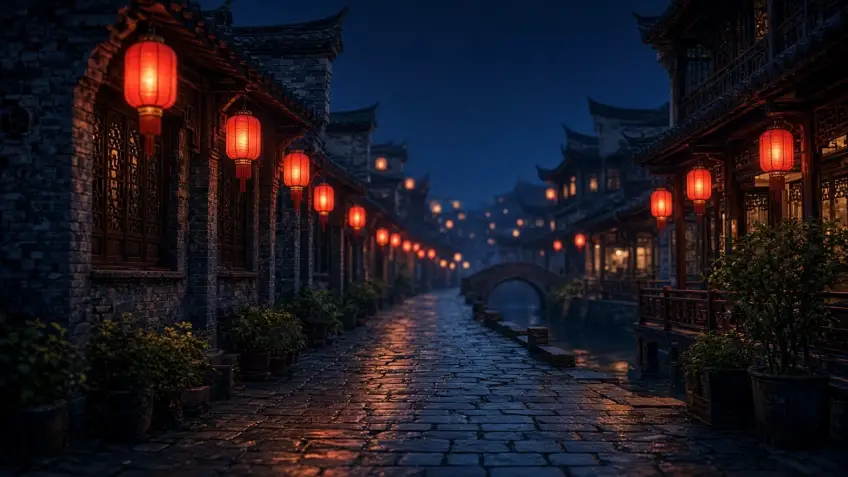
Nantang Old Street looks even better at night than during the day. After dark, lanterns and shop light boxes gradually turn on, reflecting off the stone-paved streets. The best time for night photography is about half an hour after sunset, when the sky still holds a hint of blue and the lanterns have just lit up, creating the richest layers. Later, once it's fully dark, only the lights remain.
To see the old city from the water, look out for night cruises on Nantang River. Ningbo offers a night cruise called "Boating Luocheng · Yongshui Ballad." The route covers about 1,400 meters and takes around 40 minutes, letting you view the lights on both banks and the old city's waterways from the river. Schedules, boarding points and reservation requirements depend on the operator's arrangements for the day, so it's best to check before you go.
Two things to keep in mind when strolling at night: first, North Street gets even more crowded after dark than during the day, so families with kids should agree on a meeting point in case you get separated—the memorial archway at the north end works well. Second, most shops close around 21:00, so don't arrive too late if you want to shop or sit down for tea.
For photos, daytime and evening each have their sweet spots. During the day, head to South Street and find an alley corner where horse-head walls meet whitewashed walls; shoot vertically to fit the eaves and sky into the frame. At dusk, stand on Yongshui Bridge and shoot toward the district to capture the river and the lights on both banks. At night on North Street, lower your lens close to the flagstones so lantern reflections fill the foreground. Your phone's night mode is plenty—a tripod just gets in the way in the crowds.

Getting there & combining it with Moon Lake and Tianyi Pavilion
Metro: Take Line 2 to Yunxia Road Station or Chenghuangmiao Station, then walk about 5 minutes to the old street. Bus: Routes 6, 525 and others stop at "Nantang Old Street" right outside. Driving: Navigate to "Nantang Old Street Parking Lot." There's an underground garage, but spaces can be tight on weekends and holidays.
From Ningbo Railway Station: The old street is about 2 km from Ningbo Railway Station, roughly a 10-minute taxi ride. If you're arriving by high-speed train and want to explore the old town first, store your luggage or drop it at your hotel before heading over light.
International visitors can scan QR codes with Alipay or WeChat to ride the metro, buses and taxis—Alipay lets you link an international credit card. Most shops on the old street also accept QR payments, so just carry a little cash as backup. When hailing a taxi, enter "Nantang Old Street" as your destination; every driver knows it.
Nantang Old Street, Moon Lake, and Tianyi Pavilion are all in the old town, less than 10 minutes apart by taxi. How to choose depends on your schedule:
Only one evening: Head straight to Nantang Old Street at dusk. After taking in the lanterns and night views, hop on a night cruise if you have time.
A full day: Visit Tianyi Pavilion and Moon Lake in the morning, rest in the afternoon, and head to Nantang Old Street by evening. For tips on exploring Moon Lake, see our Ningbo Moon Lake loop route.
Traveling with seniors or kids: The street is flat throughout, perfect for a leisurely stroll. The stone paving gets slippery in the rain, so seniors should wear non-slip shoes. Kids can easily get separated in crowded North Street—keep a close eye on them at night.
Also visiting Xikou and Mount Xuedou: It takes over an hour to drive from downtown Ningbo to Xikou, so plan a separate day. Booking a private car round-trip from the old town is the most hassle-free option.

FAQs
Does Nantang Old Street require tickets? What are the opening hours?
No tickets required—the area is open around the clock. Shops generally operate from 9:00 to 21:00. Daytime strolling is best between 10:00 and 16:00, while 17:00 to 20:00 is ideal for the night views.
How long does it take to explore Nantang Old Street?
Just North Street takes 30 minutes to an hour. North Street, South Street and walking back along the river takes 1 to 1.5 hours. If you come in the evening for the night views and a night boat ride, allow about two hours for a relaxed visit.
Are Nantang Old Street, Chenghuang Temple and the Drum Tower the same place?
No. Chenghuang Temple and the Drum Tower are in the old city center, while Nantang Old Street is just outside the south gate of the ancient city, some distance away. Chenghuang Temple Station on Metro Line 2 is close to the old street, so they're often mentioned together, but they are different neighborhoods.
Should I go during the day or at night?
For historic architecture and old residences, daytime light makes the details easier to see. For lanterns and night views, after dusk is better. If time allows, arrive around 4 or 5 pm to see the buildings first, then wait for dark so you can experience both in one visit.
How does Nantang Old Street compare with water towns like Wuzhen and Xitang?
They're not the same kind of place. Nantang Old Street is a historic neighborhood within the city—small, free and easy to reach—ideal for a 1- to 2-hour stroll while exploring Ningbo's old city. Wuzhen and Xitang are full-scale water towns that need half a day to a full day set aside. If your itinerary already includes a water town, treat Nantang Old Street as an evening stop in Ningbo's old city rather than expecting the same scale.