
Yuantouzhu (Turtle Head Isle) is a peninsula scenic area on the northwest shore of Lake Tai in Wuxi, with something to see in every season: Somei-Yoshino cherry blossoms peak in mid-to-late March, lotus flowers bloom from late June to late August, Chinese tallow leaves turn red in autumn, and black-headed gulls visit from November through March. Admission is ¥90 (reference price for Nov 2026; subject to the scenic area's official announcement), including the round-trip ferry to Lake Tai Fairy Island. In summer, visit between 8 and 10 am or after 4 pm to avoid the sun. To cover Yuantouzhu, Lingshan and Huishan Ancient Town in one day, check out the private tour Yuantouzhu sightseeing route.
Wuxi, Jiangsu: travel notes
In old Chinese texts, "yuan" is an ancient creature of rivers and lakes, a symbol of mystery and dignity that looks something like a large turtle or softshell turtle. "Zhu" means a small island or a sandbar. Put the two together, and the name Yuantouzhu reads like a landscape painting in a few brushstrokes.
Yuantouzhu is a peninsula on the northwest shore of Lake Tai. It takes its name from a huge rock jutting into the lake that looks like a turtle raising its head. The grounds hold a Taoist temple, Taoist and Buddhist grotto statues, many historic sites, and private gardens built by wealthy and prominent families of the past.
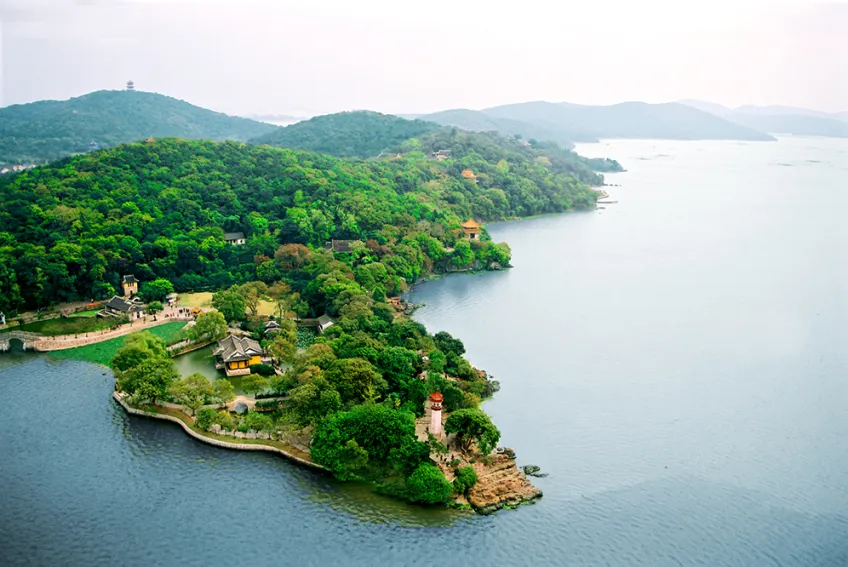
Over the centuries, many scholars and poets have come here and left poems behind.
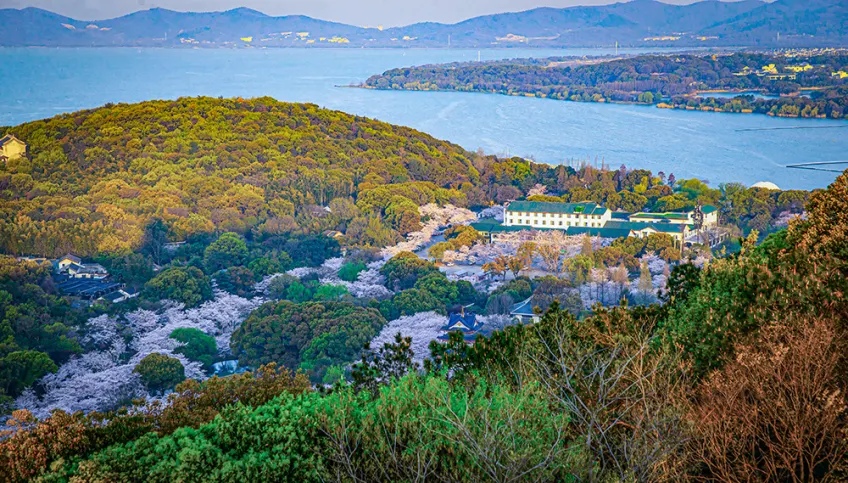
In spring, pink cherry blossoms spread over the hillsides with Lake Tai behind them. It is Yuantouzhu's best-known view.
A century-old garden: how it began
But Yuantouzhu's scenery didn't appear overnight. It has been shaped for more than a century, since the late Qing and early Republic years. In the early Republic, Yang Hanxi, a Wuxi businessman who had passed the provincial imperial exam (juren), bought 60 mu of hillside around Yuantouzhu for 2,000 silver dollars and started its modern development. He built Hengyun Villa, restored Guangfu Temple, and blended the natural scenery with landscaped gardens, giving Yuantouzhu its first cultural layer.
Other Wuxi notables and officials followed, building private gardens and villas nearby. With the Yang family leading the way, gardens in many styles went up along the hillsides. This joint effort by private families made Yuantouzhu one of the best-known sights on Lake Tai.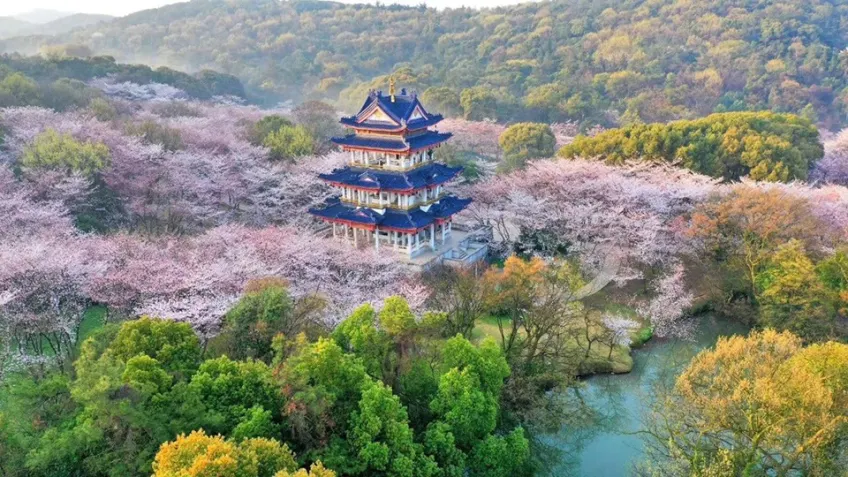
The blue-roofed Cherry Blossom Viewing Tower stands in the valley of pink blossoms. Climb it to look down over the trees. It's also one of the most photographed spots in the park.
Yuantouzhu sightseeing guide
Cherry blossoms in spring, lotus in summer, a palette of color in fall, and black-headed gulls in winter: each season gives this peninsula on Lake Tai a different look.
Why Yuantouzhu's cherry blossoms are famous
Spring at Yuantouzhu belongs to the cherry blossoms. While Lake Tai still looks gray and quiet from winter, the first trees here are already in bloom.
Cherry blossoms are Yuantouzhu's most famous sight, and they have made it one of China's best-known places for blossom viewing.
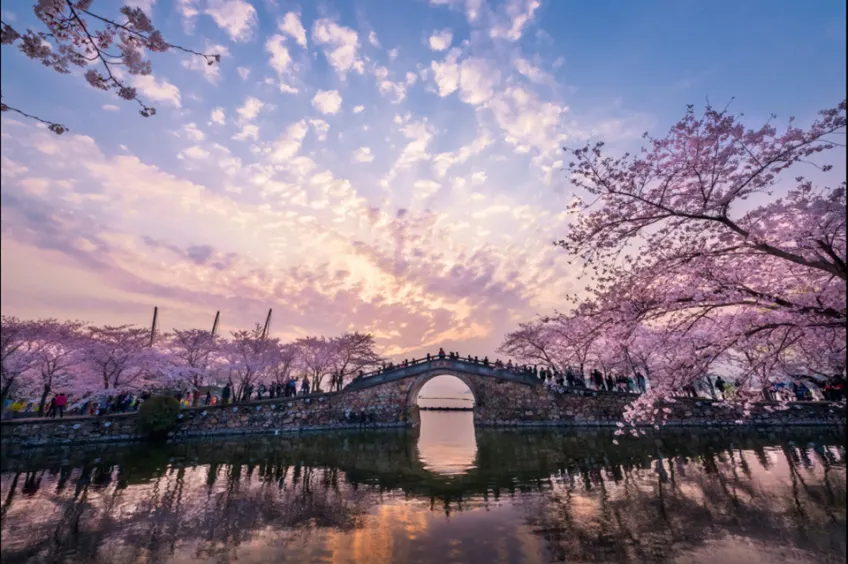
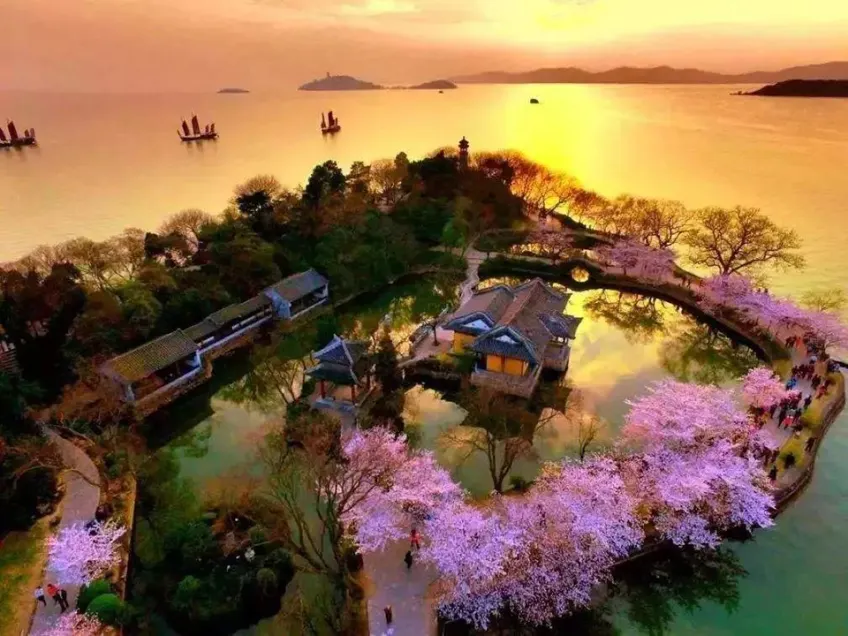
Changchun Bridge (长春桥) is modeled on the Jade Belt Bridge at the Summer Palace in Beijing. When the cherries bloom, the bridge and the blossoms are mirrored together in the water, and the scene is just as pretty under the evening lights.
How the cherry trees came to Yuantouzhu
The story of Yuantouzhu's cherry blossoms begins in 1918. That year, Yang Hanxi, a member of the local Wuxi gentry, planned a garden at Yuantouzhu. It began as his private garden, and the cherry trees were only a few decorative touches.
The cherry trees only grew into a real grove in the 1980s. In 1986, Japanese friends Keishiro Sakamoto and Kiyomi Tanikawa proposed the "China-Japan Cherry Blossom Friendship Grove." They planted 1,500 cherry trees at the foot of Luding Hill and built a Friendship Pavilion and cherry blossom walking paths.
After Dushan Village was relocated in 2008, the groves expanded again. Cherry Blossom Valley (樱花谷) opened in March 2010. By then the cherry plantings at Yuantouzhu covered 650,000 square meters, with more than 30,000 trees of 68 varieties, and the park became known as "China's top cherry blossom destination."
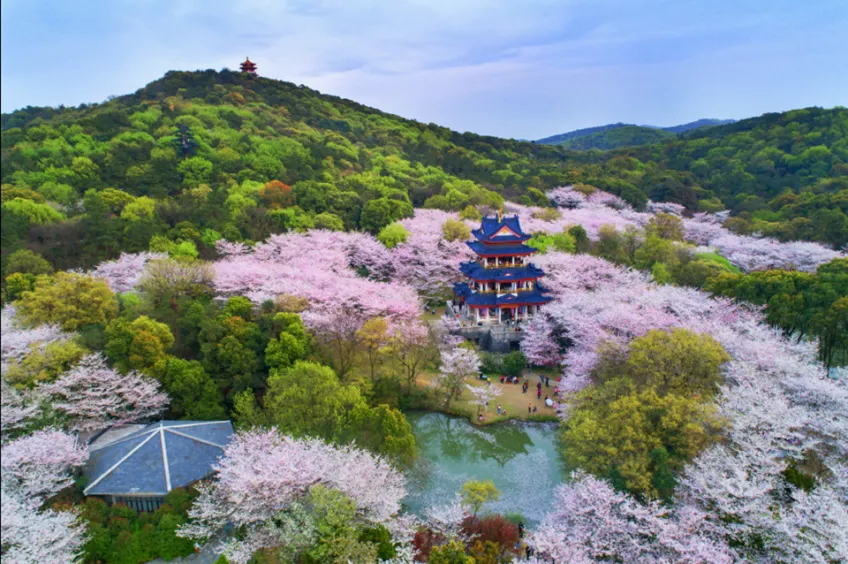
The blossoms are thickest around Cherry Blossom Valley and the Cherry Blossom Viewing Tower, so put this area at the center of your walk.
Cherry blossom season at Yuantouzhu
What makes Yuantouzhu's cherry blossoms special is the setting: the trees grow in a garden, and the garden sits on the lake. You can enjoy them from the water, along the paths and from high viewpoints.
In early March, early varieties such as Tsubaki-kanzakura and Kawazu cherries open one after another. In mid-to-late March, Somei-Yoshino and Kanzan cherries reach full bloom. More than 30,000 trees in Cherry Blossom Valley come out in turn, and the whole hillside turns pink and white.
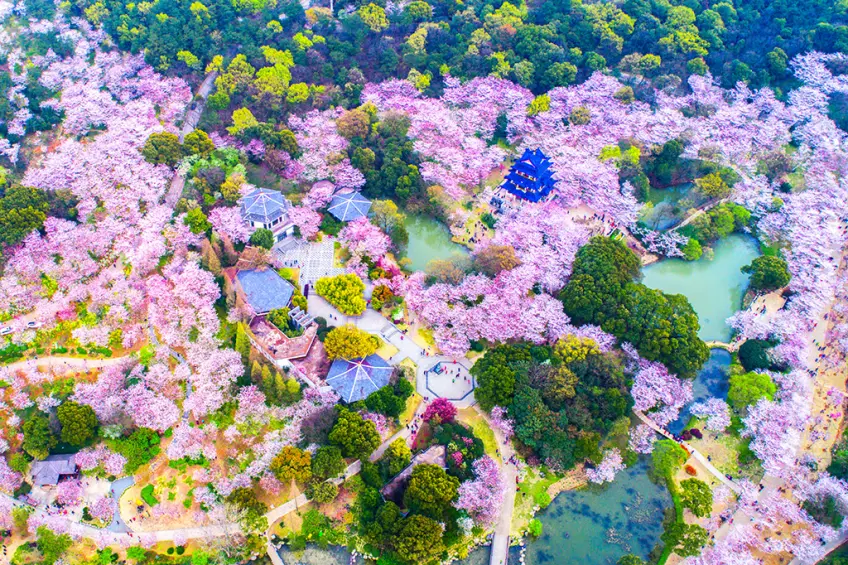
When night falls and the lights come on, the blossoms look completely different. Around Changchun Bridge and the Cherry Blossom Viewing Tower, the lights mix with the water and the old buildings half appear in the dark. Almost any photo you take here looks good.
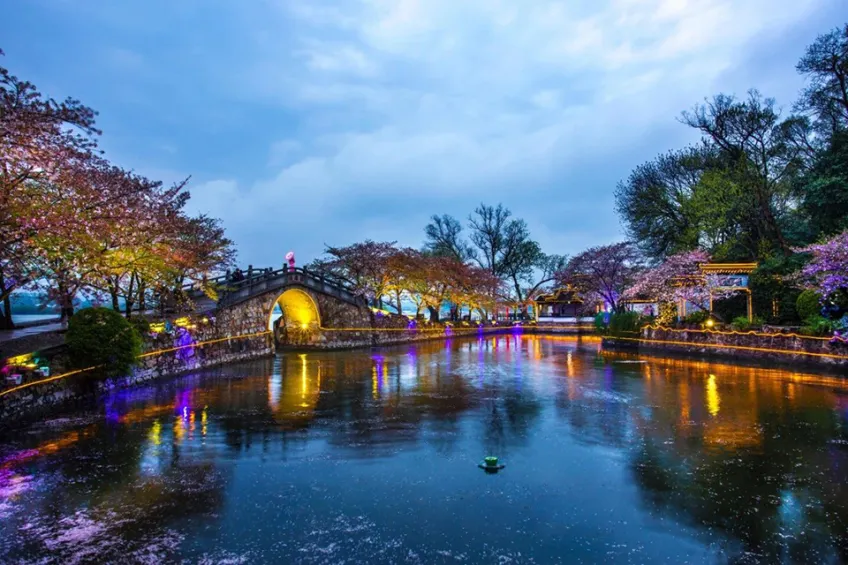
After dark, lights pick out the arch of Changchun Bridge and the cherry trees on both banks. Their reflections in the water are the best part of the night viewing.
Cherry blossoms at Changchun Bridge
"Changchun Blossom Ripples" is Yuantouzhu's signature cherry blossom view. Changchun Bridge, modeled on the Jade Belt Bridge at Beijing's Summer Palace, crosses the water with cherry trees on both banks. In full bloom, petals fall onto the water under the bridge and drift out into Lake Tai. That is the scene the name describes. On some weekends in blossom season there are parades in hanfu (traditional Chinese dress); check the park's seasonal notices.
No wonder people say you haven't really seen spring in Jiangnan until you've seen the cherry blossoms at Yuantouzhu.
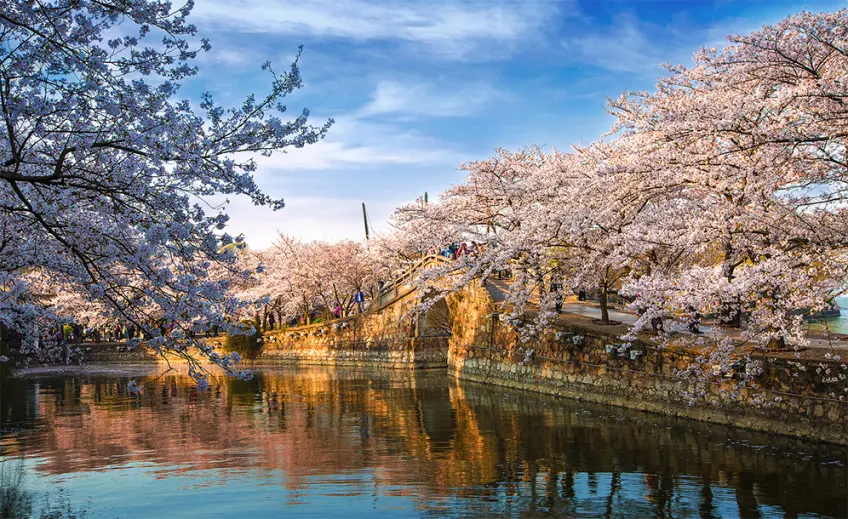
By day, pink blossoms crowd both banks of Changchun Bridge and petals land on the water. This is the heart of "Changchun Blossom Ripples."
Suggested cherry blossom route
Walking route: Chongshan Gate (充山大门) → Chongshan Yinxiu → Yixiu Bridge → Cherry Blossom Grove → Cherry Blossom Viewing Tower → Renjie Garden → Cherry Blossom Valley → Changchun Blossom Ripples → Juqu Shengjing → Ten-Mile Fragrant Path
Best viewing spots: Changchun Bridge, Cherry Blossom Grove, Cherry Blossom Valley, Cherry Blossom Viewing Tower, and the Turtle Head
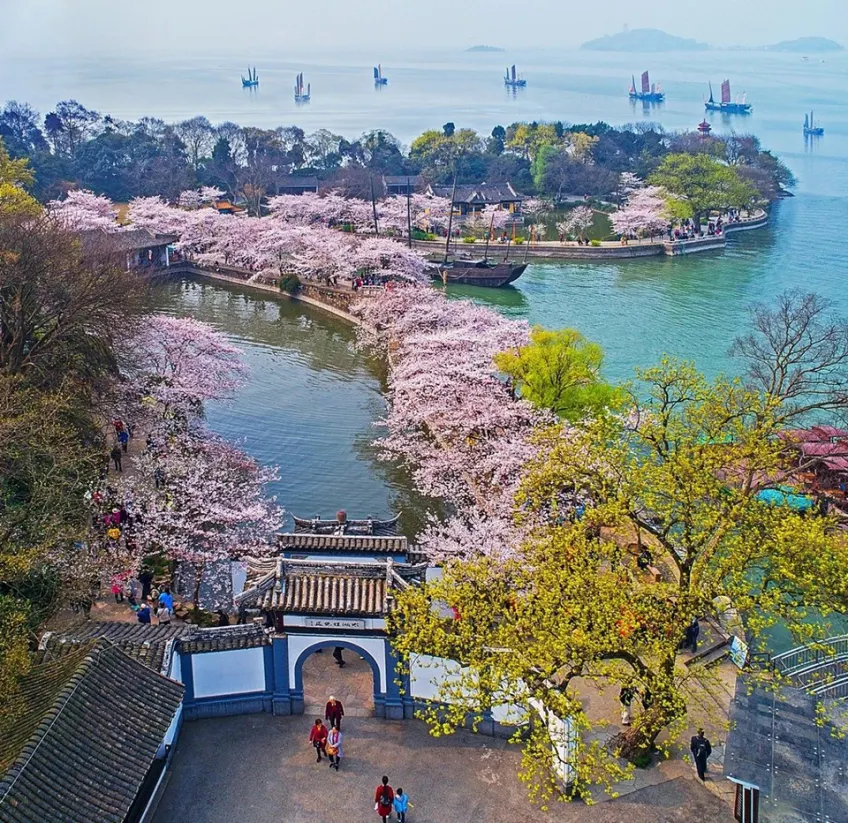
Shoreline cherries, the arch and distant sails in one shot: this is the lakeside stretch of the walking route.
Lotus season at Yuantouzhu
As the cherry blossoms fade, summer brings lotus season to Yuantouzhu.
From late June to late August, lotus season runs for more than two months, peaking from mid-July to early August. Green leaves and pink flowers spread across the water and turn this century-old garden into a cool "Monet garden on the water."
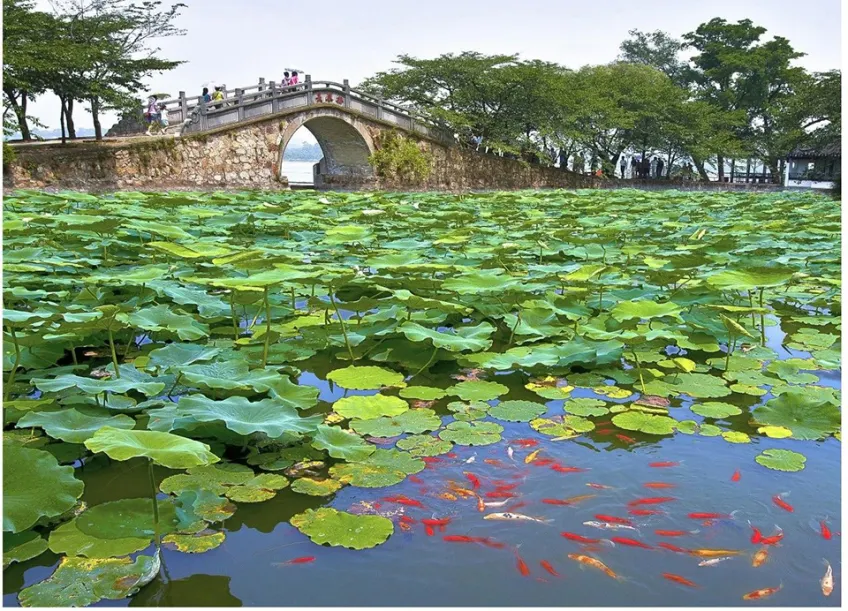
In lotus season you can enjoy the view from the shore or take a sculling boat. The boatman rows deep into the lotus beds while you sit at the stern, with flowers within arm's reach. You're no longer watching from the bank. You're right among the lotuses.

Yuantouzhu's vast lotus ponds make a Jiangnan summer feel cool and calm. They're worth a trip on their own.
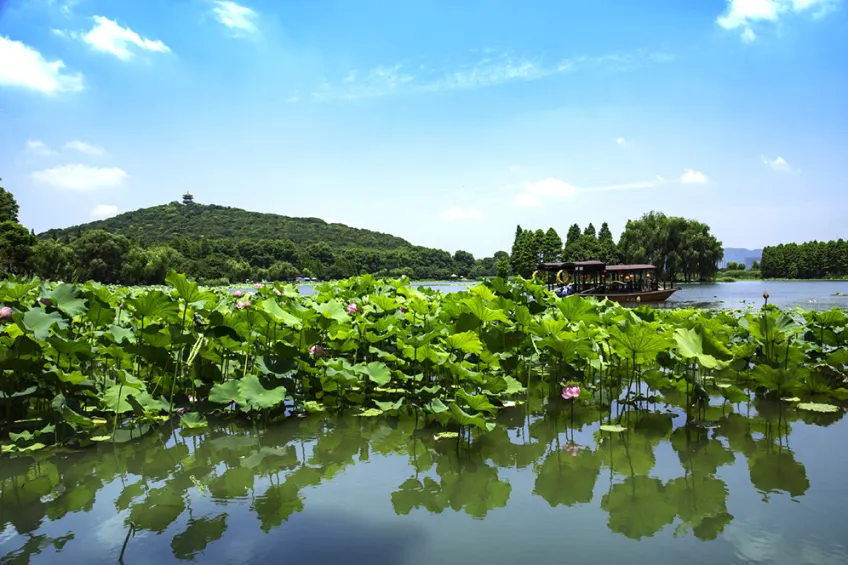
When the pink lotus is out, tour boats glide slowly across Lake Tai, with green hills and pavilions on the far shore. It's one of the coolest places to spend a summer day.
Lotus season routes
Classic summer route: Chongshan Gate → Chongshan Yinxiu → Jiangnan Orchid Garden → lakeside stroll → sunset at Wanlang Bridge
Lotus lover's route: Chongshan Gate → Chongshan Water Garden → Changchun Bridge waters / Ouhua Shenchu (Deep Among the Lotuses) → Cherry Blossom Valley waterways → sculling boat through the lotus → Lake Tai Fairy Island
Summer tips
Best times: 8–10 a.m., when the lotus looks its best and the light is soft, and 4–6 p.m., when the sun is lower and good for sunset photos.
Photo tips: Lotuses are most open in the morning and gradually close after noon; the evening light is ideal for portraits and sunset shots.
In lotus season you may occasionally spot a "twin lotus" here: two flowers on the tip of one stem, sharing a single base. They're rare, so if you visit Wuxi in summer, keep an eye out around the ponds.
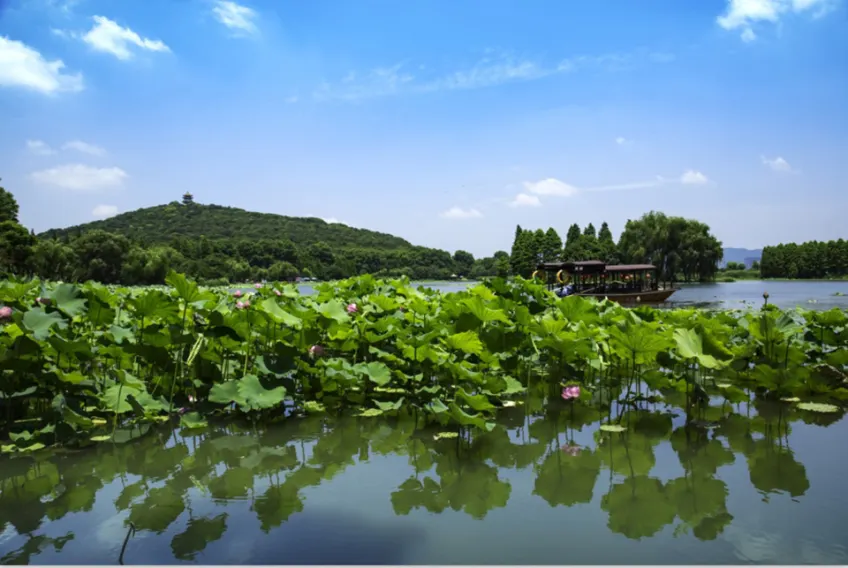
Lotus leaves cover the water near the shore, with the hilltop pavilion and moored boats behind. Come early in the morning for the best light.
Fall at Yuantouzhu
In one word, fall at Yuantouzhu is colorful. Even before the summer heat is gone, the peninsula quietly starts to change, from green to gold and then from yellow to red, like colors mixing on a palette.
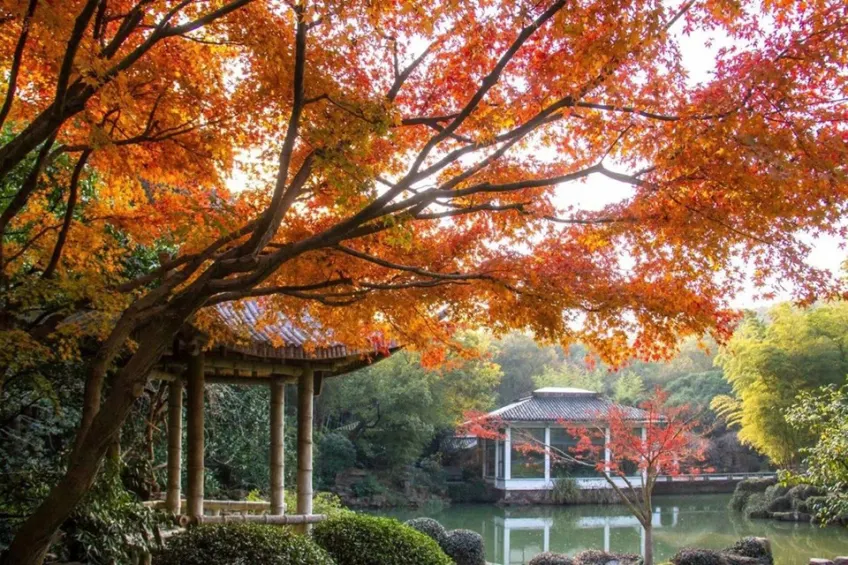
Chinese tallow trees provide most of Yuantouzhu's fall color. They shift from pale yellow-green to orange-red and, in late fall, deep purple-red, so a single tree can look like a watercolor gradient. The Ten-Mile Fragrant Path and Chongshan Yinxiu have the most tallow trees in the park, and the colors deepen layer by layer there. It's the best place for a fall portrait.
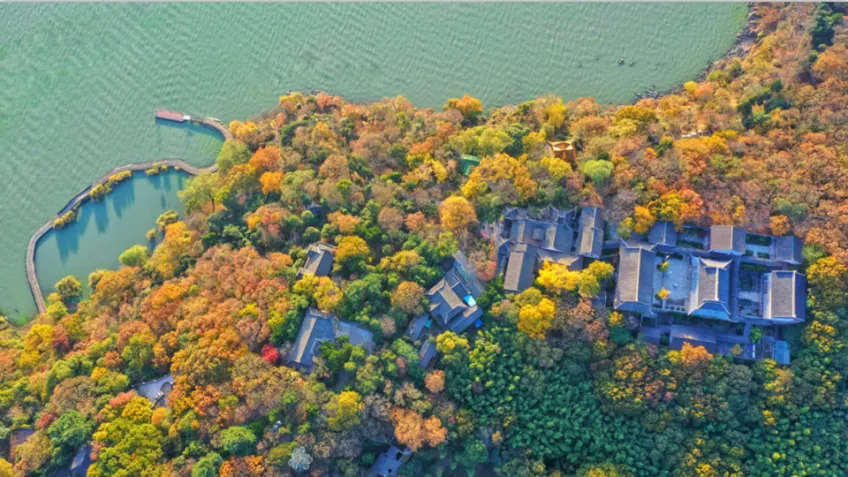
An aerial view of the autumn peninsula's winding shores reveals layers of gold, orange and red. Climb to Shutian Pavilion on Luding Hill for a panoramic view of Lake Tai in fall.
Fall routes
Classic foliage route: Chongshan Gate (Chinese tallow and sweetgum trees) → Chongshan Yinxiu (Japanese maples) → Finest Spot of Lake Tai (red maples with traditional architecture) → Changchun Bridge (lake and mountain views) → Wanlang Bridge (reeds at sunset)
Panoramic viewpoint route: Luding Hill (view Lake Tai's autumn colors from Shutian Pavilion) → descend through Cherry Blossom Valley (ginkgo trees) → take a boat to Lake Tai Fairy Island (red maples on the island and lotus remnants in the lake)
Quiet route: enter via Dushan Gate → head straight to the lakeshore → walk along the shore to the Yuantouzhu Lighthouse → stop for tea at Chenglan Hall → end at the fall show in Jiangnan Orchid Garden
If the routes above don't suit you, or if you have other questions, contact customer service and we'll arrange an itinerary based on your needs.
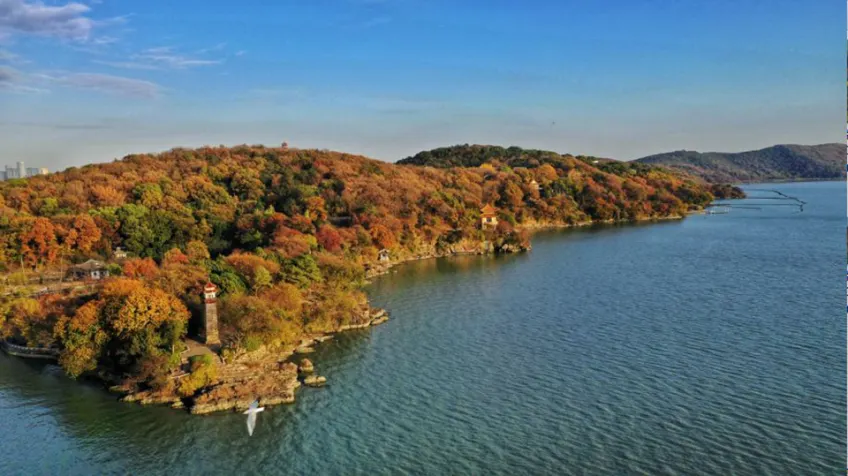
The lighthouse in fall colors, with gulls skimming past. The weeks between late fall and early winter are a good time to visit too.
Fall tips
Best time: late November to early December. Maples turn red, ginkgos turn yellow and reed plumes are at their peak—the most colorful period of the year.
Fall event: the Jiangnan Orchid Garden fall show. This orchid garden sits on Qimei Road below Guangfu Temple, and each fall it holds an exhibition of fall-blooming orchids and chrysanthemums. Worth a look if you're interested.
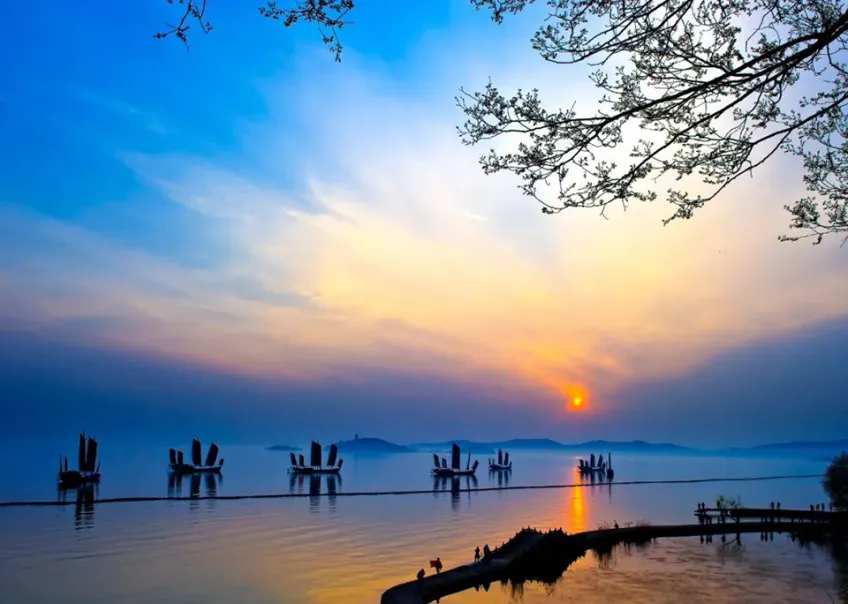
Sunset sails and boardwalk silhouettes on Lake Tai—the area around Wanlang Bridge is a classic spot for photographing sunsets and reed plumes.
Winter at Yuantouzhu
In winter, Yuantouzhu gets visitors from far away: black-headed gulls. Their arrival is the warmest moment of the cold season here.
Every year from November to March, black-headed gulls migrate to Lake Tai and become Yuantouzhu's most striking winter sight. They often follow the ferries to and from Lake Tai Fairy Island, and sometimes whole flocks rise and land together in "bird waves," a scene you only see here in winter.
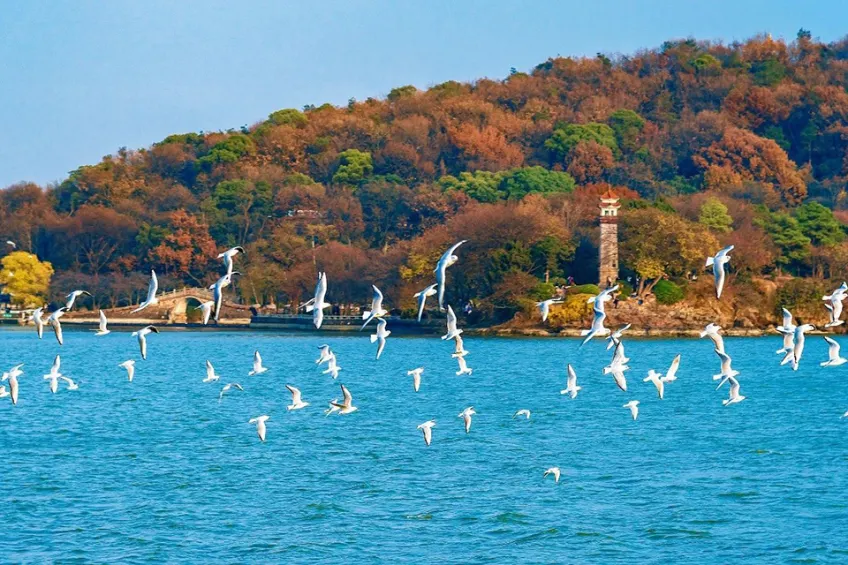
The gulls come back every winter like clockwork, so you can count on seeing them. If you plan a winter visit, bring some crackers or steamed buns with no oil or salt. Toss pieces into the air and the gulls will swoop in close.
Wuxi and Nanjing 3-day 2-night private tour | Yuantouzhu (Turtle Head Isle) · Nanjing Museum · Niushou Mountain
A 3-day 2-night private tour starting in Wuxi and ending in Nanjing: Day 1 features a boat ride on Lake Tai at Yuantouzhu (Turtle Head Isle), Plum Garden and Nanchang Street; Day 2 covers Huishan Ancient Town followed by the Nanjing Museum; Day 3 visits Niushou Mountain. Includes transportation, guide, two nights of hotel accommodation and admission tickets. Flights or trains are not included. An English-speaking guide is available upon request.
Yuantouzhu itineraries
Half-day gull-watching route: Chongshan Gate → take a boat to Lake Tai Fairy Island (watch and feed the gulls from the deck, about a 30-minute ride) → stroll around Lake Tai Fairy Island (looking back at the lake from the island is especially atmospheric) → return by boat (enjoy being surrounded by gulls once more) → watch the sunset at Wanlang Bridge (in the evening, see the gulls fly alongside the setting sun)
Full-day route: Chongshan Gate → Chongshan Yinxiu (a quiet garden in the winter sun) → Jiangnan Orchid Garden (occasional orchid shows, peaceful as ever) → lunch of fresh lake fish at a lakeside restaurant → boat ride to watch and feed the gulls → explore Lake Tai Fairy Island → back on shore, walk past the Yuantouzhu Lighthouse and Chenglan Hall → photograph the sunset and returning gulls at Wanlang Bridge
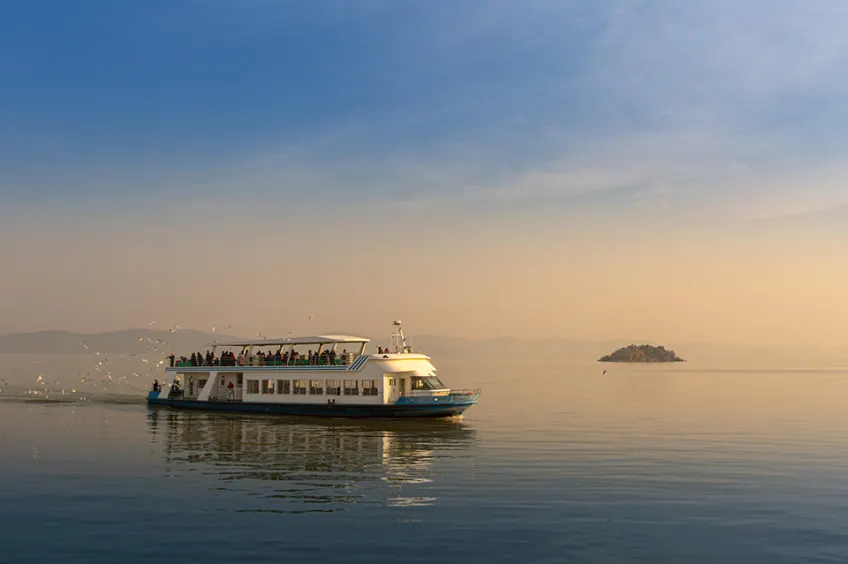
Double-decker ferries run to and from Lake Tai Fairy Island, and flocks of gulls often follow the stern. Ferry tickets are usually included in the admission ticket and allow multiple rides.
Practical tips for visiting Yuantouzhu
Best time: December to February each year is the peak season for black-headed gulls. During the day, the gulls are most active in the morning and late afternoon.
Gull-watching boats: Admission usually includes the round-trip ferry to Lake Tai Fairy Island, and you can ride more than once. Sit by the rail for the best view.
Feeding tips: Gull feed is sold in the park, or bring your own crackers or steamed buns with no oil or salt. Feed carefully, and don't throw wrappers into the lake.
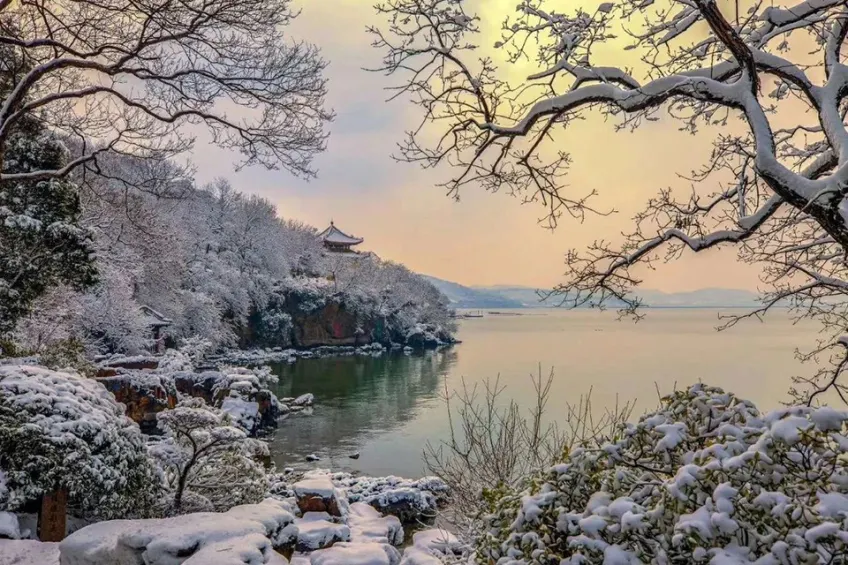
A peninsula, a century-old garden.
Every season here has its own colors and an unhurried pace. Yuantouzhu is waiting for you on the shore of Lake Tai.
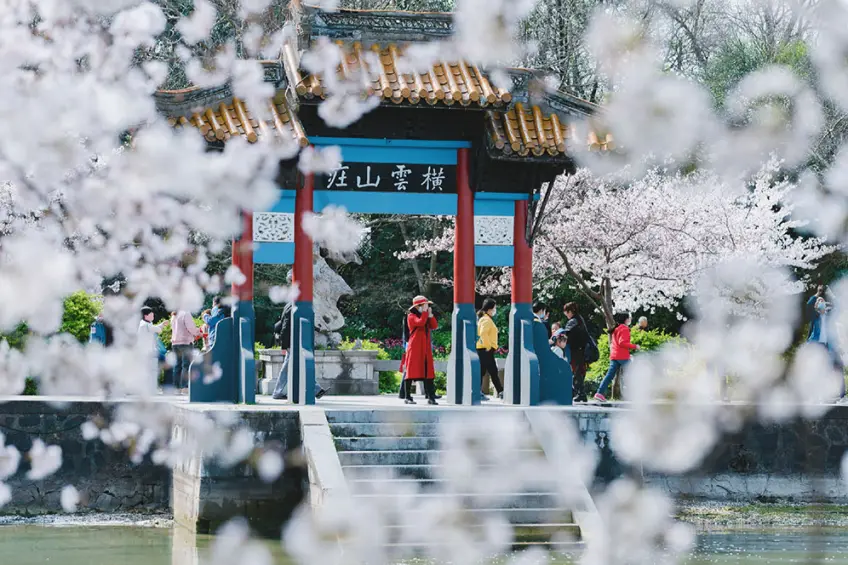
If it's your first visit to Yuantouzhu, we suggest a custom tour:
You don't need to figure out transport routes yourself, or worry about tickets, hotels and sightseeing because you don't speak Chinese. We can arrange an itinerary based on your group size and preferences, along with airport pickups, transfers between your hotel and attractions, hotel and ticket bookings, boat rides and more — all at a relaxed, unhurried pace.
FAQs
What's Yuantouzhu like, and is it worth visiting?
Yes. This peninsula on the northwest shore of Lake Tai has something for every season: cherry blossoms in spring, lotus in summer, fall colors and gulls in winter. If you only have one day in Wuxi, put Yuantouzhu at the top of your plan.
When is the best time to see the cherry blossoms?
Early cherry blossoms usually appear in early March, while Somei-Yoshino and Kanzan cherries bloom in mid to late March. Changchun Bridge, Cherry Blossom Valley and the Cherry Blossom Viewing Tower are the main spots, and the area around Changchun Bridge is lit up for night viewing.
How do tickets, opening hours and boat schedules work?
Admission is ¥90 (November 2026 reference price; check the official notice) and includes the round-trip ferry to Lake Tai Fairy Island. Night tickets and hours during cherry blossom season follow the scenic area's notice on the day. In winter, sit by the railing on the boat to watch the gulls.
Who is this guide for? Is it good for seniors and kids?
It suits flower lovers, lake photographers and families with seniors or children. The park has gentle slopes and boat service, so older visitors can walk less and ride more. In summer, avoid the midday sun: 8–10 a.m. or late afternoon is much more comfortable.
How do I get to Yuantouzhu: group tour or private car?
You can take a taxi or bus to the Chongshan or Dushan gate. If it is your first visit or you want to combine Lingshan and Huishan, a private tour is the easiest option. For a custom itinerary based on the season, choose custom travel. For station transfers, ask about station pickup and drop-off or private car service. For commentary, you can hire a guide.