
Xitang (西塘) is in Jiashan, Jiaxing, Zhejiang, where Jiangsu, Zhejiang and Shanghai meet. Take the high-speed train to Jiashan South Station (嘉善南站), then a taxi of about 20 minutes. A single ticket costs ¥95 (reference price as of November 2026; check the official announcement) and is valid for one day. The highlights are the Misty Rain Corridor (烟雨长廊), Songzi Laifeng Bridge (送子来凤桥) and Shipi Lane (石皮弄), only 0.8 meters wide at its narrowest. After dark, take a hand-rowed boat to see the lanterns. Jay Chou also filmed his music video for "Tianya Guoke" here.

Xitang, a Jiangnan water town
Xitang is one of the best-known Jiangnan water towns, at the point where Jiangsu, Zhejiang and Shanghai meet. Its old names were Xutang and Xietang. In the Spring and Autumn period, Wu Zixu, a minister of the State of Wu, built waterworks here and brought water from north of Mount Xu to irrigate the land, which gave the town the name Xutang.
The land here is flat, and by the Kaiyuan era of the Tang dynasty there were already many villages. In the Southern Song they grew into market towns. From the Yuan dynasty on, the rich waterways turned the area into a trading town, and by the Ming and Qing it was a major center of crafts and trade in Jiangnan.

A thousand-year-old town people still live in
Xitang still keeps its Ming and Qing water-town look and way of life, which is why it's called "a living thousand-year-old town."
"Spring and Autumn waters, Tang and Song towns, Ming and Qing architecture, modern people" is a common way to describe Xitang. The town has 9 intersecting waterways, 27 ancient stone bridges, and nearly 2,000 meters of riverside covered corridors.
There are also 122 lanes, of three kinds. Water lanes run from the river to the houses, so families away from the water could fetch water and do their washing. Street lanes link two parallel streets. Side lanes run beside the main halls and are usually dim. Together they form the framework of the town.

Shipi Lane and its sliver of sky
The most famous is a narrow lane called Shipi Lane. It is about 68 meters long and just 0.8 meters wide at its narrowest point, flanked by fire walls 6-10 meters high. The ground is paved with thin stone slabs, which is why it is called "Shipi Lane" (stone-skin lane).

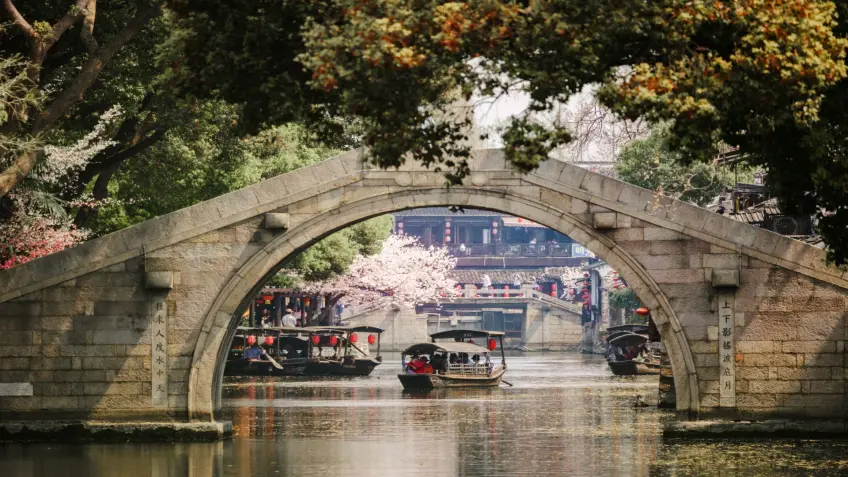
Step out of Shipi Lane and you face homes built along the water and Wupeng boats on the canal. Narrow lanes and waterways like these form the backbone of Xitang, and they show the quiet elegance of a Jiangnan water town at its best.
Homes and gardens follow the old patterns: shop in front and home behind, shop below and home above, street in front and river behind. Whitewashed walls, dark tiles, stepped gable walls, carved wooden windows and brick-carved gateways are everywhere. More than 2,600 local households still live along the water, working by day and resting at night to the sound of oars. Whenever you come, you'll see everyday Jiangnan life going on.

Xitang through the seasons

Spring in Xitang
Spring in Xitang is colorful. Besides cherry blossoms, peach, pear and apricot trees flower among the white walls and dark tiles, and with the small bridges, canals and old courtyards, the town feels even more classical.
Flower season: March to May (mainly peach, cherry, pear and apricot blossoms, azaleas, rapeseed flowers, magnolias and wisteria)
Best spots for spring flowers: the Misty Rain Corridor, Zuiyuan Garden, West Garden and the banks by Huanxiu Bridge
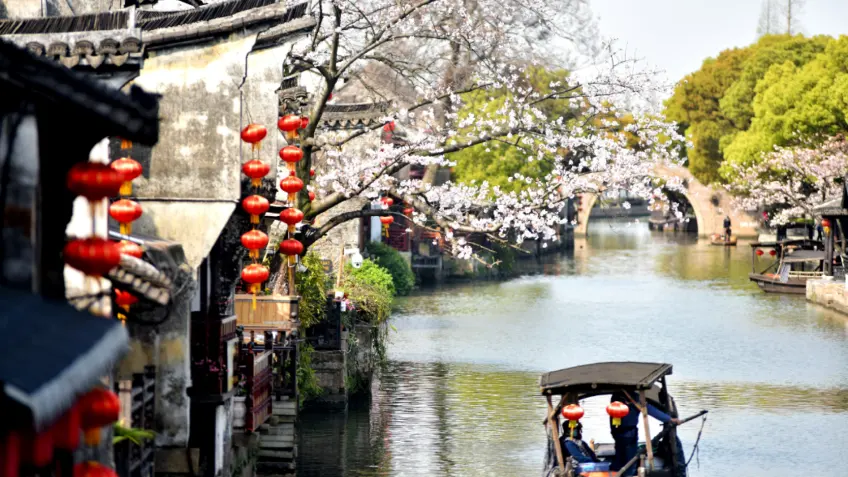
Suggested spring route: enter at 7–8 a.m. → walk West Street past the Root Carving Museum, the Eaves Tile Museum and the Button Museum → cross Anjing Bridge → follow the old street on the east side of Xitang Harbor → see the Ni Residence and Shengmiao Temple → photos at the Misty Rain Corridor → Songzi Laifeng Bridge → Zuiyuan Garden and the Seventh Master Temple → back to Huanxiu Bridge for dinner and the night view → night boat ride
In spring, Xitang often holds traditional events such as Qingming (Tomb-Sweeping Festival) outings, tea gatherings and opera performances, a chance to see Jiangnan customs as they really are. Events and dates follow the official seasonal announcements.
Summer in Xitang
In summer, flowers still line the riverbanks and bridges. With the old buildings and stone bridges, the town looks like an ink painting slowly unrolling, calm and charming.
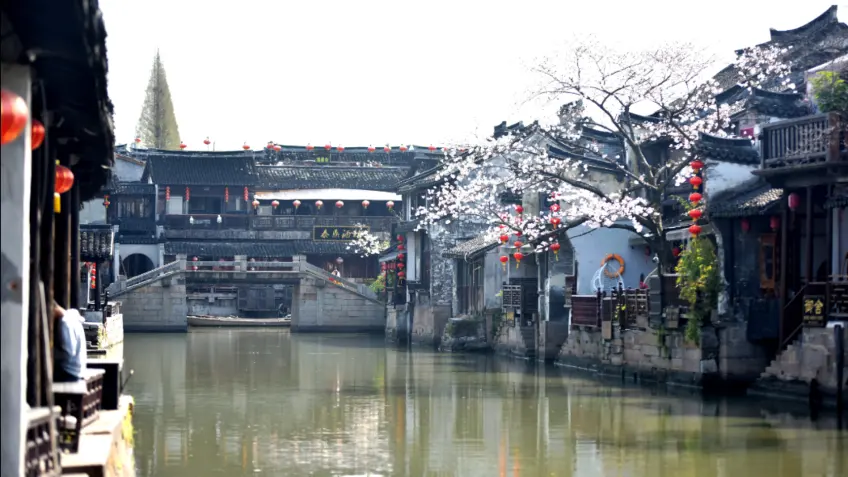
Summer-only events in Xitang:
Each summer, Xitang runs "Dream Xitang · Boat Tales," usually from late July to early September. It's a staged night show on the water launched in recent years, built around a parade of decorated Chinese-style boats that mixes opera, hanfu and local legends with light shows. People call it "a moving scroll of Jiangnan culture."
Dream Xitang · Boat Tales schedule: the regular night parade runs Friday–Sunday, 7:30–8:30 p.m. The water-town vendor boats run daily at 10 a.m., 3 p.m. and 6:30 p.m.

Suggested summer route: enter the town → Misty Rain Corridor → West Garden and Zuiyuan Garden → eat at a riverside restaurant (try local snacks like Lu's wontons and Grandma Guan's stinky tofu, or home-style dishes like salt-and-pepper pumpkin and steamed whitefish) → Button Museum → Zhang Zheng Root Carving Museum → night views of the town from Huanxiu Bridge → evening boat ride.

Xitang is a "living thousand-year-old town," famous for its many bridges, lanes and covered corridors, showcasing the classic Jiangnan charm of small bridges over flowing water and homes built along the river.
Xitang is a "living thousand-year-old town," famous for its many bridges, lanes and covered corridors, showcasing the classic Jiangnan charm of small bridges over flowing water and homes built along the river.Autumn in Xitang
Autumn comes late to Xitang, then all at once. The trees along the banks can turn gold overnight, red maples and golden ginkgo put on their best color, and the water runs clear. It's the best season for a boat ride: as the oar parts the water ahead of you, it feels like unrolling a Jiangnan ink painting.

Where to see autumn color: the Misty Rain Corridor, West Street, and around Huanxiu and Yongning bridges.
Autumn photo tips:
Misty Rain Corridor: in autumn, the red lanterns under the roof set off the yellowing leaves. Stand in the middle section and use the river as your backdrop.
West Street: the shops and falling leaves make a quiet, poetic scene. Shoot from the entrance and let the street lead the eye. You'll get atmospheric shots with little effort.
Best time for autumn color: mid-to-late October through mid-November. Come early in the morning or near sunset, when the light is soft and the colors are rich.

Suggested autumn route: enter via Shipi Lane or Beizha Street → take a boat from the pier (few boats on the water early in the morning) → West Garden, the Button Museum and the Zhang Zheng Root Carving Museum → snacks along West Street and the Misty Rain Corridor (try Grandma Guan's stinky tofu, Lu's wontons and Master Zheng's plum blossom cakes) → Huanxiu Bridge for a view over the Xutang River → after dark, Yongning Bridge or Anjing Bridge for night photos → night boat ride

Winter in Xitang
Winter in Xitang is quieter. In early winter, thin mist wraps the bridges and canals, and the dark tiles and white walls drift in and out of the gray morning fog. In deep winter, icicles hang from the eaves and snow covers the roofs and walls, and the town is at its most poetic.
Winter only: Xitang sometimes gets snow. The morning after a snowfall, when the town is covered in white, is the best time for photos and sightseeing.
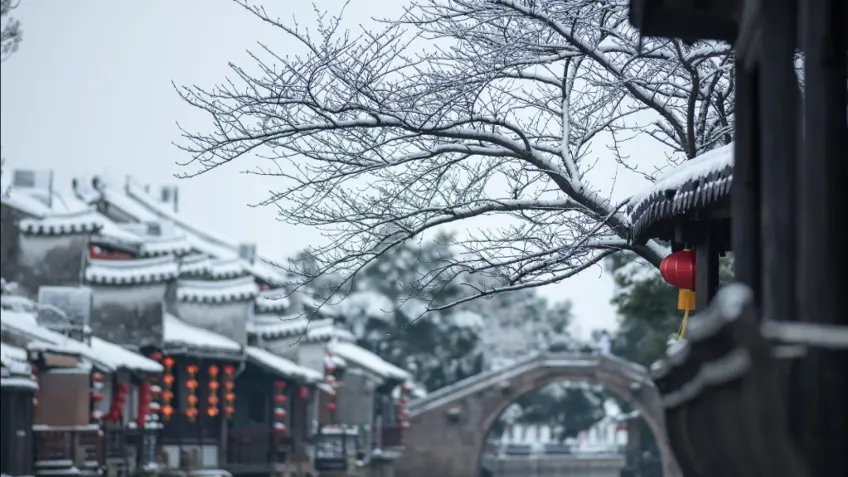
Suggested winter route: enter at the west main entrance → Misty Rain Corridor → Flower Lane Square → Songzi Laifeng Bridge → Huanxiu Bridge → West Street → Shipi Lane → West Garden and other main sights → eat at a riverside restaurant (local favorites include old duck and wonton stew, Xitang rice wine, Grandma Guan's stinky tofu, Lu's wontons, Lao Ma's rice-flour steamed pork and braised pig's trotters)
Chinese New Year in Xitang
People say New Year in Jiangnan is the most festive of all, and Xitang is no exception. Every Lunar New Year, the town puts on a big celebration.
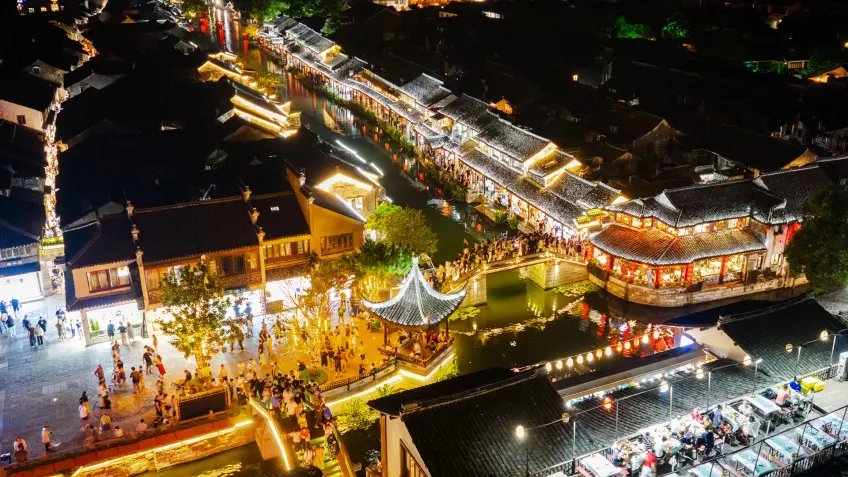
Xitang's Spring Festival events mix tradition and fun. They usually run from the 28th day of the 12th lunar month to the 6th day of the first lunar month. During the holiday, the town stays open in the evening and runs activities from morning to night.
What to do at New Year
If you come at New Year, spend the day at the floating market, where vendors sell from boats along the river, and try making a woodblock New Year print at Huguo Suiliang Wang Temple. In the lanes, pop-up performances of the intangible-heritage horse lantern dance and the "horse-face skirt" dance take turns, and wedding boats parade on the river, showing old Jiangnan wedding customs.
After dark, buy a lantern at the market and carry it through the decorated lanes. During the 2026 Year of the Horse Spring Festival, there were also zodiac-themed interactive displays and a stamp-collecting trail. The program changes each year, so check the official announcements.
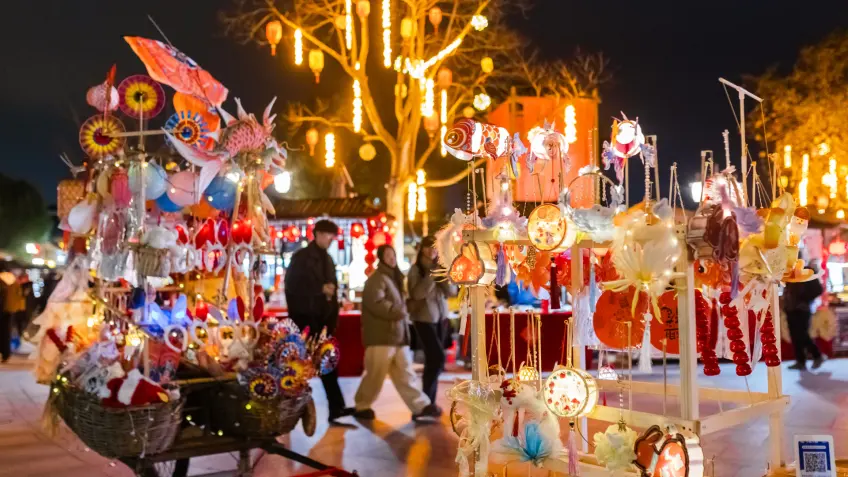
Xitang keeps its old buildings intact, and its classic water-town setting and deep cultural roots make it an ideal venue for traditional Chinese festivals and modern markets.
Events such as Hanfu Culture Week, hanfu weddings and the Gu Xidong Opera Arts Week have all been held here, so Xitang is more than a sightseeing stop. It's a place where you can take part. Whether you want to experience folk traditions up close or feel the mood of a Chinese festival, Xitang usually has a pleasant surprise in store.
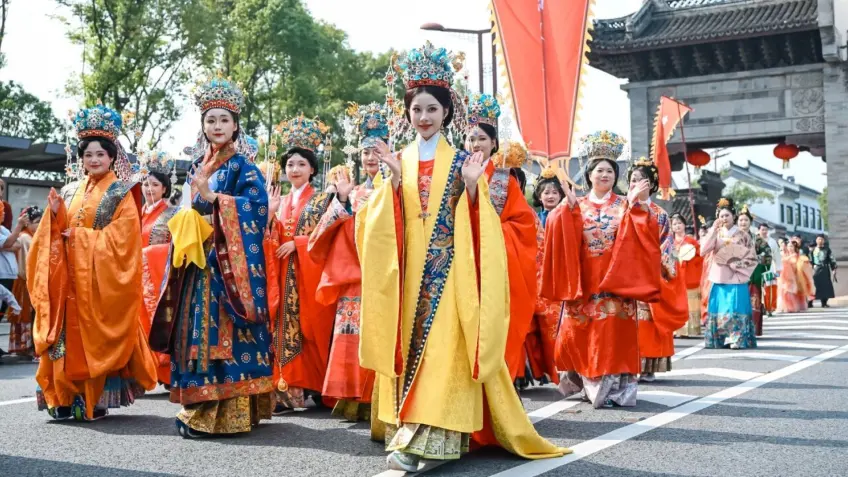
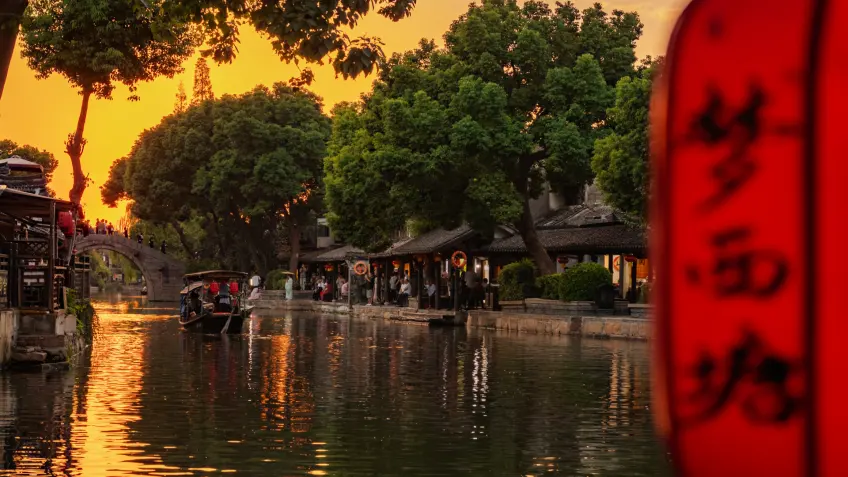
When the hanfu parade ends, walk down to the river for the dusk view. Lanterns come on and Wupeng boats drift by, the picture of Xitang many visitors remember most.
6-day 5-night private tour of Shanghai, Hangzhou, Wuzhen and Qiandao Lake | Xitang · West Lake boat cruise
A 6-day 5-night private tour starting and ending in Shanghai: Wuzhen East Scenic Zone and West Scenic Zone, Xitang and Lingyin Temple's Feilai Peak, plus a day at Tianyu Mountain on Qiandao Lake. On the way back, enjoy a West Lake boat cruise and visit City God Temple and Nanjing Road. Includes airport transfers, transportation, guide, 5 nights' hotel and admission tickets. English-speaking guide available.
Xitang tickets
Price: a single ticket costs ¥95 per person and is valid for one day for the sights inside. During the 2026 Spring Festival, a discounted night ticket was also sold for ¥60 (valid 5–9 p.m.). Whether night tickets are on sale is announced each day on the official "Xitang Tourism" (西塘旅游) WeChat account.
How to buy tickets: buy under your real name through the official "Xitang Tourism" WeChat account or the Xitang tourism website. Once you link your face, you can enter by face scan and come and go all day. Foreign visitors without a Chinese ID card can buy at the visitor center ticket window with their passport.
Free entry and night tickets: on night-opening days a separate night ticket is sold (¥60 during the 2026 Spring Festival); check the announcements. Free entry in hanfu applies only during Xitang Hanfu Culture Week. You must register in advance on the "Xitang Tourism" WeChat account and pass a review, then show your registration code and ID on site; foreign visitors use their passport. Studio-rental costumes, stage costumes (emperor or swordsman outfits), hezi skirts, Qing-style cloud collars, Qing Han-style women's wear and mamianqun skirts worn by men don't count as approved hanfu.

Getting to Xitang
By high-speed train: Jiashan South Station is the best choice. From there, take bus 222 or the direct shuttle to Xitang, or a taxi (about 20 minutes).
Register and buy high-speed train tickets with your passport on the 12306 English website or app. Hong Kong, Macao and Taiwan residents use their Mainland Travel Permit. E-tickets don't need printing. Show the original ID you booked with at the station; passport holders usually use the staffed lane.
By bus: Direct buses to Xitang (about 1.5 hours) depart from Shanghai South Long-Distance Bus Station or Shanghai Pudong Airport Station.
By car: Xitang is about 1 hour's drive from Shanghai, Hangzhou or Suzhou. Navigate to "Xitang Ancient Town Parking Lot No. 1," by the main west entrance. On busy weekends, use "Parking Lot No. 3" by the east entrance, which is quieter. Foreign visitors generally can't drive in China on a home-country or international license, so a private car with a driver is the easier option.
Boat rides
Prices: boats are priced per boat and seat about 6 people, and you can often share with others at the pier. Check the prices posted at the pier that day.
Piers and boat routes
East entrance pier: boats run along the main canal past landmarks such as the Misty Rain Corridor and the old bridges.
West entrance boat pier: Yanta Bay ↔ Songzi Laifeng Bridge (about an 8-minute ride).
Songzi Laifeng Bridge pier: in the heart of town by the bridge, this is the best pier for an evening ride. Board after 6 p.m. for the best atmosphere (check the pier's notice to see whether boats run that night).
Hours: 8 a.m.–4:30 p.m. (until 8:30 p.m. on holidays and in July–August).

Group tours, private cars or custom trips
If you want to fit the Misty Rain Corridor, Songzi Laifeng Bridge and a night tour into one day, start with a private tour that includes Xitang (or browse the Enchanting Qiandao Lake route with Xitang or the China travel overview). If you take the high-speed train to Jiashan South Station and need door-to-door service, we can arrange station transfers and a private car. To rearrange your stops based on your interests, book a custom private trip. For Chinese-English commentary, hire a guide separately. When you contact us, please specify your group size, dates, departure city and whether you want a night tour or hanfu experience, and our travel consultant will provide a workable plan at your pace (prices and availability are subject to the confirmation letter).
FAQs
How much is a Xitang ticket?
The Xitang ticket costs ¥95, is valid for the day and covers the sites inside the scenic area. Buy it under your real name on the official "Xitang Tourism" WeChat account or the Xitang tourism website; after linking your face, you can come and go all day. Foreign visitors without a Chinese ID card can buy at the visitor center ticket window with their passport. During night-tour events a discounted night ticket is sold separately (¥60 for 5–9 p.m. during the 2026 Spring Festival); check the WeChat account's announcements.
How do I get to Xitang by high-speed train?
The best option is the high-speed train to Jiashan South Station, then transfer to bus 222 or the direct shuttle to Xitang; a taxi takes about 20 minutes. You can also take a direct bus from Shanghai South Long-Distance Bus Station or Pudong Airport, which takes about 1.5 hours. Foreign visitors generally cannot drive in China with a home-country or international license, so book a private car for door-to-door service. If driving yourself, set your navigation to Xitang Ancient Town Parking Lot No. 1, the main west entrance.
When is the best time to visit Xitang?
March to May is flower season, with blossoms along the Misty Rain Corridor, in Zuiyuan Garden and West Garden, and by Huanxiu Bridge. In autumn, mid-to-late October through mid-November is best, and it's the ideal time for a boat ride. In winter, the morning after a snowfall is the best time for photos.
What's special about Shipi Lane in Xitang?
Shipi Lane is the most famous narrow lane in Xitang. It is about 68 meters long and just 0.8 meters wide at its narrowest point, flanked by fire walls 6 to 10 meters high. The ground is paved with thin stone slabs, which gives the lane its name. There are 122 lanes in Xitang town, divided into water lanes, street lanes and side lanes.
Where do I catch a night boat in Xitang?
For a night ride, use the Songzi Laifeng Bridge pier; boats after 6 p.m. have the best atmosphere. But the piers usually run 8 a.m.–4:30 p.m., extended to 8:30 p.m. only on public holidays and in July–August, so check the notice at the pier for evening sailings. Boats from the west entrance pier run between Yanta Bay and Songzi Laifeng Bridge, an 8-minute ride. Fares are posted at the pier.