

Introduction to Xiangfu Temple in Lingshan, Wuxi
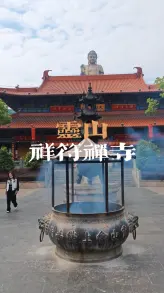
Xiangfu Temple sits at the foot of the 88-meter-tall Lingshan Grand Buddha inside Lingshan Scenic Area in Wuxi. Legend has it that during the Tang Dynasty, Xuanzang noticed the hills here resembled Vulture Peak in India and named the spot "Little Lingshan," after which his disciple Kuiji began teaching there. During the Dazhong Xiangfu era of the Northern Song, it was granted the name "Xiangfu Zen Temple." Today's halls were rebuilt on the original site in the 1990s, so they look brand new even though their roots go back over a thousand years. To enter the temple, you first need a Lingshan Scenic Area ticket (¥210).
The Thousand-Year Story of Xiangfu Temple in Lingshan
Here stands Xiangfu Temple. Just looking at its exterior, you might mistake it for a faux-ancient building constructed to complement tourism in Lingshan Scenic Area. In fact, that's a long-standing historical misunderstanding.
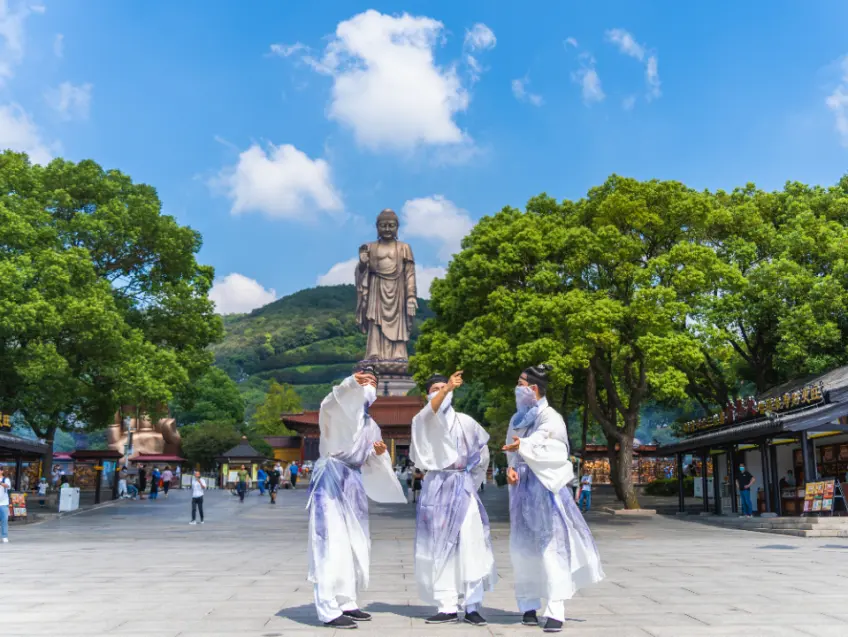
In truth, this is an ancient temple with a thousand-year history. Without the millennium of Buddhist heritage beneath our feet, there would be no reason for the Grand Buddha to sit here today.
The Story of Xiangfu Temple, a Thousand-Year-Old Monastery
Xuanzang Names Xiaolingshan
This history stretches back more than 1,300 years to the Tang Dynasty. According to legend, when Master Xuanzang returned from India, he passed through this area and saw the layered green peaks behind him so closely resembling India's Vulture Peak that he happily named the place "Little Lingshan."
Later, his disciple Kuiji began teaching Buddhism here at a temple named Lingshan Hermitage, and from then on, Buddhist chants echoed and the dharma lineage continued unbroken.
Over the centuries, the temple rose and fell several times, yet its Buddhist lineage was never broken, like a flame passed from lamp to lamp. Today, we part the curling incense smoke and brush the dust from ancient steles to trace the long history of this thousand-year-old monastery, record its modern revival, and look ahead to the spiritual legacy that drifts into the future with every morning bell and evening drum.
How Xiangfu Temple Got Its Name
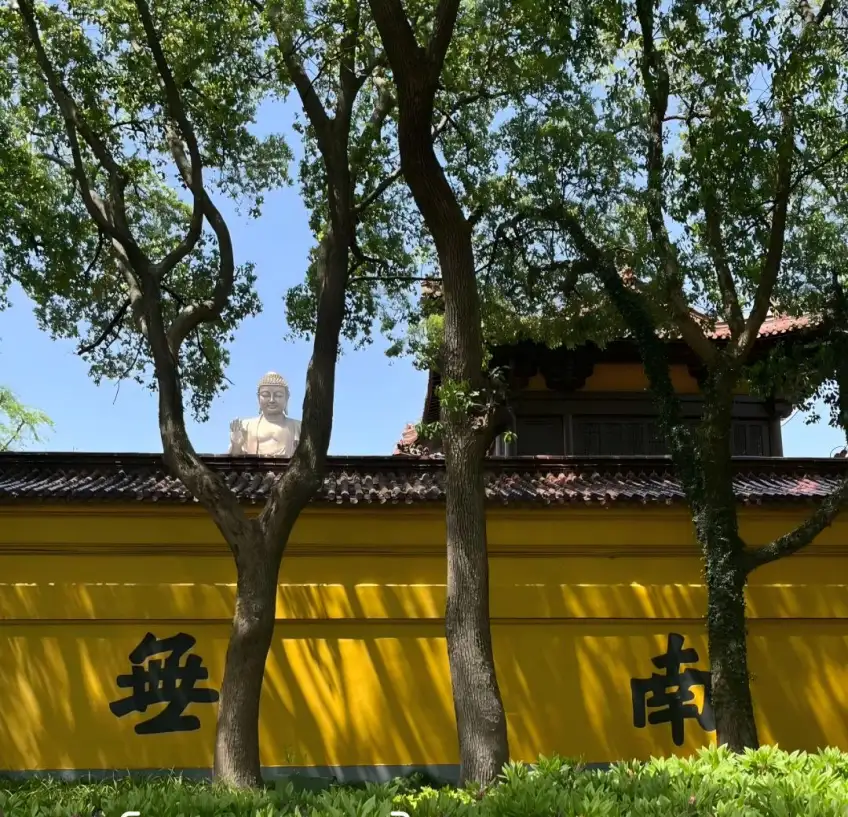
During the Dazhong Xiangfu era of the Northern Song Dynasty, Emperor Zhenzong bestowed a new name on this temple by Lake Tai: "Xiangfu Zen Cloister."
Naming a temple after an emperor's reign title was a mark of great importance. It meant the imperial court officially recognized the temple and brought it into the national spotlight.
From then on, it was no longer just a quiet hermitage hidden in the mountains. With imperial endorsement, it gained the confidence to resonate with the pulse of the entire nation.
Later, in the 4th year of the Xuanhe era of the Northern Song Dynasty, the temple was upgraded from a "yuan" (cloister) to a "si" (temple), becoming "Xiangfu Zen Temple."
In the Song Dynasty, a "si" ranked higher than a "yuan." That single-character change represented a tangible upgrade, reflecting the temple's scale and status.
Under the Song Dynasty's official temple management system, a "si" typically meant a larger scale, a more complete organizational structure, greater resources, and higher-level official recognition.
From "Xiangfu Zen Temple" to "Xiangfu Temple," two imperial namings over roughly a century trace its rise during the Northern Song. A Buddhist sanctuary by Lake Tai gradually made its way into the inner circle of the Buddhist world of that era.
Although the Song Dynasty buildings were long ago destroyed by war, this history has been passed down to this day.
Xiangfu Zen Temple Through the Ups and Downs of the Ming and Qing Dynasties
During the Ming and Qing dynasties, Xiangfu Zen Temple also went through several rises and falls.
In the Ming Dynasty, the temple was rebuilt many times. It was restored in the second year of the Hongwu reign, and in the tenth year of the Zhengtong reign the imperial court presented it with a copy of the Tripitaka. During the Jiajing and Wanli periods, the main hall, sutra hall, and pagoda were successively renovated. As a result, incense never stopped burning throughout the Ming Dynasty.
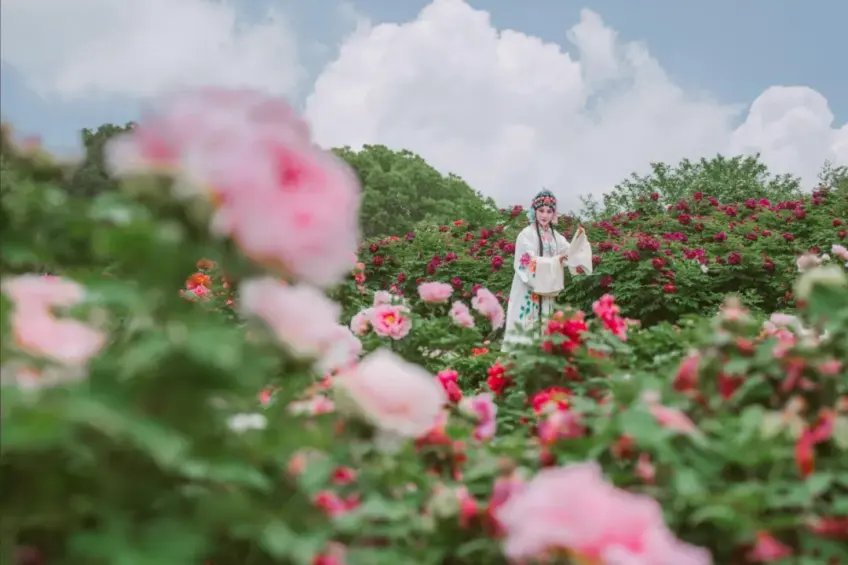
During the Kangxi reign of the Qing Dynasty, a man named Su Zijing funded the reconstruction of Xiangfu Zen Temple. The work took nine years, and he invited an eminent monk to serve as abbot. At that time, the temple was thriving with many monks and plenty of visitors. Emperor Kangxi even bestowed a plaque reading "Shenjun Temple"—quite an honor. It is said that when Emperor Qianlong later traveled to Jiangnan, he visited here as well.
But the good times didn't last. In the 10th year of the Xianfeng reign, the fires of the Taiping Rebellion burned Xiangfu Temple to the ground. Not a single page of the sutra collection survived—only a dozen or so rooms, including the Hall of Heavenly Kings, the storehouse and the kitchen, were spared.
Xiangfu Temple in Wuxi has many more fascinating stories, but hearing them isn't enough. I recommend clicking customer service to share your travel dates, group size and trip requirements. Our customer service team can create a one-on-one customized itinerary for you.
Xiangfu Temple and Lingshan Grand Buddha
In the 1990s, reconstruction of Xiangfu Temple began on its original site. During construction, workers unearthed ancient components from the Tang, Song, Ming and Qing dynasties, such as lotus pillar bases and stone pagodas. These relics buried underground had been silently recording the past all along.
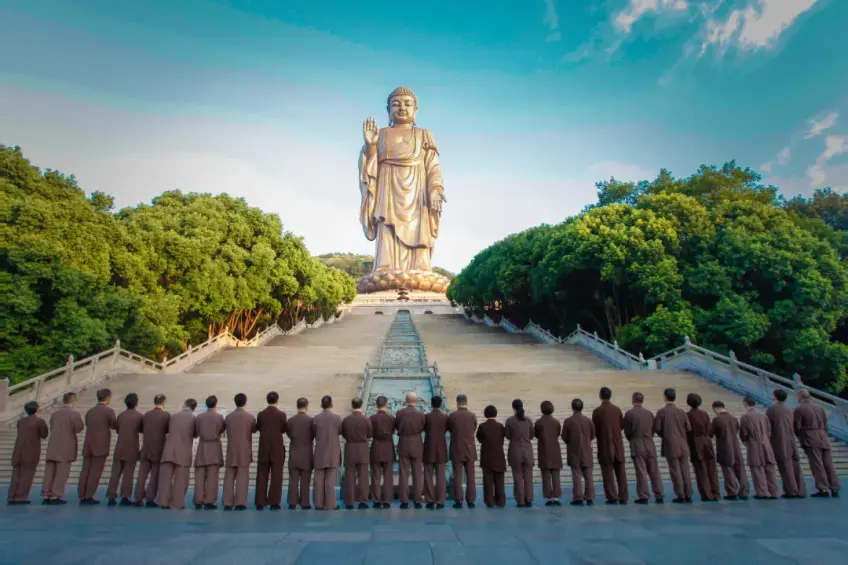
The awe and splendor of Lingshan Grand Buddha
Built with over 700 tons of bronze and 1,560 copper panels welded together over more than 30 kilometers, the Lingshan Grand Buddha was completed and consecrated on November 15, 1997.
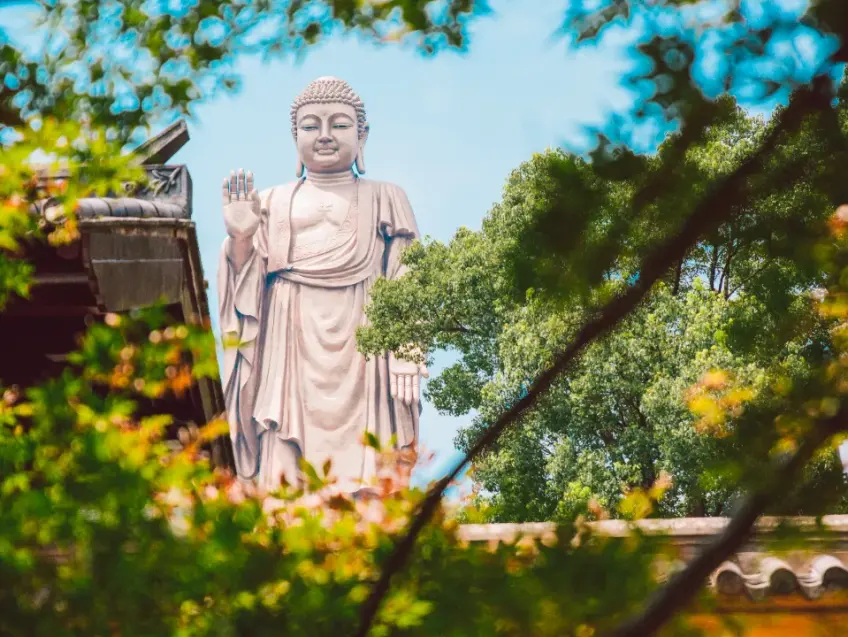
Zhao Puchu, former president of the Buddhist Association of China, wrote a poem for the occasion: "Ten thousand acres of lake light like pure lapis lazuli, reflecting on Lingshan where perfect wisdom dwells. Body level with the clouds, showering the dharma rain; eyes cast down to teach the people, revealing boundless compassion." Once completed, the Lingshan Grand Buddha joined Hong Kong's Tian Tan Buddha, Sichuan's Leshan Giant Buddha, Shanxi's Yungang Buddha, and Henan's Longmen Buddha to form the "Five Buddhas of the Five Directions."
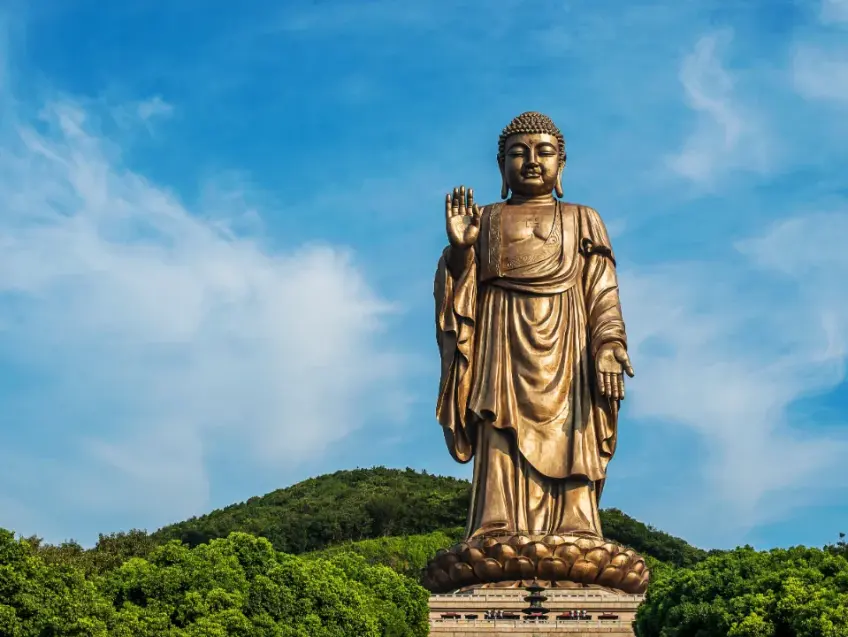
And so, Xiangfu Temple, once in decline, rode the fame of the Lingshan Grand Buddha to transform from an ordinary ancient temple into a world-class Buddhist cultural landmark.
How do I get to Xiangfu Temple at Lingshan?
Xiangfu Temple is located inside the Lingshan Scenic Area, so you need to buy a Lingshan Scenic Area ticket first to visit the temple.
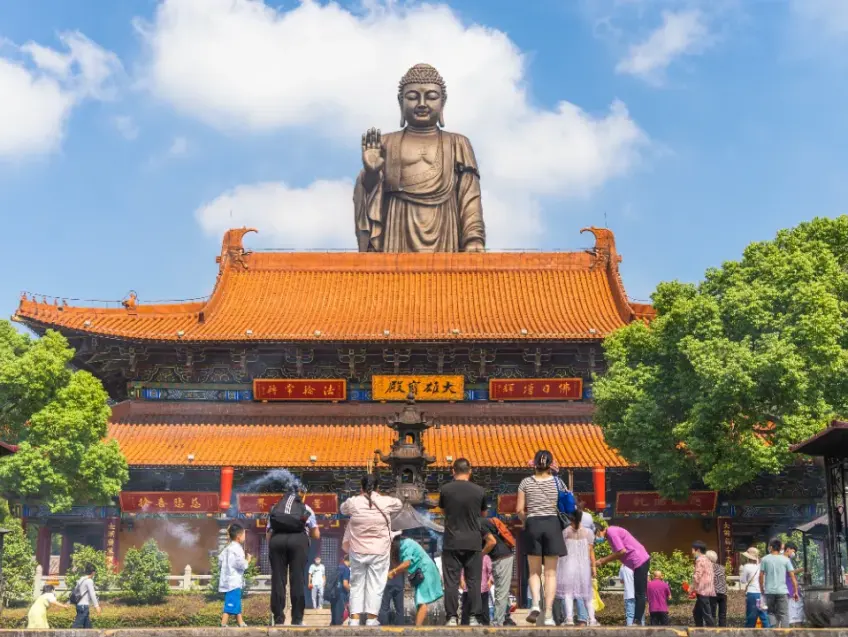
After entering Lingshan Scenic Area, follow the highlight route so you won't miss Xiangfu Temple or the Lingshan Grand Buddha.
Getting to Lingshan
By bus: Take bus 88, 89, or 91 from Wuxi Railway Station and get off at the "Lingshan Scenic Area" stop. The ride takes about an hour.
Taxi: About 40 minutes from Wuxi Railway Station.
Architecture of Xiangfu Temple
The layout of Xiangfu Temple strictly follows the traditional Chinese "seven-hall sangharama" temple plan, facing south with symmetrical buildings along a central axis. Although most of the existing structures were rebuilt in the 1990s, they imitate Song Dynasty architectural styles and inherit the classical charm described in the Yingzao Fashi (Treatise on Architectural Methods), giving you a sense of the grandeur of Song-style architecture.
Wuxi Lingshan sightseeing routes
Lingshan Grand Buddha scenic area highlights route
After entering the main gate of the Lingshan Scenic Area, follow this route to see all the highlights.
First, take a look at the "No. 1 Wall in China." This screen wall is 39.8 meters long and features reliefs depicting the story of the Tang Monk bestowing Zen teachings. When the monk Xuanzang visited here, he noticed the mountain resembled India's Vulture Peak and named it "Little Lingshan" (Little Vulture Peak).
Next, cross Wuming Bridge. As you walk over, you might wonder what "Wuming" means. In Buddhism, it refers to five fields of knowledge: Shengming (linguistics), Gongqiaoming (arts and crafts), Yifangming (medicine), Yinming (logic), and Neiming (inner wisdom).
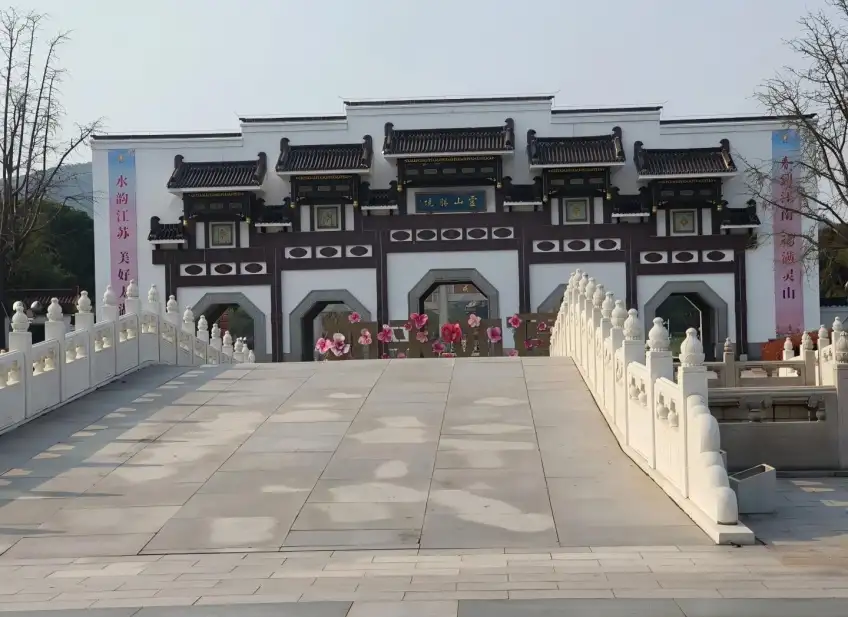
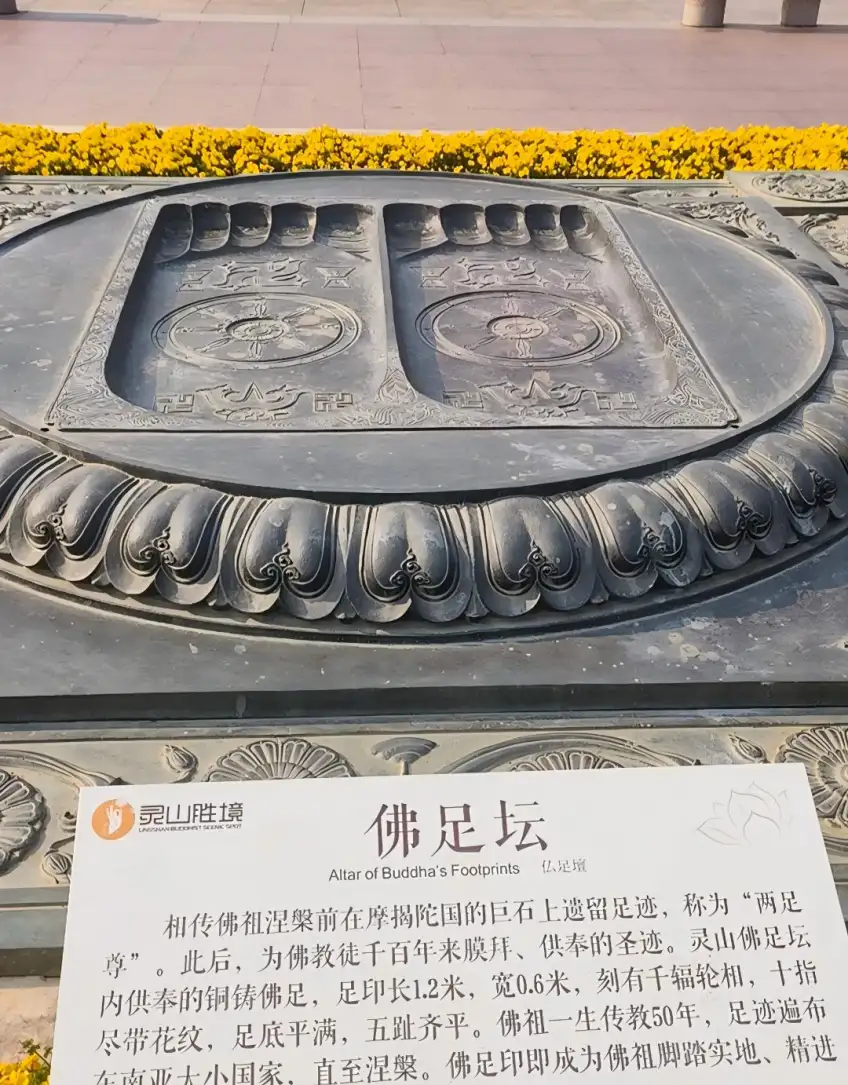
Inside the Buddha Footprint Altar is a large footprint said to be carved after the Buddha's own. It's worth stopping to take a look.
The Wuzhi Gate at Lingshan symbolizes the "Five Wisdoms," representing the five kinds of wisdom needed for spiritual practice. What are they? The wisdom of the dharma realm, mirror-like wisdom, the wisdom of equality, the wisdom of observation, and the wisdom of accomplishment.
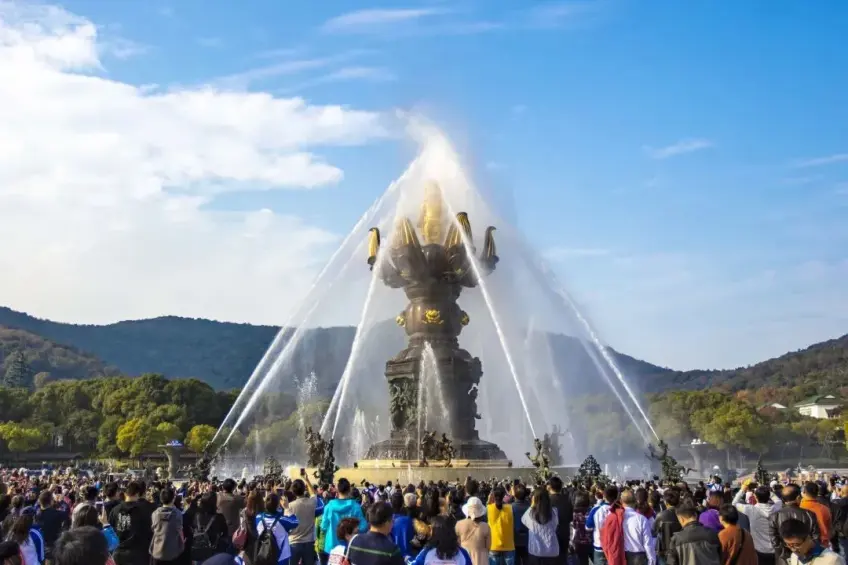
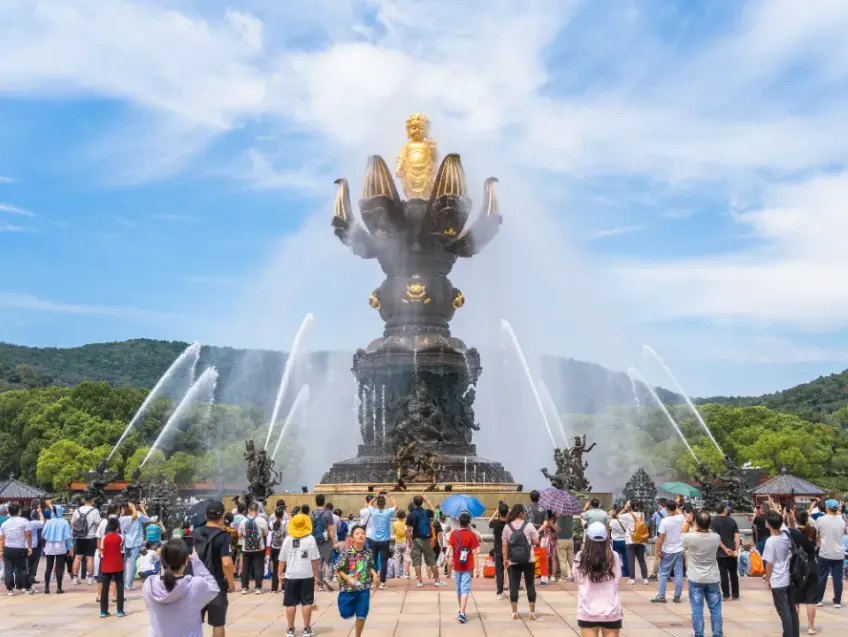
When the music for the Nine Dragons Bathing the Buddha show begins, nine dragons spray water and the infant Buddha slowly rises from the lotus flower. It's quite spectacular.
Sunlight shining through the mist sometimes creates a rainbow. In that moment, it feels like a recreation of the scene in Lumbini Garden over 2,000 years ago, when Prince Siddhartha was born, lotuses bloomed beneath his every step, and nine dragons sprayed water to bathe him.
The interior of Lingshan Brahma Palace is dazzlingly golden. The dome, murals, and carvings are all exquisitely crafted—definitely worth a walk through.
Step beneath the dome and you can't help but be awed by its splendor. It's not gaudy excess, but solemnity carved with precision. Dongyang woodcarving, Dunhuang-style murals, Yangzhou lacquerware, and Jingdezhen blue-and-white porcelain—countless intangible cultural heritage crafts converge here. Glazed lamps on the dome shift in color, yet the fixtures themselves remain invisible.
This place is worth exploring, not just for its beauty, but because it brings the imagination of a "Buddhist realm" to life through the finest craftsmanship on earth. Walk slowly, look up at the murals, look down at the floor tiles—every corner holds an artisan's devotion.
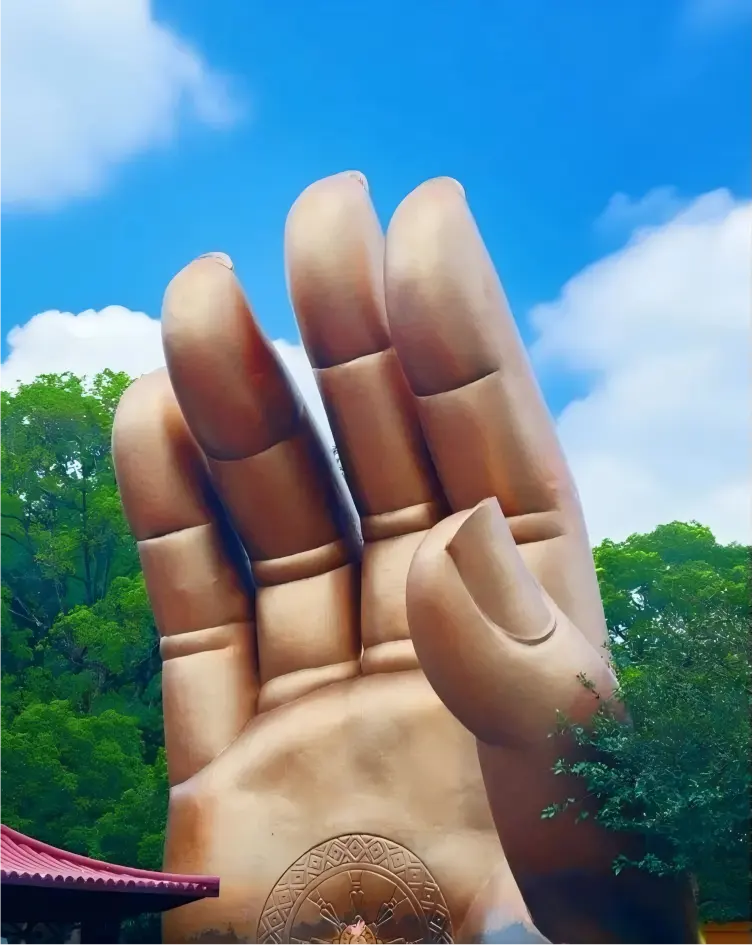
Head to the First Palm Under Heaven to touch the Buddha's hand for good luck. They say, "Touch the Buddha's hand and your worries go away," so everyone lines up here for a touch.
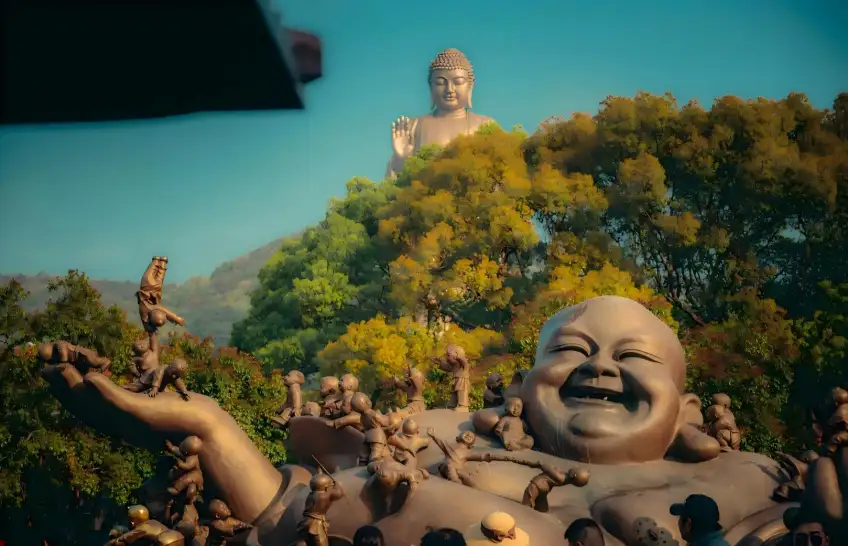
Visit the Hundred Children Playing on Maitreya to see a hundred children playing on Maitreya Buddha—some climbing his shoulders, others tugging his ears. It's great fun.
Next, head to Xiangfu Temple and arrive at the temple's mountain gate hall, the Hall of Heavenly Kings. A pair of stone lions guards the entrance. Inside, a smiling Maitreya Buddha sits in the center, with Skanda Bodhisattva behind him and the Four Heavenly Kings standing on either side.
Lingshan Scenic Area & Xiangfu Temple route
The Mahavira Hall is the core building of the temple. The hall is magnificent, featuring a double-eave hip-and-gable roof covered with blue cylindrical tiles, and its ridge is decorated with chiwen (owl-tail ornaments) and mythical beasts.
The main hall is seven bays wide and four bays deep, making it quite imposing. In the center stands a statue of Sakyamuni Buddha, flanked by the venerable disciples Kasyapa and Ananda, with the Eighteen Arhats on either side.
The Buddha statue is solemn and dignified. Behind it is a large wall relief of Guanyin on an island, featuring numerous figures in a grand scene.
The side halls include a bell tower, a drum tower, the Patriarch Hall, and the Sangharama Hall.
In the bell tower on the east side hangs the "Xiangfu Zen Bell." This 12.8-ton bell is engraved with the characters "Xiangfu." Every time it rings, it seems to remind people that this temple's roots were planted over a thousand years ago during the Northern Song Dynasty.
A Living Relic at Lingshan, Wuxi: The Millennium Ginkgo
If the Song-style architecture is Xiangfu Temple's "new clothes," then these millennium-old relics in the courtyard are the true "soul" of this ancient temple. They cannot speak, yet they have witnessed real history.
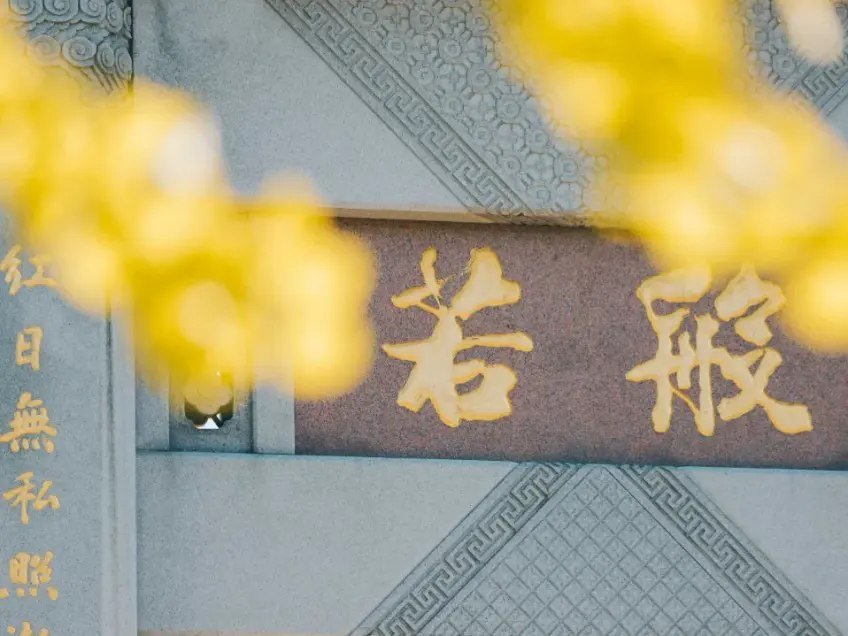
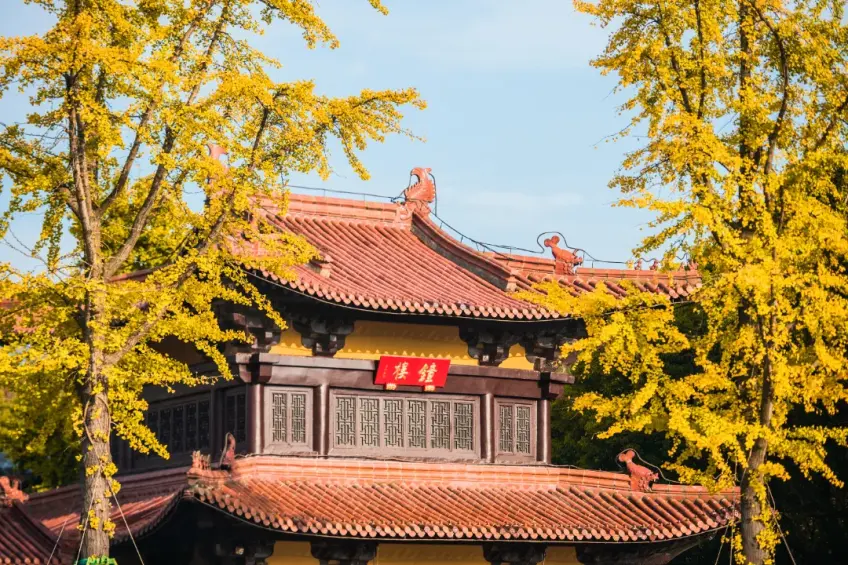
Passing through the Hall of Heavenly Kings, the first thing you see is that thousand-year-old ginkgo tree. Legend has it that monks planted it during the Zhenguan era of the Tang Dynasty, making it over 1,300 years old today.
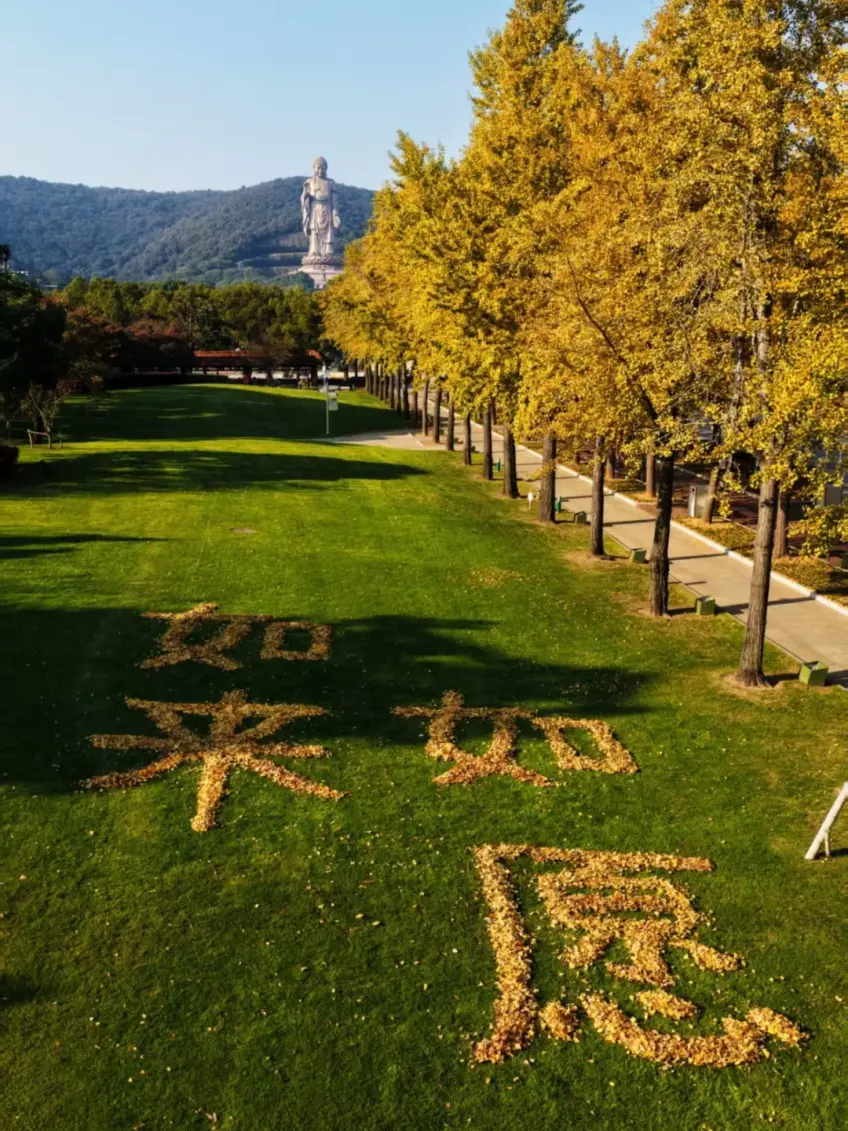
Late autumn is when this ginkgo is at its most beautiful. In mid-to-late November, the leaves slowly turn from emerald green to golden yellow.
When the wind blows, golden leaves rustle down and carpet the bluestone slabs, crunching softly underfoot.
Many photography enthusiasts come specifically at this time, setting up their gear and waiting half a day just for a beam of slanting sunlight to graze the treetops, or a wisp of incense smoke to drift past the trunk.
The classic shot of the large and small Buddhas together at Lingshan Scenic Area
In the center of the temple stands a scaled-down bronze statue of the Lingshan Grand Buddha, about seven or eight meters tall.
Though it's called the "Small Buddha," it isn't actually small. It only seems that way when you look up toward the summit and see the 88-meter-tall Grand Buddha sitting behind it.
That's when you suddenly understand where the word "small" comes from.
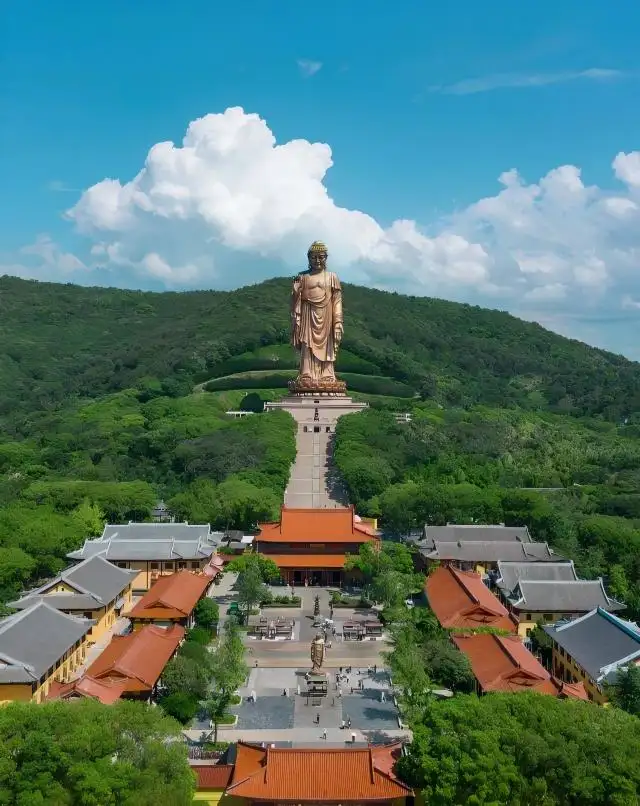
The large and the small, the far and the near, face each other perfectly. Stand here to take a photo and you can fit both Buddhas into the frame: the Small Buddha close by with its gentle expression, and the Grand Buddha on the summit looking down over all.
This is one of the most interesting sights at Lingshan Scenic Area: the Small Buddha in front, the Grand Buddha behind; one among the people, the other reaching into the clouds.
The Small Buddha stands on the temple's central axis, receiving incense offerings and meeting visitors eye to eye. With downcast eyes, its compassion feels within reach.
The Grand Buddha sits quietly on the summit, gazing down over all. You have to look up to see it, and climb 218 steps just to reach its feet.
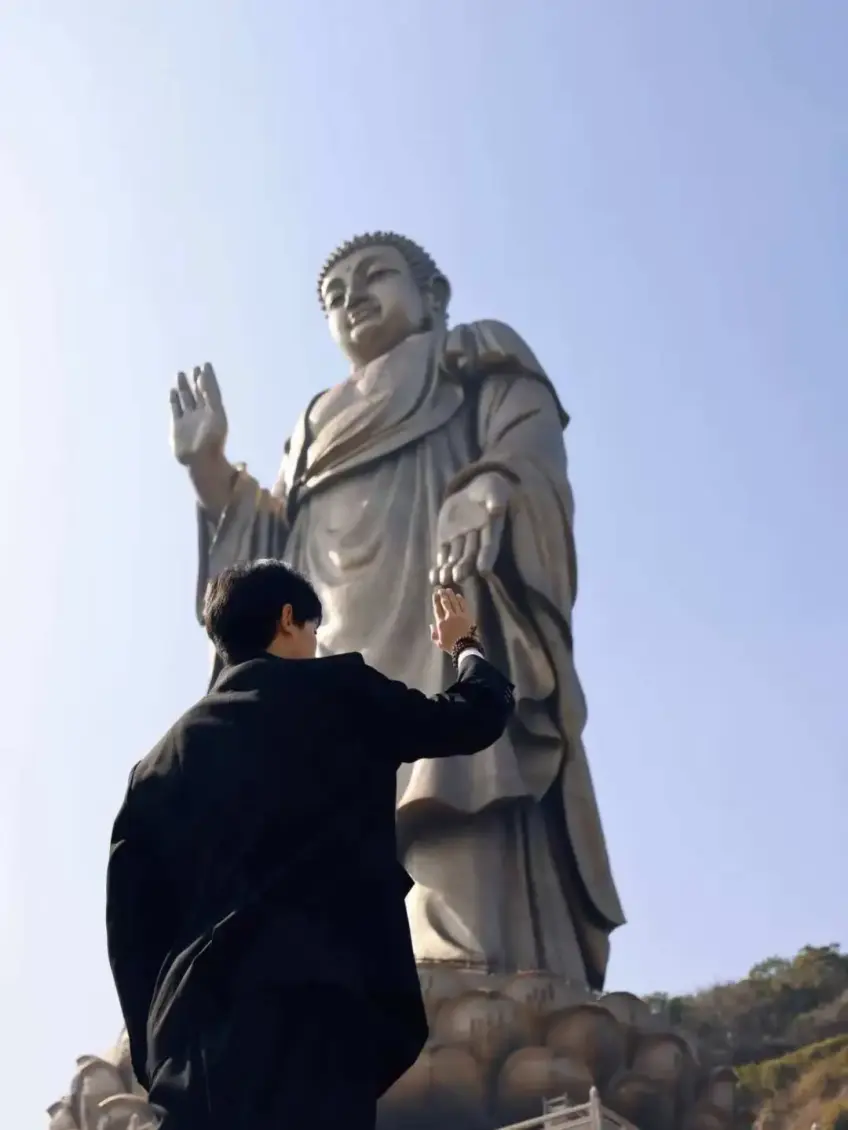
This is one of the most classic photo spots at Lingshan. Guides and visitors alike recommend snapping a picture here. Around 3 or 4 p.m., when the sunlight slants in, the small Buddha is bathed in gold while the giant Buddha behind it appears faintly against the sky—any casual shot looks great.
[Yuantou Scenery Day Tour] In-depth Wuxi tour of Lingshan, Lake Tai Yuantouzhu and Huishan Ancient Town
[Top Attractions] Yuantouzhu (Turtle Head Isle), Lingshan Grand Buddha, Huishan Ancient Town [Thoughtful Service] Custom vehicles and East China drivers with years of safe driving experience for a worry-free trip! [No Shopping Stops] No-shopping group tour for a pure travel experience—one trip, lifelong memories! [Free Bonus] One bottle of branded mineral water per person per day!
A glimpse through time from the steps of Lingshan
Leaving Xiangfu Temple and walking a little further, you reach the 218 steps leading up to the Grand Buddha.
Climb up and hug the Buddha's feet to pray for peace. There's a Chinese saying: "Never burn incense until trouble comes, then clutch the Buddha's feet."
Originally a playful proverb, it describes someone who never puts in the effort but scrambles for help at the last minute.
At Lingshan, this phrase loses any joking tone and takes on a beautiful meaning: whenever you choose to draw near, it is destiny.
After hugging the Buddha's feet, turn around and the entire Lingshan Scenic Area unfolds before you.
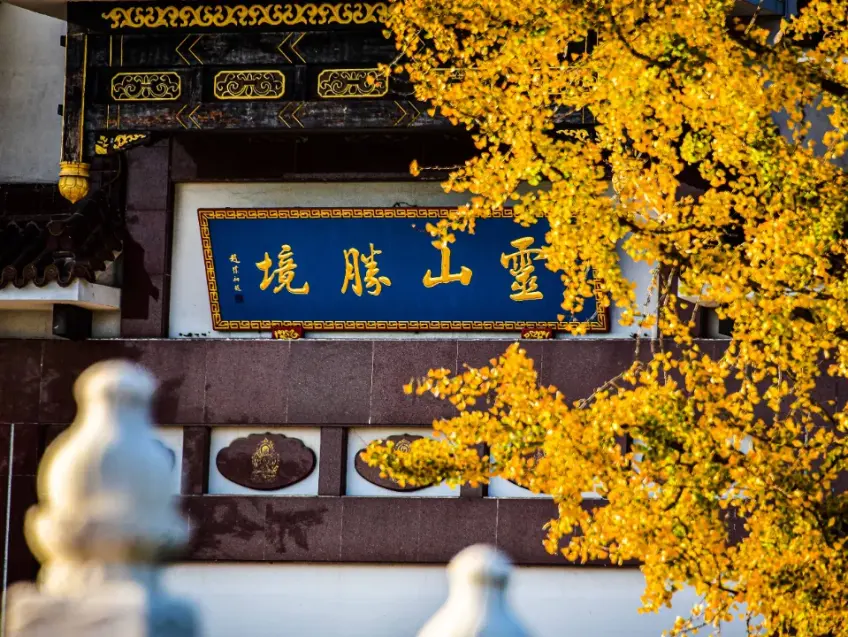
What really stays with you at this point of the route may not be the gilded halls, but the 1,300-year-old ginkgo tree in the courtyard and its silent witness to time. Perhaps that's the true meaning of a "thousand-year-old temple"—not the brand-new buildings, but these things that are still alive.
How to make the most of your Lingshan visit
To be honest, if you just wander around Lingshan on your own without taking much in, it's a real shame.
For example, you'd never guess that the 1,300-year-old ginkgo tree has ties to Master Xuanzang unless someone told you. What's the significance of washing your hands with water drawn from the octagonal well? What's the legend behind the White Lotus Pond? Why are the 218 steps of the Cloud Path divided into three sections? You really need someone to walk you through these details to appreciate them.
So if you're interested, feel free to contact me. A reliable guide can take you through the site at a relaxed pace with a well-planned route—it really makes the experience different.
If you don't want to rush through, hire a guide to learn about the ginkgo legends, the octagonal well, and Dengyun Path. Short on time? Choose a group tour that includes Lingshan. Use station transfers or a private car for arrivals and departures in Wuxi. To combine Lingshan, Nianhua Bay, and more into a multi-day trip, book a custom private trip. Just send your date, group size, and departure city to your travel consultant.