
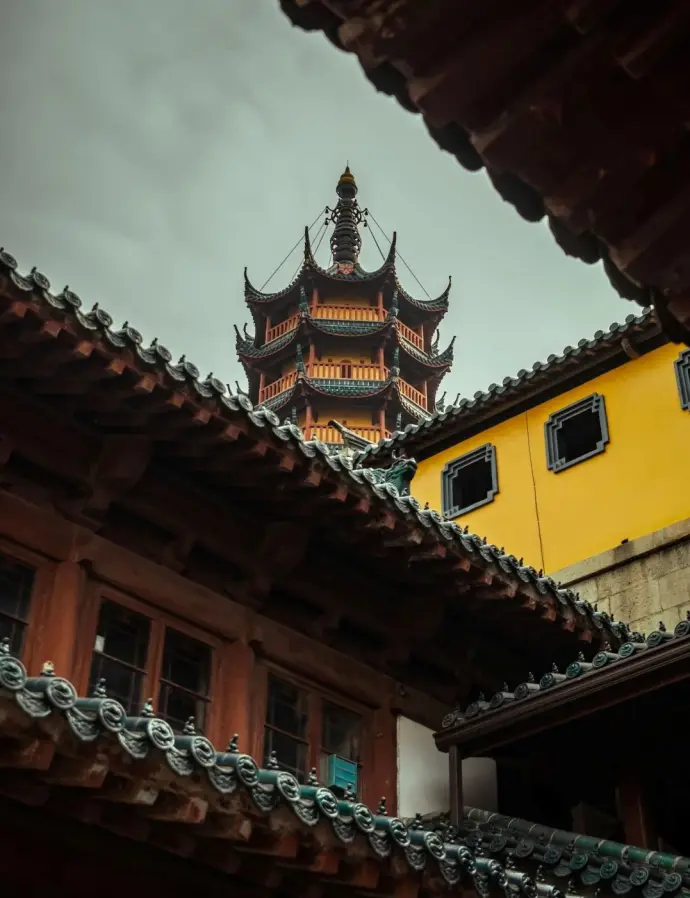
Jinshan Temple (金山寺) sits on Jinshan Hill in the northwest of Zhenjiang (镇江). It was first built in the Eastern Jin dynasty and took the name Jinshan Temple in the Tang dynasty. During his tour of the south, the Qing emperor Kangxi renamed it Jiangtian Chan Temple. This is the temple from the "flooding of Jinshan" episode in the Legend of the White Snake. Halls and pavilions climb the hill from bottom to top, so the temple seems to wrap the whole hill. At the summit stands Cishou Pagoda (慈寿塔), about 36 meters tall, with seven stories and eight sides. Fahai Cave and White Dragon Cave are also on the hill. Open daily 8 a.m.–5:30 p.m.
A short history of Jinshan Temple
In ancient times, Jinshan was a small island standing in the Yangtze River.

Jinshan Temple
Founded during the Eastern Jin Dynasty, Jinshan Temple is located in Zhenjiang, Jiangsu. Famous for the Lady White Snake legend of "Flooding Jinshan," it is one of the four great Chan Buddhist temples in China.Fahai, the founding master
During the Eastern Jin Dynasty, a monk built a thatched hut on the island to practice and founded a small temple called Zexin Temple. In the Tang Dynasty, Pei Toutuo—son of Tang Prime Minister Pei Xiu and better known as the famous Chan Master Fahai—arrived here. Seeing the temple in ruins, he burned his finger before the Buddha and vowed to rebuild it. During the restoration, gold was unearthed and reported to the court. Emperor Xuanzong of Tang was deeply moved when he learned the story, and ordered the gold returned to fund the temple's reconstruction, naming it Jinshan Temple. The name Jinshan Temple has been used ever since, and Chan Master Fahai is honored as its founding master.
The temple's golden age
In the Song dynasty, Jinshan Temple entered its golden age. While the eminent monk Foyin was abbot, the great writer Su Dongpo often came to talk about Chan with him, which gave rise to the well-known story of "the jade belt that guards the temple gate." That jade belt is still one of the temple's "Four Treasures." Jinshan Temple is also where the Water and Land Dharma Assembly began. According to the Song-dynasty text Shimen Zhengtong, Emperor Wu of Liang held one at Zexin Temple on Jinshan as early as 505 AD (the fourth year of the Tianjian era). It is regarded as the first such ceremony in Chinese Buddhist history, and it secured the temple's high standing in the Buddhist world.
During the Ming and Qing dynasties, Jinshan Temple was celebrated throughout the Chan Buddhist community for its genuine practice, housing tens of thousands of monks at its peak. During the Qing Dynasty, Emperor Kangxi traveled south to Zhenjiang and, seeing the river and sky merge into one color, personally bestowed the name "Jiangtian Chan Temple." However, people still commonly call it Jinshan Temple.
How the temple wraps the hill
Over the centuries, the temple expanded along the contours of the hill, gradually forming a unique layout.
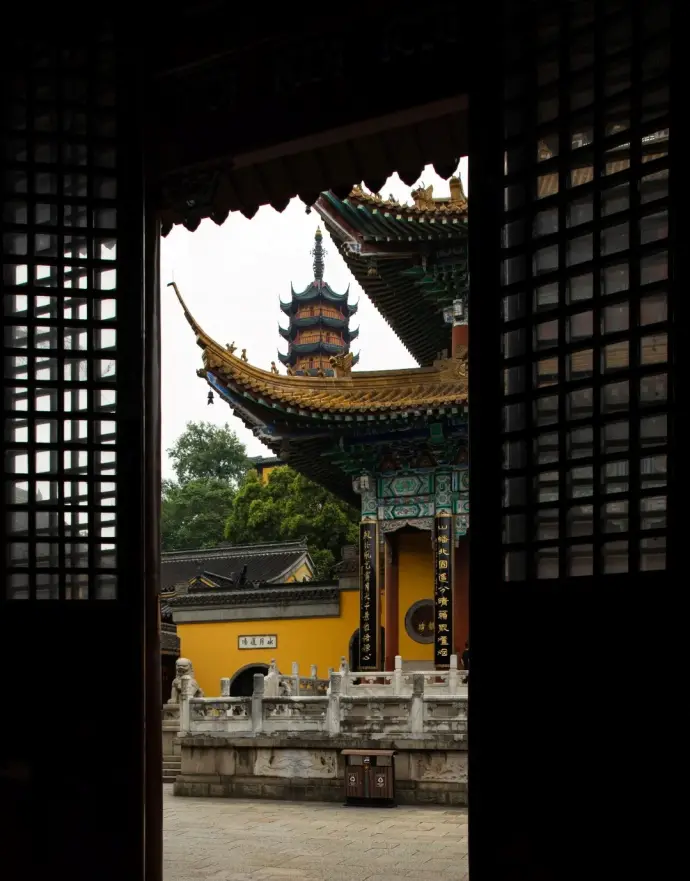
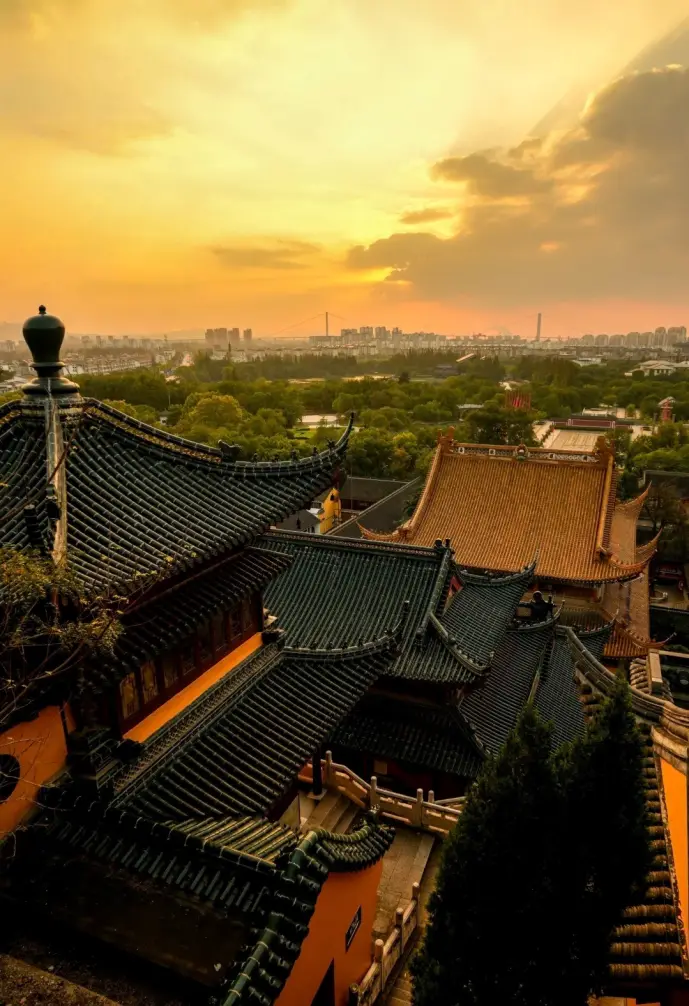
Built entirely along the slopes of Jinshan Hill, the temple features halls, pavilions, and towers linked one after another, with terraced staircases and connected verandas. From the foot to the summit, the buildings densely wrap around the entire hill. Whether viewed up close or from afar, you see the temple but not the hill—the two blend seamlessly into one.
Even more unusual, the mountain gate of Jinshan Temple faces west toward the Yangtze River, breaking with the traditional south-facing layout of Chinese temples. The buildings are cleverly connected by winding corridors, overhanging eaves and stone steps, creating a unique design where a pagoda rises above the halls, pavilions extend beyond the buildings, and kiosks nest inside the pavilions.
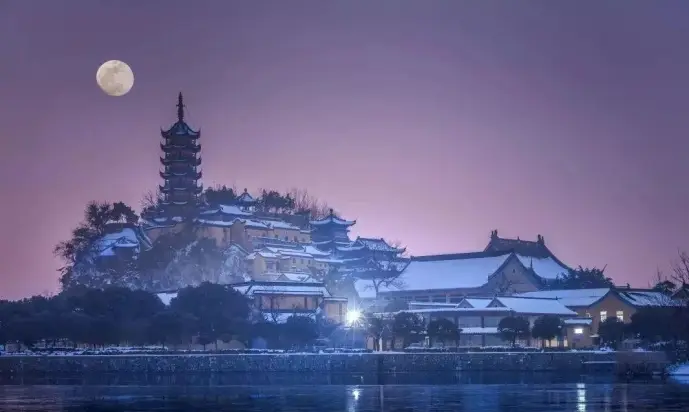
This distinctive style—"Jinshan Temple wraps the hill; you see the temple and the pagoda, but not the hill"—has made Jinshan Temple famous at home and abroad.
Poets, generals and the White Snake
For centuries, Jinshan Temple has drawn monks from all directions as well as countless poets and scholars. Fan Zhongyan, Ouyang Xiu, Wang Anshi, Shen Kuo, Su Dongpo, Mi Fu, Lu You and Tang Yin all left behind poems, calligraphy and paintings here. Those works have become timeless classics, leaving the temple with a living scroll of ink and color.
Folk legends grew up around the temple too. Liang Hongyu is said to have beaten the war drums here to rally the troops, keeping the Jin army trapped at Huangtiandang for 48 days. The story of General Yue Fei dreaming of "two dogs talking" and asking a Jinshan monk to interpret the dream is also set here. None of these stories can be proven, but they give the temple an air of mystery.
Yet the main reason Jinshan Temple is so widely known today is the legend of "the flood engulfing Jinshan" from the Legend of the White Snake. On the temple hill, you can still visit caves tied to the tale, such as Fahai Cave and White Dragon Cave.
What to see at Jinshan Temple
In the late Guangxu era, new sandbars formed around the islet, connecting the "Lotus in the River" to the south bank. Yet its signature look — a temple wrapping the hill — remains unchanged.
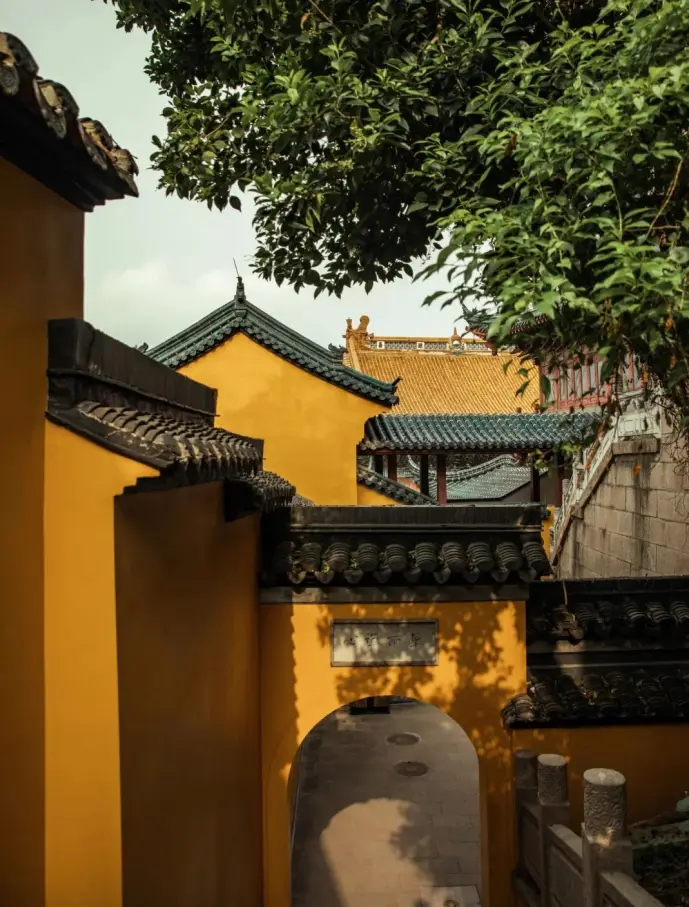
Yellow walls and dark tiles climb from the foot of the hill to the top, wrapping it like a huge monk's robe. As you climb the steps, one hall leads to the next, the corridors twist and turn, and each level opens a new view. The buildings are not separated by walls. Curved corridors, overhanging eaves and stone steps link them instead: a pagoda above a hall, a pavilion beside it, and a smaller pavilion within.
Cishou Pagoda
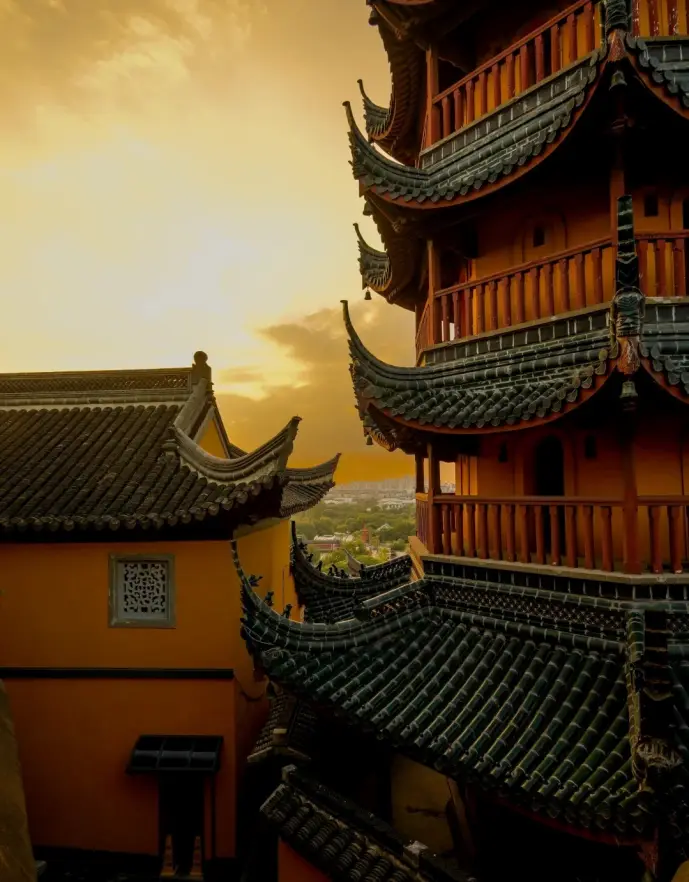
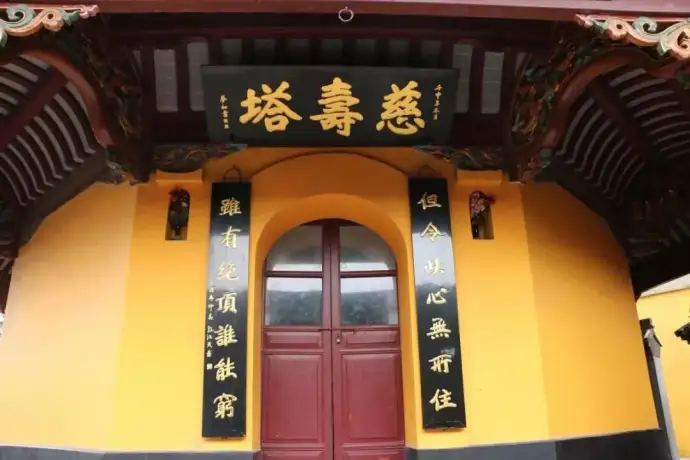
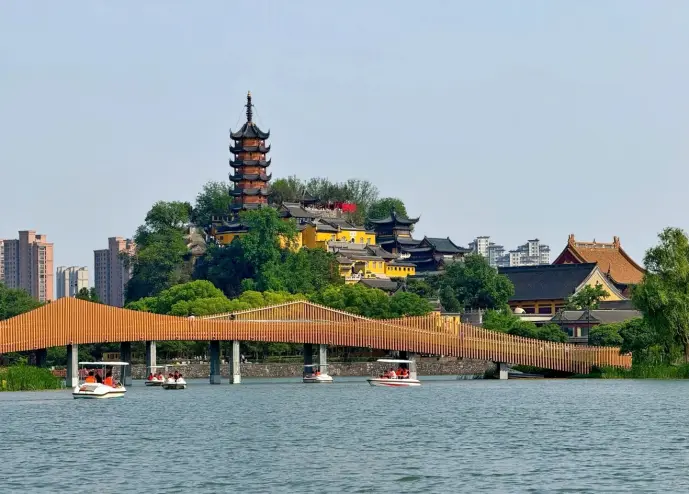
Cishou Pagoda is still the temple's centerpiece. It rises above several tiers of halls and terraces, about 36 meters tall, with seven stories and eight sides, built of brick and wood. From a distance its spire is the focal point of the whole hill. Legend says Su Dongpo wrote his poem "Shui Diao Ge Tou" here, and it is also said to be where Liang Hongyu beat the war drums at Jinshan. Next to the pagoda is Liuyun Pavilion, which still holds a stone tablet inscribed by Emperor Kangxi with the words "River and Sky at a Glance." The Mahavira Hall is as grand as ever, its stone steps worn by generations of worshippers.
Sutra Library
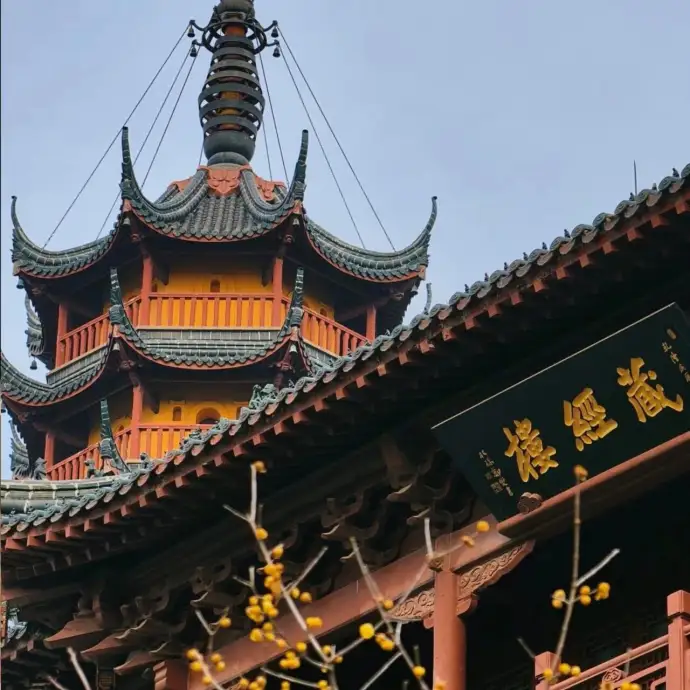
The Sutra Library sits at the highest point on the temple's central axis, blending into the hillside. It houses the Tripitaka—sutras, vinaya and shastras—accumulated over nearly 2,000 years since Buddhism arrived in China. The plaque reading "Sutra Library" is an original work by Zheng Banqiao, leader of the Eight Eccentrics of Yangzhou, who deliberately left out one stroke in the character for "cang" (to store), implying that "the sutras are endless and the dharma is boundless."
Fahai Cave
Fahai Cave and White Dragon Cave are carved into the hillside and connected to the pavilions above. Here, legend and reality meet in a remarkable way.
To this day, the hill remains the same hill and the temple the same temple. Even though the river later changed course and dynasties rose and fell, this unique look of "the temple wrapping the hill" has stayed unchanged for a thousand years.
Seen from afar across the river, Jinshan Temple looks like a Buddhist palace floating in midair.
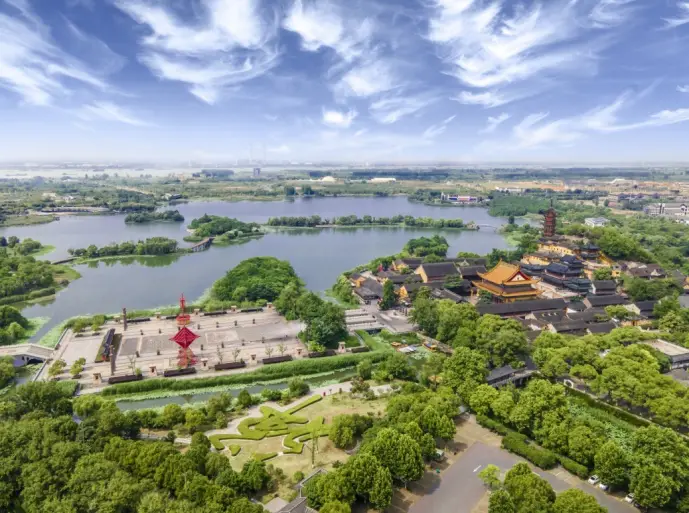
Mornings, evenings and temple activities
Come early in the morning and you may find Jinshan still in mist. Damp air drifts in off the river and through the corridors, and the whole temple seems to be just waking up. The tap of the monks' wooden fish, a hollow wooden percussion block, sounds from deep inside the halls and deepens the quiet.
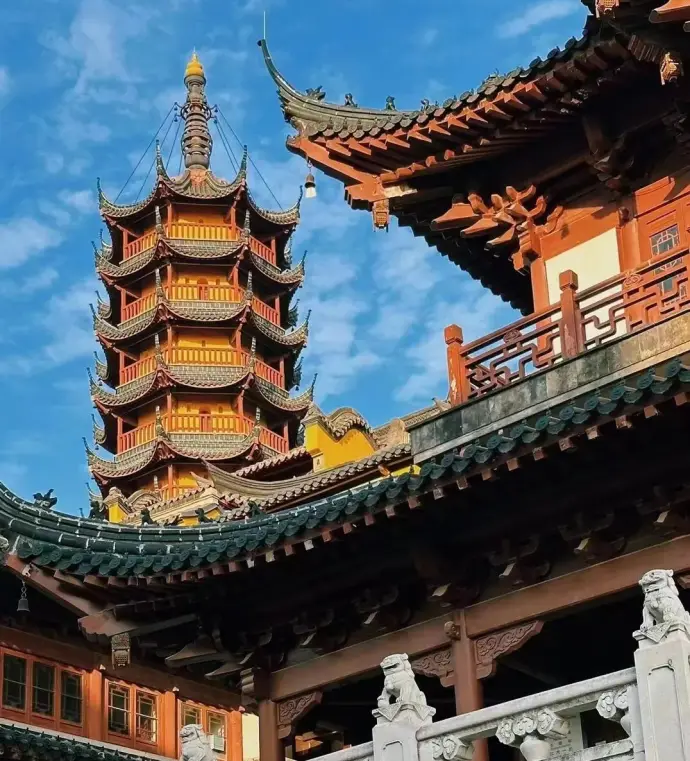
If you come in the evening, you can see Jinshan Hill bathed in the setting sun. The afterglow falls on the yellow walls, dyeing the whole hill a warm gold. Looking out from the hilltop, you will see the sun slowly sinking into the river while the evening bell echoes through the dusk, as if this ancient temple were all that remained between heaven and earth.
If you come during a holiday, you'll find Jinshan alive with incense smoke. Devotees travel here from across the country, and clouds of incense swirl in front of the Mahavira Hall from morning till night. Chanting, prayers, and wind chimes blend together, giving the temple another kind of vibrant energy.
On New Year's Eve the temple is busy. Lanterns hang along Zexinfang Street, and stalls selling blessing souvenirs and traditional handicrafts line the main path. You can pick out a lucky keepsake or collect a printed "fu" (good fortune) character, while costumed dance performances run one after another until midnight.
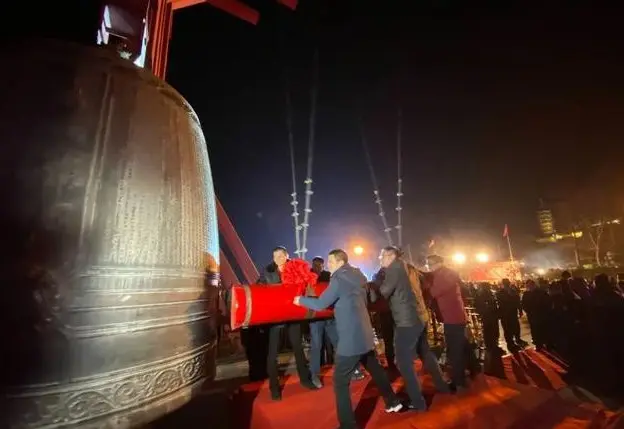
At Jinshan, people don't count down to the New Year. They "wait for the bell." Near midnight, monks take the stage in the Buddhist Square and strike the great bell 108 times. The number comes from the Buddhist idea that people have 108 afflictions, and each strike clears one away. It is also the sum of the year's 12 months, 24 solar terms and 72 five-day periods. The temple still keeps a Qing-dynasty woodblock of the bell-ringing rites.
Meanwhile, Jinshan Temple also regularly hosts activities such as seated meditation and sutra copying.
Seated meditation is usually held early in the morning or at dusk. You follow the monks into the meditation hall and sit quietly on a cushion.
Sutra copying takes place in the scripture hall below the Sutra Library. A sheet printed with the Heart Sutra lies on the desk, and pine-soot ink is ground on the inkstone. You copy it stroke by stroke, character by character. The Heart Sutra has only 260 characters, but finishing it often takes about two hours.
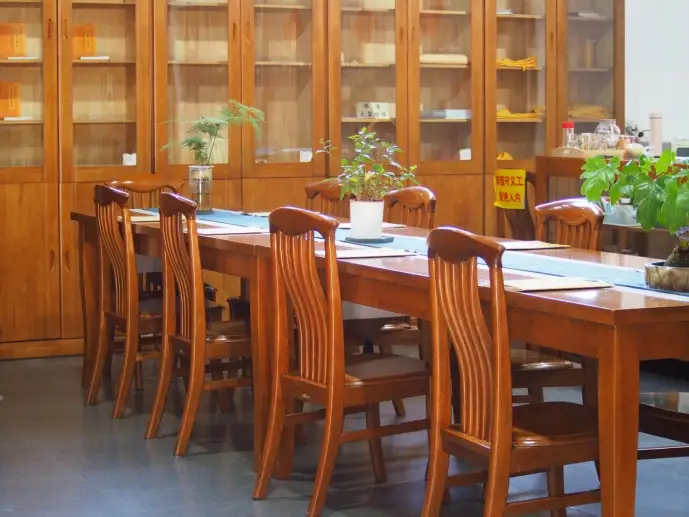
At Jinshan Temple, practice is not only for monks. Anyone can take part. No background in Buddhism is needed; just come with a quiet mind.
Jinshan Temple is less a temple than a scripture full of legends. Whenever you come, it is here: flowers in spring, rain in summer, the moon in autumn, snow in winter. It has been waiting 1,600 years for the day you visit.
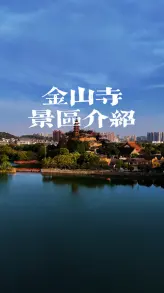
Of course, when you visit, there's no need to ask whether the "flooding of Jinshan" really happened, or to investigate who Fahai actually was. Just stand beneath Cishou Pagoda for a moment, and its thousand-year-old Zen spirit will settle in your heart.
Tickets, hours and getting there
Jinshan Temple is a national 5A tourist attraction, China's highest rating for scenic sites. You need a ticket to enter (check the official site for the current price), and you have to buy a new one to re-enter, so plan to see everything in one visit. Take the high-speed train to Zhenjiang Station (镇江站). From there it's a 15-minute taxi ride, or bus No. 2 goes straight to the temple.
Opening hours: daily 8 a.m.–5:30 p.m. (ticket sales and entry end at 4:30 p.m.; Jiangtian Chan Temple closes at 5 p.m.)
Classic route: Mountain Gate → Mahavira Hall → Fahai Cave → White Dragon Cave → Cishou Pagoda → Liuyun Pavilion → Zhongling Spring. This covers the temple's main sights and highlights.
Temple etiquette
1. Jinshan Temple is a Buddhist site, so please dress modestly. Avoid shorts, tank tops, low-cut tops, or other revealing clothing. Plain colors or Chinese-style attire are recommended.
2. Respect the religious site by not touching Buddha statues or ritual objects. It's recommended to wash your hands before entering the halls as a sign of reverence. Photography is prohibited inside the halls, especially near the Buddha statues.
3. Free incense is available inside Jinshan Temple. Please burn incense only in designated areas and follow the temple's rules. Do not buy or burn incense outside these areas.
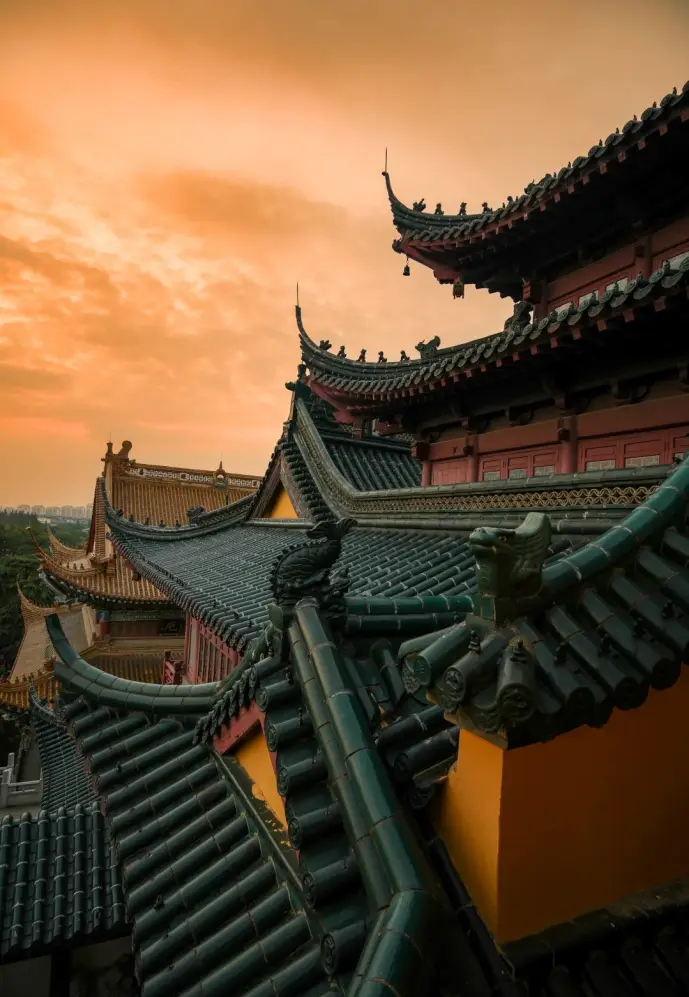
Photo spots at Jinshan Temple
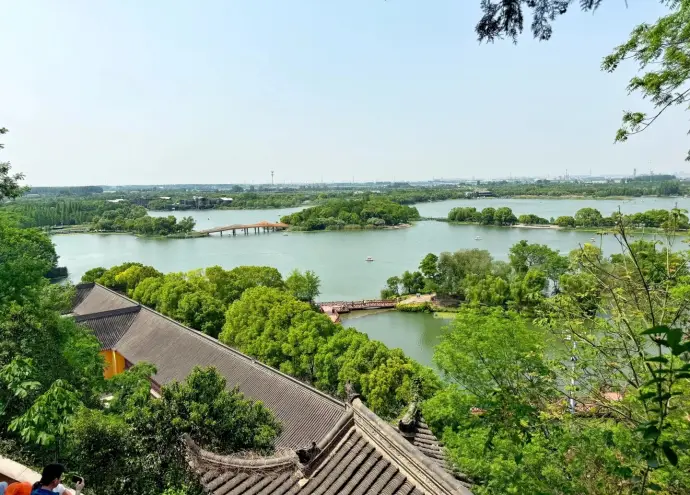
1. Cishou Pagoda: Whether you can climb it depends on conditions on site. From the base of the pagoda and around Liuyun Pavilion, you can look out over Jinshan Lake. The archway on the ground floor frames great shots of the boats on Jinshan Lake.
2. White Dragon Cave: the legendary site where Bai Suzhen battled Fahai. Dappled light filters through the rock crevices, making it a great spot for traditional-style photos.
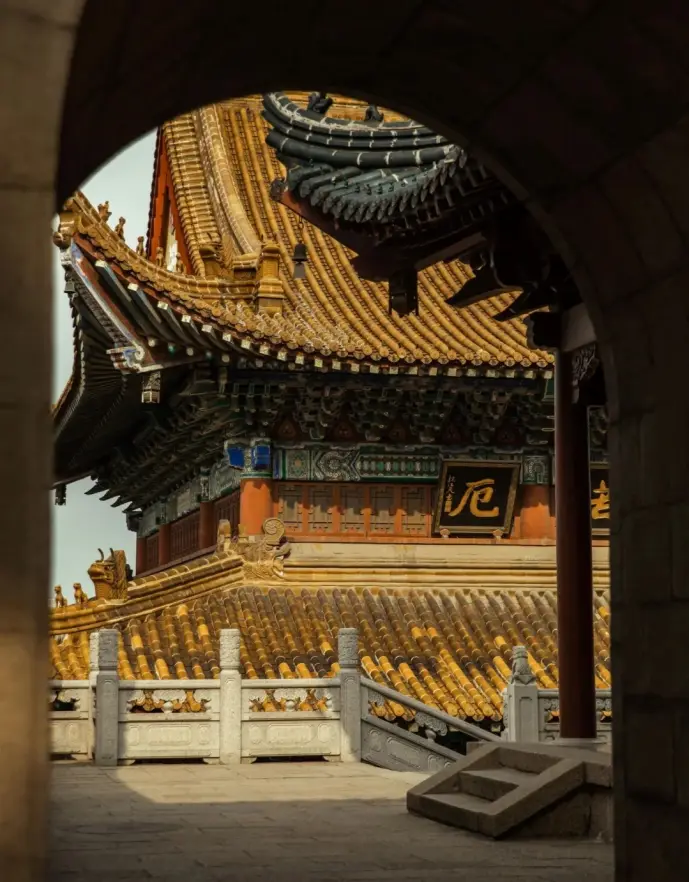
3. Mahavira Hall: the red walls and golden tiles look great against a blue sky on clear days.
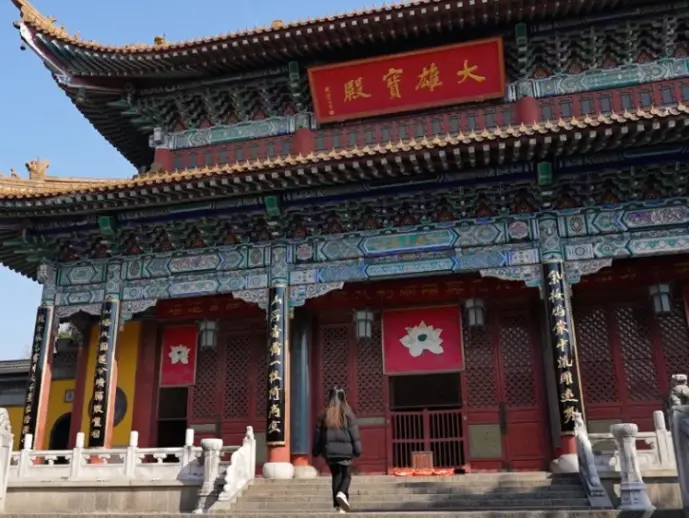
4. Top floor of Xiyang Pavilion: wide-open views let you frame the Yangtze River, the temple and the city in a single shot.
5. Imperial Wharf waterfront platform: mist often rises off the water at sunrise, and at low tide you can photograph the temple's reflection.
Blessing customs at the temple
Gold sweeping
1. Gold sweeping: before entering the temple, pick up a "fu" (good fortune) sticker at the Jinshan Fu stand, stamp it with the gold seal, then brush gold powder over it.
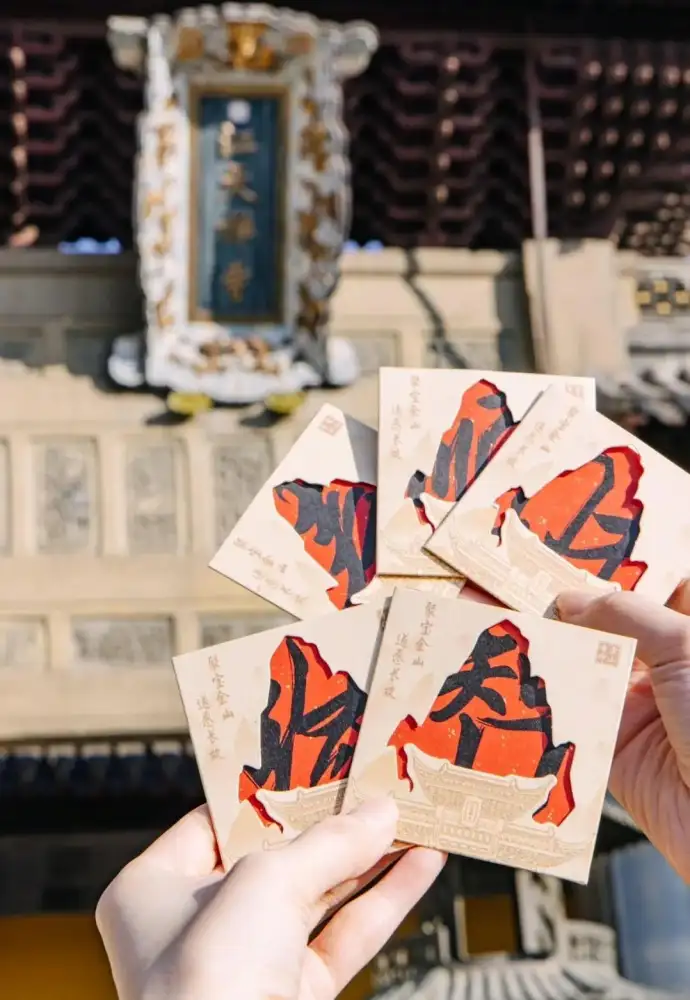
Golden character wish cards
2. Golden character wish cards: A unique prayer souvenir introduced by Jinshan Temple in recent years, featuring auspicious Chinese characters like "Fu" (fortune), "Lu" (prosperity), "Shou" (longevity), "Xi" (joy), "Cai" (wealth), "Yuan" (destiny), "Hui" (wisdom) and "Shun" (smooth sailing) in various calligraphy styles. Each card is foil-stamped and decorated with motifs of the temple's iconic Cishou Pagoda, auspicious clouds and lotus flowers. More importantly, each character carries its own meaning. Choose the one that best matches your wish and take it home.
If you'd rather not work out hours, tickets and the route up the hill yourself, book a Zhenjiang day tour that includes Jinshan Temple. A guide explains everything along the way, and transport and hotels are arranged for you.
Jinshan Temple has 1,600 years of history. If you just wander around on your own, it is nothing more than yellow walls, dark tiles, and a few halls and pavilions. But with a professional guide beside you, everything comes alive. At Fahai Cave, they will tell you how the monk Pei Toutuo burned his finger to make a vow and dug up gold to build the temple. At the foot of Cishou Pagoda, they will point out where the imperial stele inscribed with "A sweeping view of river and sky" once stood. In front of the Mahavira Hall, they will explain how Su Dongpo's jade belt became one of the "four treasures of the hill."
Zhenjiang private day tour | Jinshan Temple, Beigu Mountain and Xijin Ferry
Pickup and drop-off at Zhenjiang Railway Station. Spend the day visiting Jinshan Temple, Beigu Mountain and Xijin Ferry Old Street. All three are in the city center, so the pace is relaxed. This private tour is just for your group and includes a vehicle, guide and admission tickets. An English-speaking guide is available on request — feel free to ask about dates.
Then there are the stories hidden within those yellow walls and dark tiles—the drumbeats of Liang Hongyu rallying troops at Jinshan seem to still echo across the river; the legend of Yue Fei interpreting his dream at Jinshan Temple lingers in the wind; and the love and heartbreak of the White Snake and Xu Xian feel close enough to touch when brought to life by your guide.
Beyond Jinshan Temple, this day tour also takes you to Xijindu—an ancient street where you can "see a thousand years at a glance"—to taste pot-lid noodles, one of Zhenjiang's "Three Oddities," and to learn about the brewing craft of Zhenjiang vinegar. In a single day, you'll journey from an ancient temple to everyday local life, from historical legends to authentic flavors. It's a full itinerary, yet perfectly relaxed.
FAQs
How do I get to Jinshan Temple in Zhenjiang?
Take a high-speed train to Zhenjiang Station, then a taxi (about 15 minutes) or bus No. 2 straight to the temple. Jinshan Temple is a 5A-rated site, and the classic route starts at the Mountain Gate and climbs all the way to Cishou Pagoda.
What are the opening hours and ticket prices for Jinshan Temple in Zhenjiang?
Jinshan Temple is open daily 8 a.m.–5:30 p.m. Ticket sales and entry end at 4:30 p.m., and Jiangtian Chan Temple closes at 5 p.m. You need a ticket to enter; check the official site for the current price. Re-entry requires a new ticket, so plan to see everything in one visit.
What's the best route for visiting Jinshan Temple in Zhenjiang?
The classic Jinshan Temple route starts at the Mountain Gate, then the Mahavira Hall, Fahai Cave, White Dragon Cave, Cishou Pagoda and Liuyun Pavilion, ending at Zhongling Spring. The 36-meter-tall Cishou Pagoda has seven stories and eight sides, and from the Liuyun Pavilion area beside it you can look out over the Yangtze River and Jinshan Lake (whether the pagoda is open for climbing depends on conditions on site).
What's the connection between Jinshan Temple and "Legend of the White Snake"?
Jinshan Temple is the temple in the "flooding of Jinshan" episode of the Legend of the White Snake, though there's no way to prove the story. Caves linked to the legend, including Fahai Cave and White Dragon Cave, are still on the hill. White Dragon Cave is said to be where Bai Suzhen fought the monk Fahai.
What unique experiences does Jinshan Temple in Zhenjiang offer?
On New Year's Eve the temple bell is struck 108 times, with stalls selling blessing souvenirs and traditional crafts, and costumed dance performances. During the year the temple also holds regular meditation and sutra-copying sessions, and no Buddhist background is needed. Before entering, you can pick up a "fu" sticker to try gold sweeping, or choose a golden character wish card.