
Understand the price table columns before requesting a quote
People searching for "Jiaxing car rental with driver" or "Jiaxing private car" usually don't want a rigid flat rate found online. They want to know how to read a price table: how vehicle types and seats match passenger and luggage counts, how half-day, full-day, and mileage limits work, when overtime and waiting charges kick in, who pays highway tolls and parking, and whether the driver's meal allowance and overnight stays cost extra. This article only covers verifiable pricing factors and what to ask — we won't make up unpublished fixed rates. Final numbers depend on the confirmation letter from your travel consultant. We'll first break down the cost structure of renting a car with a driver, then compare the forms for guided commentary, group tours, short transfers, and custom itineraries, so you don't end up mixing transport, guide, and tour fees into one confusing bill.
Unlike its companion piece "How Tour Guide Fees Are Calculated," this article assumes you already know whether you're heading to Nanhu Lake, Yuehe, Xitang or Wuzhen. Here the focus shifts to "how to negotiate the car." Quotes usually list several items—vehicle type and seat count, hours or mileage package, pickup/drop-off points and stops, waiting time and overtime, tolls and parking, plus night and holiday rules. If someone says it's "all included" verbally but doesn't spell out the limits, disputes on the day are almost guaranteed. For point-to-point private rides, start with private car; if it's your first time hearing about Nanhu Lake's history or the layout of the old towns, add a separate guide; if coordinating feels like too much work, compare a Jiaxing-bound group tour; for door-to-door station transfers use station transfer; for trips of two days or more, or if you plan to change the route on the fly, go with custom travel.
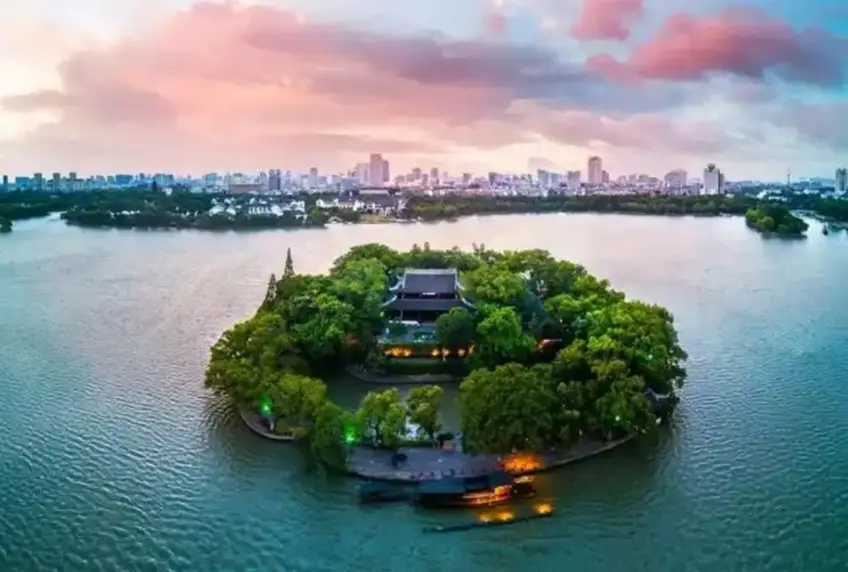
Panoramic dusk view of Lake Island on Nanhu Lake in Jiaxing, with the island and the Red Boat on the shore in the same frame. This is the core area of Nanhu Lake in Jiaxing—do not confuse it with Three Pools Mirroring the Moon on West Lake or lake islands elsewhere.
Choosing vehicle type, seats and luggage space
For a full or half day in Jiaxing city, seats and trunk space matter more than a luxury badge. A 7-seat minivan usually works for a family of three or four; for six or more people—or carry-ons plus a stroller plus camera cases—look at a larger-cabin minivan so the back row isn't crammed into fold-down jump seats. Vehicle photos are illustrations to help you understand doors and seating layouts; they don't guarantee that exact exterior model on the day. The confirmed booking document determines the actual vehicle.
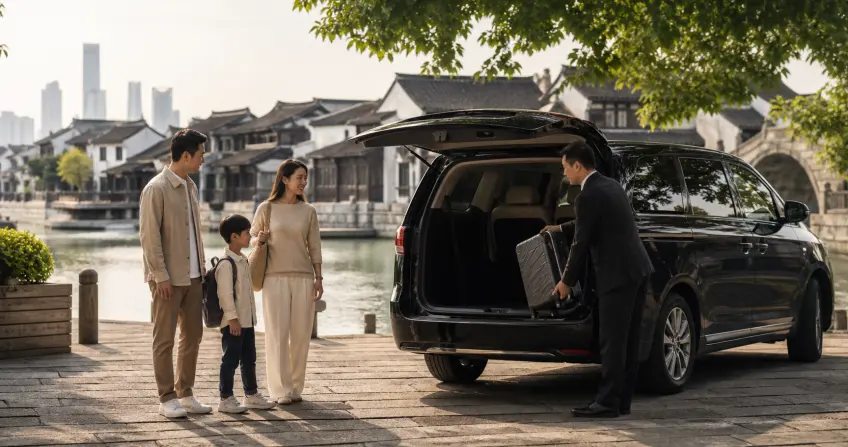
This illustration shows a driver-guide helping a family load luggage by a water town canal. It represents the feel of our private car boarding service and should not be presented as verified photos of the day's fleet.
If you're traveling with young children, state in advance whether you need a child safety seat, including its orientation and the age group; don't assume drivers carry multiple sizes. Older travelers care more about step height and rest breaks: on the road between Nanhu Lake and Xitang, or Xitang and Wuzhen, schedule short stops rather than pushing nonstop just to hit every spot. For business trips requiring front/rear privacy or quiet intercom communication, note this when requesting a quote so dispatch can match the right vehicle.
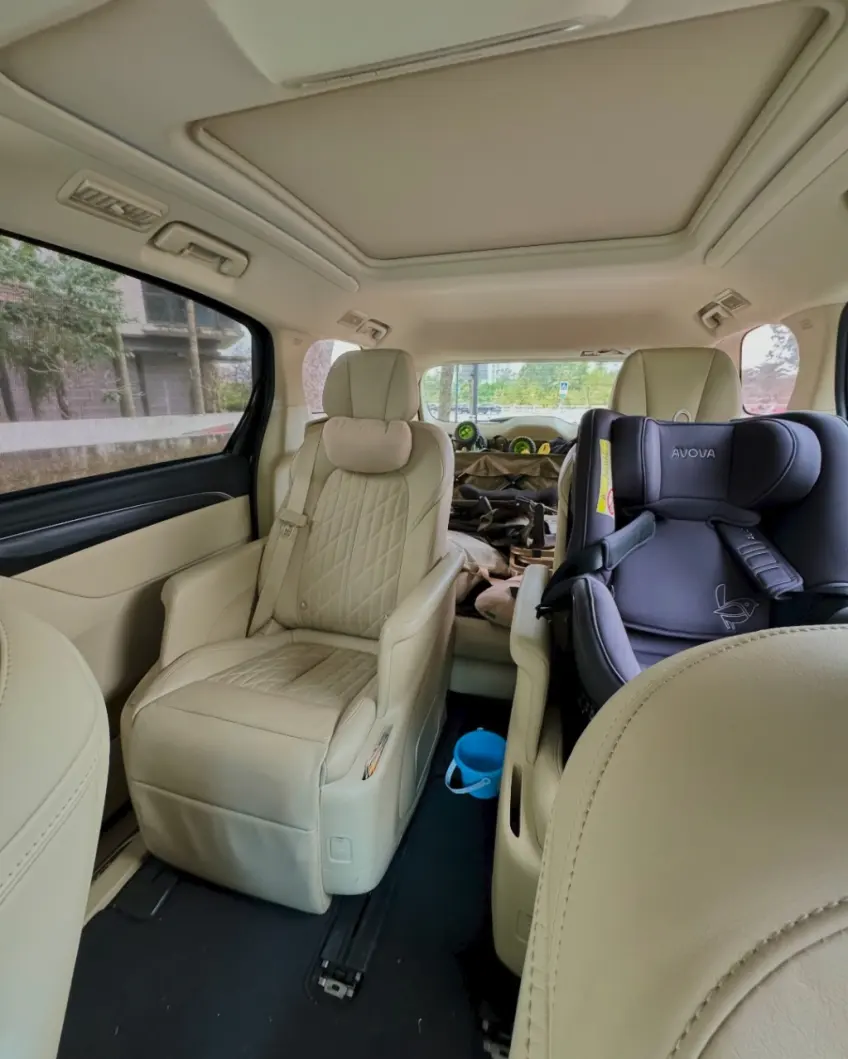
This illustration shows a minivan cabin with a child seat, where the middle row displays a child safety seat and luggage space. It represents a typical family private car layout and should not be presented as proof of a specific brand's actual vehicle.
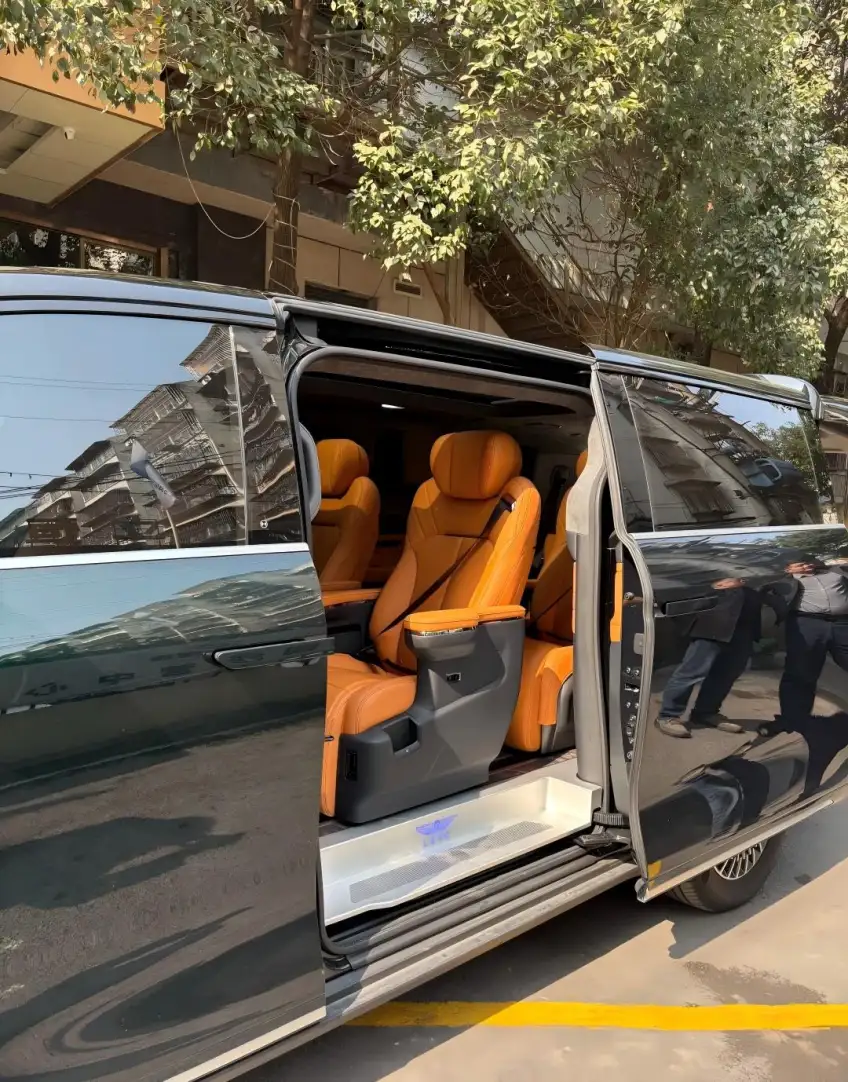
Minivan with sliding door open showing the orange cabin. This illustrates the cabin type for intercity or local private car service. Do not present it as a verified photo of that day's fleet.
One more tip: your confirmation should ideally include four items—vehicle class or seat count, luggage limit, whether a child seat is included, and whether vehicle swaps are allowed. If any item is missing, ask again. A casual WeChat promise like "about seven seats" often leads to complaints when you arrive and get a tighter vehicle—always go by the vehicle class confirmed in the system.
Half-day vs full-day mileage and overtime waiting
Billing is most commonly split into half-day and full-day, and some plans add "X kilometers included, extra charged per kilometer." A half-day usually covers one main stop plus transfer time—about three to four hours of actual use—for example, hotel → Nanhu Lake entrance → back to hotel. A full-day covers two areas including transfers, such as Nanhu Lake in the morning and Xitang in the afternoon. Whether you also visit Wuzhen East Gate at dusk must be clarified separately; don't assume it's bundled into the same full-day rate. A verbal "roughly half a day" often gets re-billed as a full day if it spans lunchtime, security checks, or peak ticket lines at the water towns—when requesting a quote, always specify start and end times and the meeting point.
For overtime charges, be sure to clarify the billing unit: is it charged by the hour, bumped up to a half-day block, or does it kick in after 30 minutes? Queuing for the island at Nanhu Lake, crowds along the covered corridors and Shipi Lane in Xitang, and ticket checks at Wuzhen East Gate can all extend the time the car waits outside. Writing an "allowed delay buffer" and "whether overtime includes driver waiting" into the notes is much cleaner than haggling afterward. If a night activity like Yuehe lantern views or a Wuzhen night tour follows a daytime route, it's usually billed as separate working hours—don't assume it's included in the daytime full-day rate.
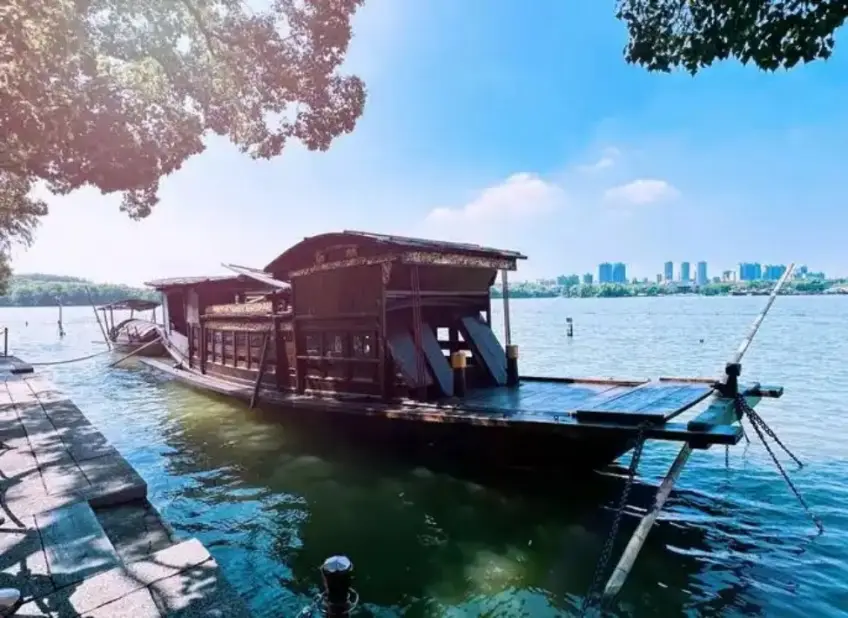
The Red Boat moored at Nanhu Lake with a distant lake view. This shows the Red Boat and the lake together, representing the experience at Nanhu Lake in Jiaxing. Do not present it as proof of a replica boat elsewhere.
When booking a mileage-based private car, pay attention to the "starting point": does the meter start when the driver leaves the garage empty, or when you get in the car? Is the empty return trip included? Trips from Jiaxing Station or Jiaxing South Station to downtown Nanhu Lake are usually short, while routes to Xitang or Wuzhen add significant distance. Writing out the full hotel name or scenic area entrance is much clearer than just saying "Jiaxing day tour." Group size also matters: a family of four and a business group of ten require different vehicle classes. Specify the number of children and seniors so the driver can plan a slower pace and more rest stops.
During holidays and long weekends, ancient towns get crowded. When schedules are tight, drivers may require prepayment or a minimum booking duration—always follow the confirmation letter. This article doesn't list fixed prices. If you visit Nanhu Lake in the morning and rush to Xitang the same day, the transfer time counts toward the full day. Don't simply add two half-days together and ask for a discount—the math for combining trips differs from a packaged full-day rate. Request separate quotes when inquiring for clarity.
Who pays for tolls and parking?
When requesting a quote, clarify three things: "Are tolls included in the price?", "Who pays for parking at scenic areas or hotels?", and "How are receipts issued for expenses paid on my behalf?" For short shuttles between Nanhu Lake and Yuehe in Jiaxing city, highway tolls are minimal or nonexistent. But for trips from Nanhu Lake to Xitang, Xitang to Wuzhen, or picking up guests coming from Shanghai into Jiaxing, highway and road tolls are common. A verbal "all-inclusive" that doesn't mention tolls often leads to disputes when you're billed for actual costs later—check either "included" or "billed separately based on actual cost" on your confirmation letter.
Parking: Rules for lots around Nanhu Lake and outside the ancient towns, guest access lanes, and short-term parking limits depend on the day's conditions. Drivers can help with drop-offs and circle while waiting, but they won't cover your fines or overtime parking fees. Core areas of Xitang and Wuzhen are mostly closed to traffic or have time limits, so the usual routine is "drop off outside → guests walk into town → pick up outside at an agreed time." Note the drop-off and pick-up points in advance—it saves far more hassle than searching for your car once you reach Shipi Lane.
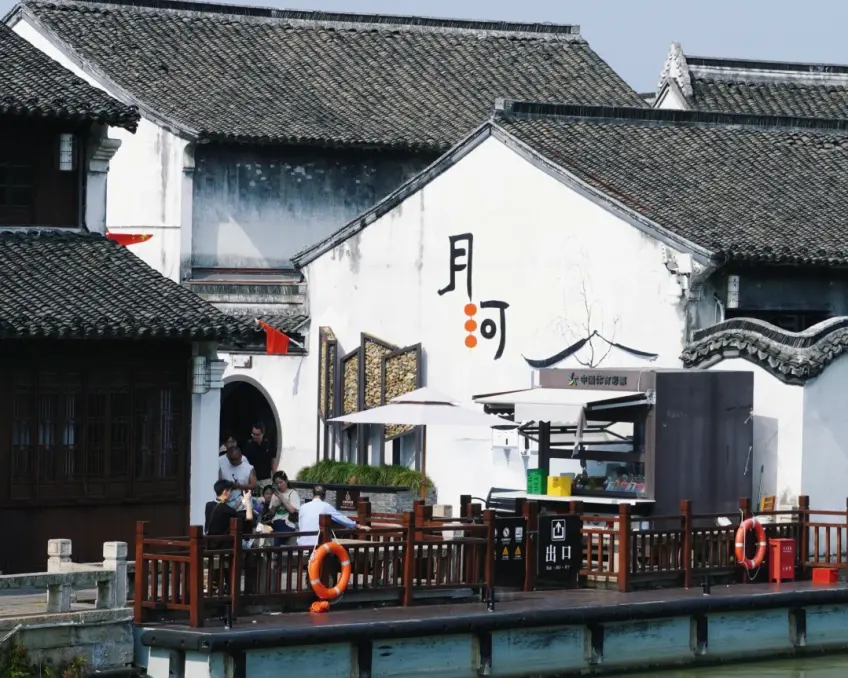
The Yuehe white-wall inscription by the waterfront: the "Yuehe" characters on the white wall framed with the waterfront belong to Jiaxing's Yuehe Historic District. Do not mistake it for Shantang Street in Suzhou or the Zhouzhuang inscription wall.
Driver meal allowance and midday waits: Full-day bookings usually specify whether a meal allowance is included or if guests need to arrange a simple meal for the driver. Don't assume that buying the driver lunch equals a free half-day extension. Point-to-point shuttles from Jiaxing Station or Jiaxing South Station don't fall under full-day private car service. Book them separately via station transfers, and don't try to squeeze shuttle hours into a half-day private car booking.
If you need invoices for business reimbursement, state upfront what the invoice title should be and whether it can be issued under transportation or tourism services. Also ask whether receipts for tolls and parking paid on your behalf can be grouped under the same confirmation letter. This article won't invent tax rates or fixed tax-inclusive prices—just remember to write "tax and invoice included" in your confirmation details.
How to combine Nanhu Lake, Xitang and Wuzhen
Common itineraries in this city: Nanhu Lake's Heart Island and the Red Boat in the morning, then Xitang's covered corridors and water lanes in the afternoon; or half a day in Xitang plus half a day in Wuzhen's East Scenic Zone. Yuehe Historic District is best for a short evening stop when the lanterns are lit—don't cram it into a full-day deep dive of two major ancient towns without leaving any buffer time. The advantage of a private car service is that you can change departure times and stops, but changing stops doesn't mean unlimited additions—every extra stop means recalculating travel and waiting time.
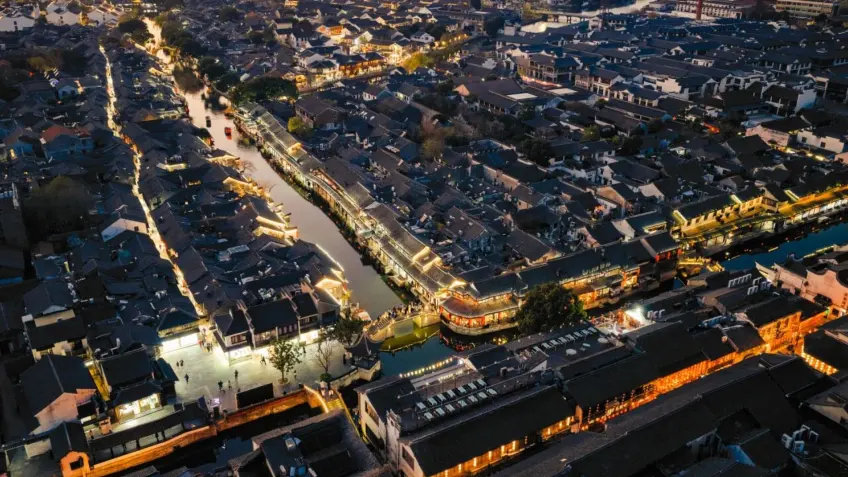
An aerial panorama of the water town of Xitang Ancient Town, showing water lanes and rooftops in the same frame. This reflects the overall layout of Xitang Ancient Town—don't use it as proof of an aerial shot of Zhouzhuang or Tongli.
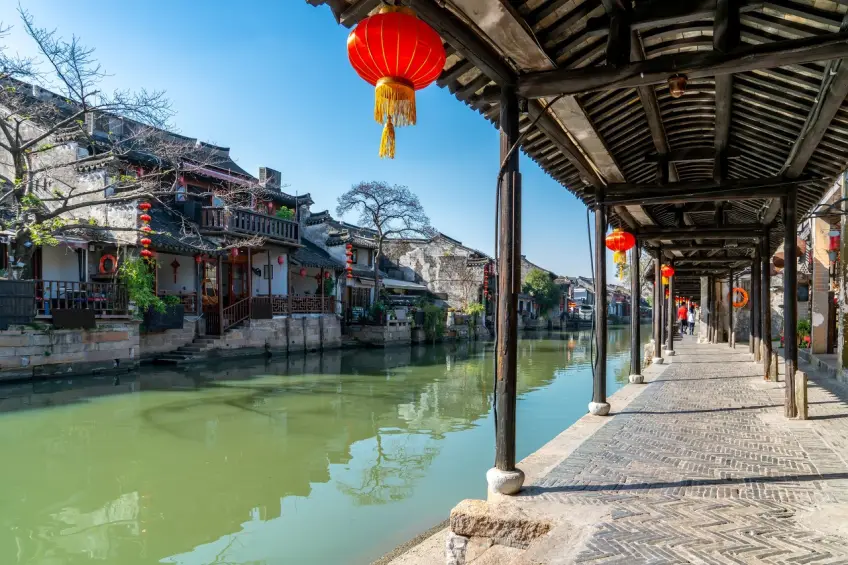
A panoramic view of red lanterns along the Misty Rain Corridor in Xitang, with the corridor, lanterns and canal in the same frame. This belongs to Xitang's Misty Rain Corridor—don't use it as proof of covered corridors and red lanterns elsewhere.
The stone paths in Xitang get slippery, and the bridges in Wuzhen get crowded, so groups with older travelers may choose to shorten the evening tour—be sure to ask whether dropping a stop means a partial refund or just waiting outside the area. Whether Xitang and Wuzhen use combo tickets or separate tickets, changes in ticket type can affect how long you stay, potentially blurring the line between a half-day and a full-day tour. Asking in advance saves more hassle than adding time on the spot.
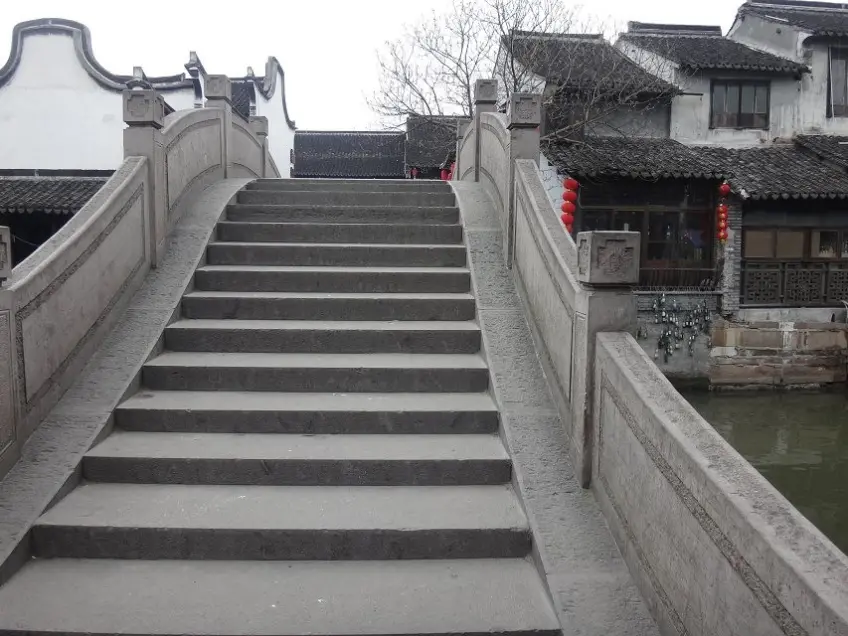
A panorama of stone bridge steps and white walls in Xitang, with wide stone bridge steps and white walls with red lanterns in the same frame. This is a bridge scene from Xitang Ancient Town—don't use it as proof of the Twin Bridges in Zhouzhuang or the arch bridges in Nanxun.
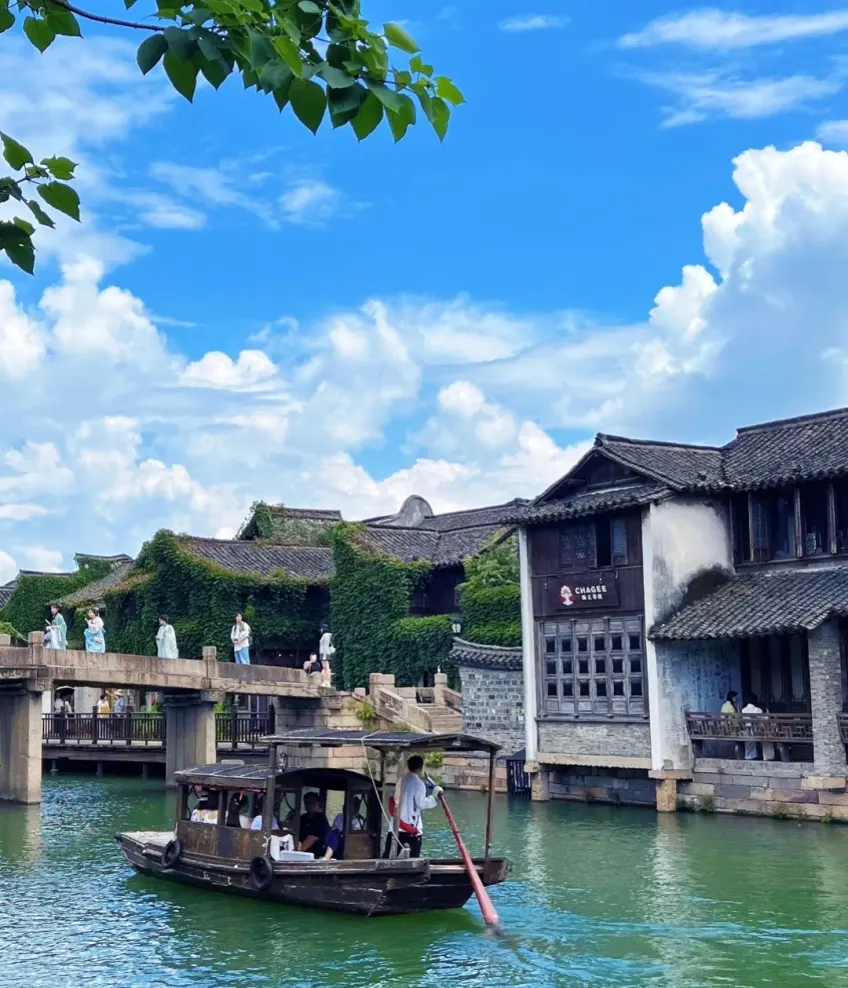
Illustration of a boat passing under a covered bridge on a Wuzhen river, with a black-awning boat and stone bridge in the same frame. This shows the vertical perspective of the Wuzhen water town; do not use it as proof for vertical images of other water towns.
Wuzhen Dongzha (East Scenic Zone) works well as a main stop for an in-depth half-day or full day. If you only want to snap photos at the gate walls, there's no need to book a car for a separate half day. The white walls and waterways along the Dongzha riverbank are great for photo stops, but cars usually park on the outskirts. List "15 minutes for photos" and "1 hour for guided commentary" separately in your itinerary notes.
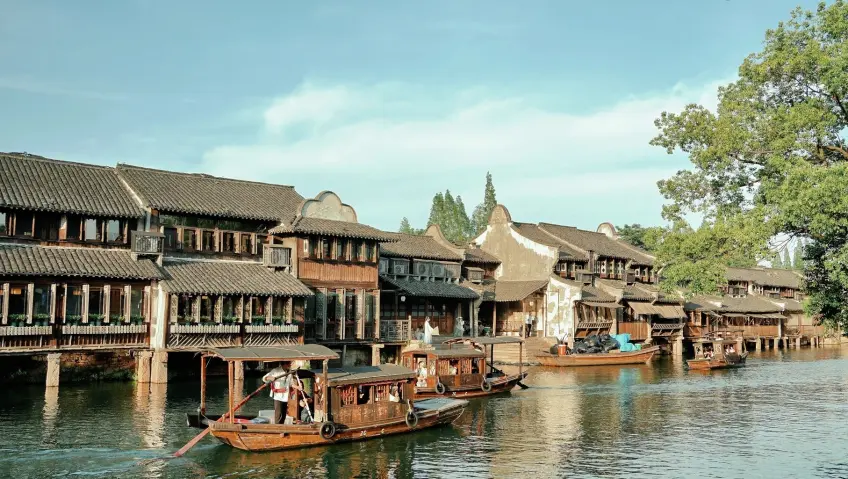
Panoramic view of the white walls along the riverbank in Wuzhen Dongzha, with the white walls and waterway in the same frame. This is the waterfront of Wuzhen Dongzha; do not use it as proof of the riverbanks in Xitang or other ancient towns.
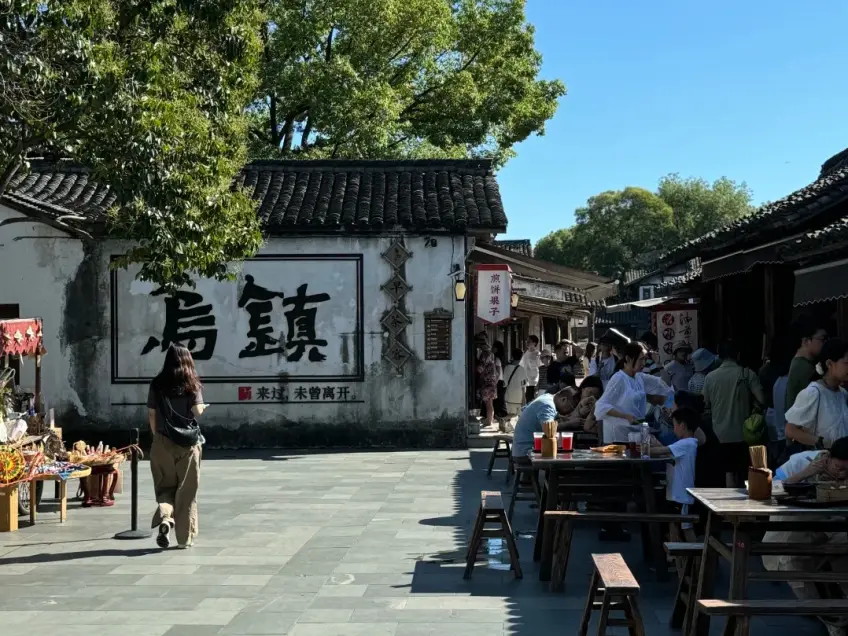
Inscription on the gate wall and street view in Wuzhen: the "Wuzhen" inscription on the white wall framed with the street scene belongs to the entrance signage area of Wuzhen. Do not mistake it for the gate tower of Xitang or another ancient town.
Adding a guide vs. joining a group tour
On the road, the driver's main job is safe driving and parking, which isn't the same as in-depth commentary at scenic spots. If it's your first time at Nanhu Lake and you want to hear the story of the Red Boat and the route around the lake island, or if you need tips on architecture and avoiding tourist traps in Xitang or Wuzhen, you can add a private guide to your private car booking. Ask about overtime charges for the guide and the car separately to avoid verbal "car + guide" package quotes that can't be split up later.
If you'd rather not plan the route yourself, check out the published group tour itineraries heading toward Jiaxing (such as multi-day Nanhu Lake–Wuzhen products like Jiashui Hongyun). Meeting points, seats and some ticket arrangements are fixed in the schedule, which suits families who want to skip the planning hassle. A private car lets you change departure times and stops, while a group tour offers a polished itinerary. They aren't opposites—just a choice between flexibility and convenience.
It's clearer to look at the three bills separately: the group tour fee is a "package price"; the car is charged by "mileage plus hours"; and guiding is charged by "person-day or half-day." Comparing only a single total makes it easy to overlook overtime and tolls. If business travel also needs to connect Hangzhou or Shanghai, a standard Jiaxing day tour won't fit. Switch to private customized travel to rearrange the days and must-see spots, then calculate the car and guide costs separately instead of forcing a cross-city trip into a full- or half-day rate.
How to combine station transfers with cross-city trips
If you're arriving or departing via Jiaxing Railway Station, Jiaxing South Railway Station, or nearby airports and only need "station → hotel" or a return drop-off, you can book station transfers separately—no need to default to a full-day private car. Once your sightseeing plan is set, simply upgrade the local segment to a private car.
Cross-city connections (for example, guests from Shanghai spending a day in Jiaxing before returning) count as two segments or a cross-city itinerary: clearly specify the start and end points, whether highway tolls are included, and whether the driver waits during sightseeing. A standard "half-day in Jiaxing" template can't be forced onto a "Hongqiao → Xitang → Hongqiao" route. When requesting a quote, state the start and end points in both cities and the latest return time. The images and itineraries in this article focus on Jiaxing's Nanhu Lake, Yuehe, Xitang, and Wuzhen—we don't pass off photos of West Lake in Hangzhou or The Bund in Shanghai as local sights.
A reminder for when you arrive: highway conditions, parking outside the ancient towns, and ticket-checking rules change with seasons and traffic controls, so always follow the day's traffic and attraction notices before setting out. This article doesn't list unverified fixed ticket prices or rigid car rates. For a quote, use the private car, guide, and form links provided in the article.
Common mistakes independent travelers make: cramming an in-depth Nanhu Lake visit together with Xitang and Wuzhen in one day without any buffer; discovering on-site that no child seat was prepared; and leaving no margin for traffic jams on the return trip, causing a missed high-speed train. Fixes: split the two major ancient towns into half-days or separate days; note the number of passengers and seat requirements when booking; and allow extra time for entering the city and security checks on the way back. If your group exceeds a sedan's comfortable capacity or you need point-to-point service for two consecutive days, outline your schedule in the form for daily quotes—you don't have to assume you can only book a "single ride."
Two more practical tips for requesting quotes. First, the line between "half-day" and "full-day": if the driver only drops you at the entrance without waiting, it's usually billed as a short point-to-point transfer. If the driver must wait outside until you finish sightseeing and then take you back, request a quote based on a full-day or wait-inclusive plan to avoid a verbal half-day turning into overtime charges. Second, "overnight" trips: staying overnight in Xitang or Wuzhen and heading to Jiaxing South Railway Station the next day counts as two segments. Clearly list both start/end points and the overnight stop in the form—it's much clearer than forcing it into a single-day private car booking.
Practical advice for getting a quote: send your consultant a checklist covering the date, number of passengers, preferred vehicle type, half-day or full-day, start and end points, whether tolls and parking are included, overtime rules, and whether you need a guide. If you need a dedicated vehicle, use the private car link; if you want to change the route and rearrange the itinerary, use the private customized travel form. Final prices are subject to the confirmation reply.
FAQs
Why aren't fixed prices shown on the website?
Prices vary widely depending on vehicle type, dates, half-day vs. full-day, mileage, tolls and parking, holidays, and whether waiting time is included, so publishing fixed prices can be misleading. The right approach is to request a quote using the price table fields and get an itemized confirmation with its validity period. This article only explains how to ask, without making up price ranges.
How is the line drawn between half-day and full-day?
Specify pickup and drop-off times, the list of main stops, and whether transfers and waiting are included. One main stop for three to four hours usually counts as a half day; two areas plus transfer time usually make a full day. If you add Yuehe at night or a Wuzhen evening tour, confirm separately whether it costs extra—don't just say "we'll take a look if there's time."
Are highway tolls and parking included in the car price by default?
Not necessarily. When requesting a quote, clearly select "included" or "charged at actual cost." Short local transfers rarely use highways, but trips from Nanhu Lake to Xitang or Wuzhen, or cross-city drives, often involve tolls. Parking outside the old towns and overtime temporary parking depend on actual conditions—don't assume the driver will cover them without reimbursement.
When should I add a guide?
If it's your first time visiting Nanhu Lake or the old towns and you need route guidance and historical context, adding a private guide to your private car booking is more helpful. If you only need point-to-point transfers and know your way around, a private car alone is enough. Ask about guide overtime and vehicle overtime separately.
How do I book a short transfer if I only need a station pickup?
For trips between Jiaxing Railway Station or Jiaxing South Railway Station and your hotel, simply use the station transfer service; you can decide separately whether to keep the private car for sightseeing. Note your train number and luggage count on the form so the driver can wait on time.
Should I choose a set group tour or a custom itinerary?
If you want a hassle-free trip and don't mind fixed stops, compare Jiaxing group tours (such as Jiashui Hongyun). If you need to change times or stops, stay overnight, or visit multiple cities, book a private car or custom travel to rearrange your itinerary. For either option, start by using the links on this page to tell us what you need.