
Video highlights
- Bukenqu Guanyin Temple was the first temple built on Mount Putuo.
- Mount Putuo reached its peak during the Ming and Qing dynasties, forming a layout of three major temples.
- The Nine-Dragon Caisson Ceiling in the Nine-Dragon Hall of Fayu Temple is a national cultural relic, relocated here by imperial decree of Emperor Kangxi.
- Chaoyin Cave lies on the coast below Bukenqu Guanyin Temple, where waves crashing against the cliffs sound like giant bells.
- Fanyin Cave is located at the eastern end of Mount Putuo, flanked by steep cliffs.
Video transcript
Auto-generated from the video audio, some words may be inaccurate
View full transcript
You may have heard of a small island in Zhoushan, Zhejiang.
It sits alone on the blue waves,
yet has carried a thousand years of incense and reverence.
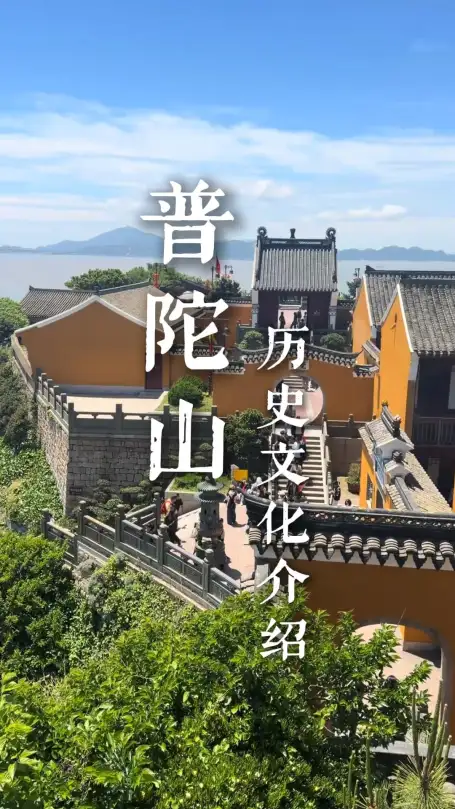
This is Mount Putuo.
It isn't a hidden paradise,
but it's known as a Buddhist Kingdom of Sea and Sky.
Its winds and waves never rest,
yet they always soothe the most restless hearts.
When we step onto this land,
the first bell we hear
seems to ask:
when did these chants over the sea begin?
The origin of Mount Putuo
starts with a legend about someone who refused to leave.
The eminent Japanese monk Egaku
obtained a solemn statue of Guanyin from Mount Wutai
and prepared to sail east to Japan.
But when his ship reached
Lotus Sea (Lianhuayang) near Mount Putuo,
the calm sea
suddenly turned violent,
with gales and towering waves
making it impossible to move forward.
Egaku suddenly realized:
perhaps the Bodhisattva refused to go east.
He immediately knelt before the statue and prayed.
Egaku built a simple thatched hut
in the Purple Bamboo Grove by the shore
and enshrined the Guanyin statue there.
This became Mount Putuo's first temple,
Bukenqu Guanyin Temple.
From then on, the "Guanyin Who Refused to Leave"
became the spiritual symbol of Mount Putuo.
By the Ming and Qing dynasties,
Mount Putuo had reached its peak,
forming the grand layout of its three great temples.
Emperors Kangxi and Yongzheng
not only funded extensive renovations
but also bestowed imperial jade steles,
pushing this island Buddhist kingdom
to the height of devotion.
Inside Fayu Temple's Nine Dragon Hall,
the exquisitely crafted nine-dragon caisson ceiling
is a national-level cultural relic.
Nine dragons coil around it,
their heads hanging low with piercing eyes
and lifelike forms,
as if forever guarding this pure land.
This caisson ceiling
originally came from the Ming Dynasty Imperial Palace in Nanjing,
and was later moved here by Emperor Kangxi's decree,
becoming one of Mount Putuo's most precious architectural relics.
Yet
perhaps Mount Putuo's greatest architect
is nature itself.
The name Chaoyin Cave
is full of poetry and Zen wisdom.
Located on the coast below Bukenqu Guanyin Temple,
it's a huge natural sea cave.
Waves surge into the deep cavern day and night,
crashing violently against the rock walls
with thunderous roars
that sound like giant bells,
shaking the soul.
At Fanyin Cave on the eastern end of Mount Putuo,
another miracle unfolds.
Here, sheer cliffs rise dozens of meters high
with an unfathomable depth between them.
Under certain light conditions,
mist fills the cave,
and as sunlight refracts,
mysterious visions of
"Guanyin appearing" often emerge.
Mount Putuo is more than a point on a map;
it's a guiding light
in the Chinese spiritual world.
Whatever you're going through right now,
take a walk on Mount Putuo.
Listen to the tidal sounds,
visit the ancient sites,
and feel the sea breeze that has blown for a thousand years.