
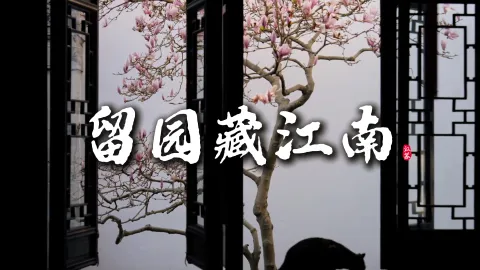

Of All the Gardens in Suzhou, Lingering Garden Is Always the Most Soothing and Timeless!
Video highlights
- Lingering Garden is one of China's Four Great Gardens and is divided into four areas.
- The first sight after entering is Intertwined Ancient Trees, with six lattice windows set into the white wall
- A corridor over 700 meters long connects the central scenic area
- The rockery in front of Wufeng Immortal Hall is stacked to mimic the shape of Wulao Peak on Mount Lu
- Cloud-Capped Peak stands 6.5 meters tall and is the finest Taihu rock in Jiangnan
- The bonsai garden in the north showcases Suzhou-style bonsai
Video transcript
Auto-generated from the video audio, some words may be inaccurate
View full transcript
Stepping over the blue bricks
and entering Lingering Garden,
lattice window shadows
fill the pavilions and hillsides.
One garden becomes four zones,
capturing all the essence of Jiangnan gardens
in a small space.
As one of China's four famous gardens,
Lingering Garden stands out
for its mature and complete layout.
The entire garden is divided into four areas,
each with its own character
yet seamlessly connected,
offering different visual experiences.
The central area is the landscape core of Lingering Garden
and the main scenic zone after entry.
This whole area centers on the middle pond,
with the garden's main buildings, plants, and rocks
arranged around the water system.
The space is open and expansive,
forming the visual center of the entire garden.
The first sight upon entering is Ancient Trees Intersecting,
a highly representative opening scene of Lingering Garden.
Century-old cypresses
grow alongside old privet trees,
their weathered branches
set against plain white walls.
Six elegantly shaped lattice windows
are set into the wall.
Garden design doesn't reveal everything at once;
it uses lattice windows to create
a play of hidden and revealed views.
The simple window designs
layer the garden scenery gradually,
subtle and captivating.
Hanbi Mountain Villa, also called the Lotus Hall,
sits along the central pond
and is the main waterside building
of the central zone.
The hall faces the entire central water area
with an open view.
The water before the door
stays clear year-round.
Every summer,
lotus flowers bloom in the pond,
greenery covering the surface
and fragrance lingering around the pavilions.
Mingse Tower is a two-story
waterside pavilion,
light and delicate in form.
Connected to Hanbi Mountain Villa,
its overall silhouette resembles a painted boat by the water.
The courtyard features continuous waterside corridors—
over 700 meters of winding walkways
linking the entire central scenic area.
Haobu Pavilion sits in the middle of the pond,
small in scale
and surrounded by tranquil water.
With little noise,
visitors sitting inside
can watch fish up close
or gaze at the towers and hills across the water.
The eastern rock zone
gathers the core sights of Lingering Garden,
featuring classical halls
and giant rocks as highlights,
preserving many top-tier historical scenes.
Wufeng Immortal Hall,
often called Nanmu Hall,
is one of the highest-grade classical halls
remaining in Jiangnan.
Its main structure
is built from precious nanmu wood,
with clear natural grain.
The building avoids elaborate decoration,
relying on the wood's texture
for a dignified, grand appearance.
The rockery before the hall
is stacked to mimic the Wulao Peaks of Mount Lu,
an important cultural landscape relic of Lingering Garden.
Linquan Qishuo Hall
features a rare mandarin-duck hall layout,
with completely different designs
on the north and south sides,
creating distinct spatial impressions.
The hall faces Cloud-Capped Peak
with an excellent view.
In ancient times, it served as the owner's main place
for receiving guests
and quietly enjoying the scenery.
Looking outward from inside the hall,
flowers and trees surround
the spacious, tidy courtyard,
with a refined and orderly layout.
Cloud-Capped Peak is the treasure of Lingering Garden
and the finest Taihu rock in Jiangnan.
Standing 6.5 meters tall,
it is a relic from the Northern Song Flower and Rock Convoys.
The Taihu rock is tall and slender,
with naturally formed surface holes,
still perfectly intact
after centuries of wind and rain.
Below the stone lies Huanyun Pond,
whose water reflects the stone's outline,
creating a superb rock-and-water scene
in Jiangnan gardens.
Shilin Small Courtyard
is a classic example of gardening in a small space.
Though modest in size,
it uses corridors, doors, windows,
and partition walls to divide the space,
creating rich layers of mountain-forest atmosphere
in a tiny yard.
This technique of seeing the grand in the small
fully demonstrates the exquisite craftsmanship
of Suzhou gardens.
The western forest zone
emphasizes natural mountain scenery.
Contrasting with the refined waterscapes of the central area,
it is the most nature-like part of the garden.
Wenmu Xixiang Pavilion,
built halfway up the hillside,
is the core viewing structure of the west zone.
Surrounded by osmanthus groves,
the fragrance fills the hills
when they bloom in autumn.
The western slopes retain more of their natural state,
planted extensively with maple trees.
In late autumn,
red leaves blanket the hills
in rich color layers.
Quiet and peaceful,
this is a prime spot to relax and wander.
The northern pastoral bonsai zone
has a sweet, simple charm,
contrasting sharply with the refined order
of the other three areas.
Huopopo Pavilion
is built by the water
with a simple, light design.
Without complex rockeries
or ornate halls,
it pairs with naturally growing pastoral plants
for a relaxed, comfortable feel.
The bonsai garden near the buildings
showcases various Suzhou-style bonsai.
It preserves many fine old potted specimens,
each carefully tended by craftsmen
to present miniature mountain landscapes.
The northern zone avoids deliberate carving;
plants grow naturally
and the layout is simple and casual,
reflecting the leisurely look of Jiangnan countryside.
This area completes the garden's scenic layers—
from refined waterscapes to natural forests
to rustic fields,
four styles unfold in sequence,
making Lingering Garden's overall design system more complete.
Looking at Lingering Garden as a whole,
the four zones each have their own character:
elegant waterscapes, dignified halls,
rustic forests, and peaceful fields.
Within one garden lie all the qualities
of Jiangnan's landscapes and ancient architecture,
showing the brilliance of traditional garden design
in a small space.
This is why Lingering Garden, after centuries,
still represents the highest standard
of Jiangnan classical gardens.