
Maoshan is located about 20 km southeast of Jurong City, Jiangsu Province, on the border between Jurong in Zhenjiang and Jintan in Changzhou. The mountain range spans both areas, but what visitors usually call the "Maoshan Scenic Area" is mainly on the Jurong side, where Jiuxiao Wanfu Palace, Yuanfu Wanning Palace, and the Laozi Statue are all found. It's closest from Nanjing—you can take a high-speed train to Jurong Station and then a taxi for about 30 minutes, or catch a tourist bus from Nanjing to Maoshan. From Shanghai, take a high-speed train to Jurong or Jintan Station and transfer; a same-day round trip is tight, so a private car or an overnight stay is recommended.
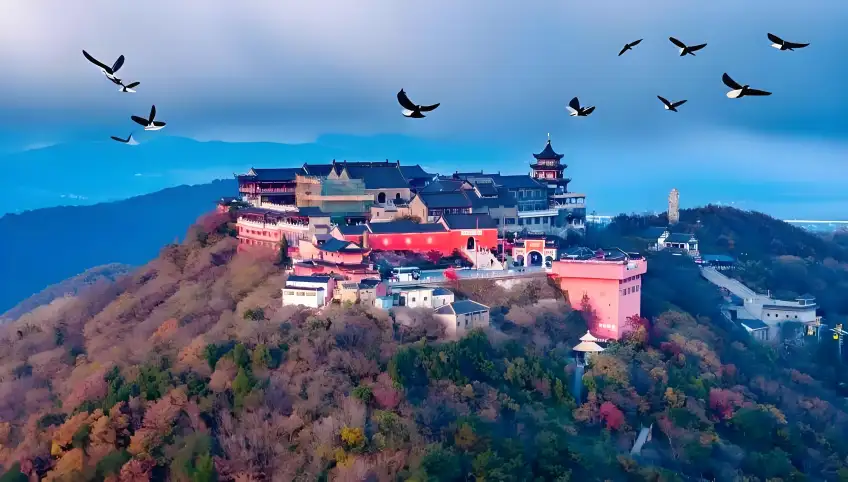
Where is Maoshan: On the border of Jurong and Jintan, with the main scenic area in Jurong
On a map, Maoshan lies roughly in the hinterland between Nanjing, Zhenjiang, and Changzhou. The mountain range runs north-south, with the western side in Jurong, Zhenjiang, and the eastern side in Jintan, Changzhou—which is why you'll see both "Jurong Maoshan" and "Jintan Maoshan" online. For first-time visitors, just remember one thing: the Taoist temples and main attractions are concentrated in the Maoshan Scenic Area on the Jurong side, so simply search for "Maoshan Scenic Area" when using navigation.
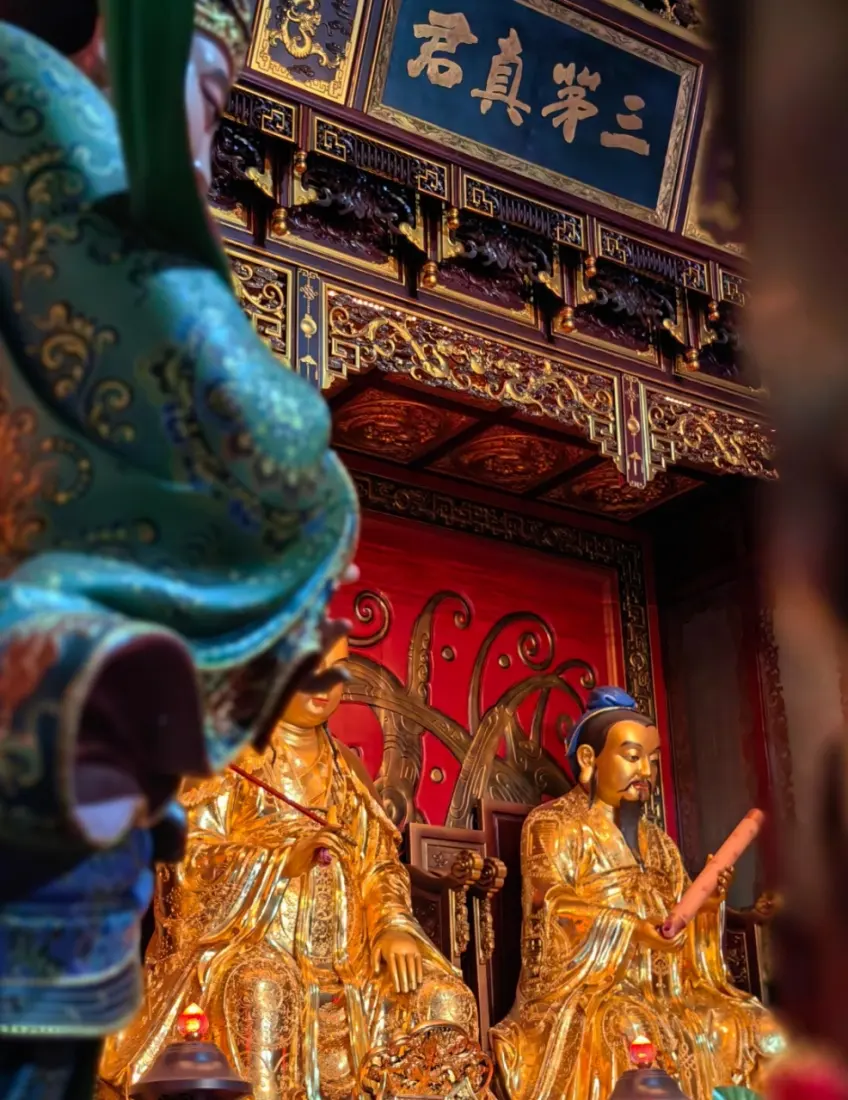
Maoshan's main peak is Damao Peak, at 372.5 meters above sea level. It isn't particularly high, but it holds great significance in Taoism: it's known as the "Eighth Grotto-Heaven and First Blessed Land," and is the birthplace of the Shangqing School of Taoism. The name Maoshan comes from the legend of three Han Dynasty brothers—Mao Ying, Mao Gu, and Mao Zhong—who cultivated the Tao here, which is why you'll often see shrines to the "Three Mao Lords" in the temples. The site is a national 5A-level tourist attraction, open from 07:30 to 16:30.
The mountain is said to have "nine peaks, nineteen springs, twenty-six caves, and twenty-eight pools." But for visitors, only two clusters really need planning: Jiuxiao Wanfu Palace at the summit, and Yuanfu Wanning Palace plus the Laozi Statue at the foot of the mountain. There's some distance between the two, so taking the sightseeing shuttle back and forth within the scenic area is generally recommended.
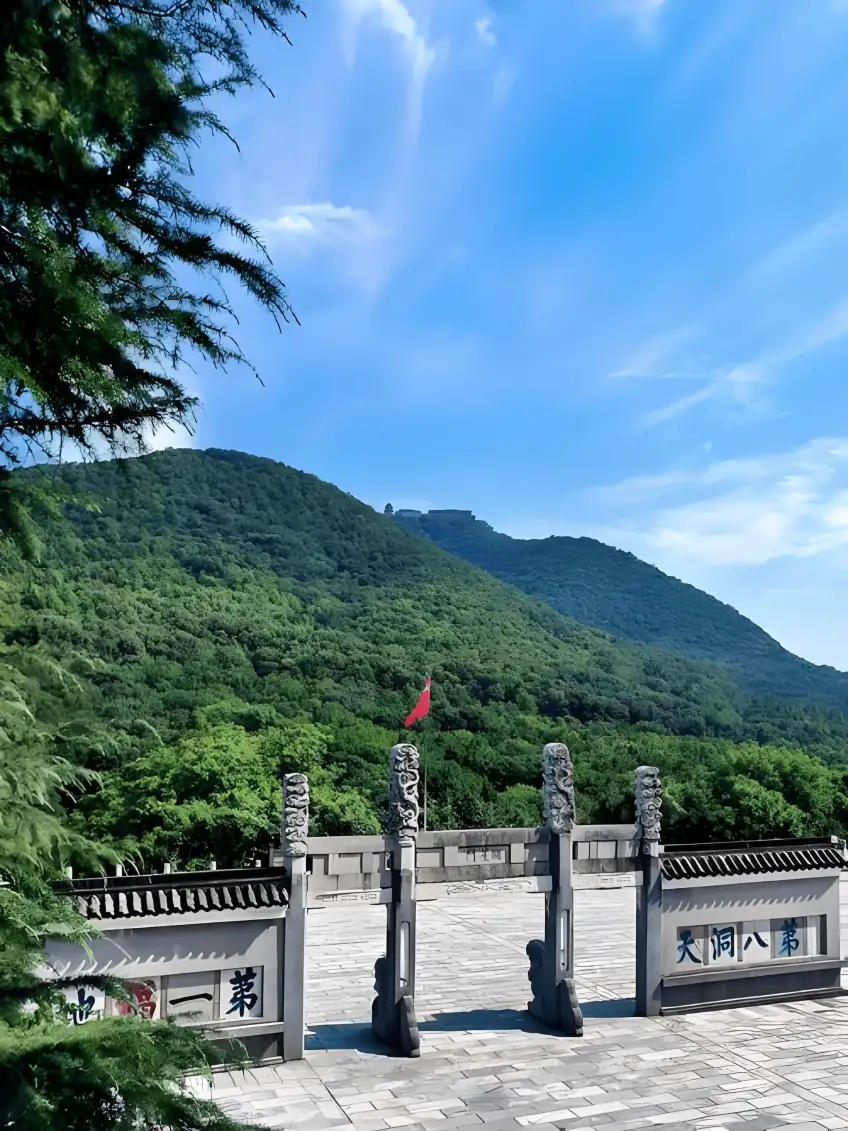
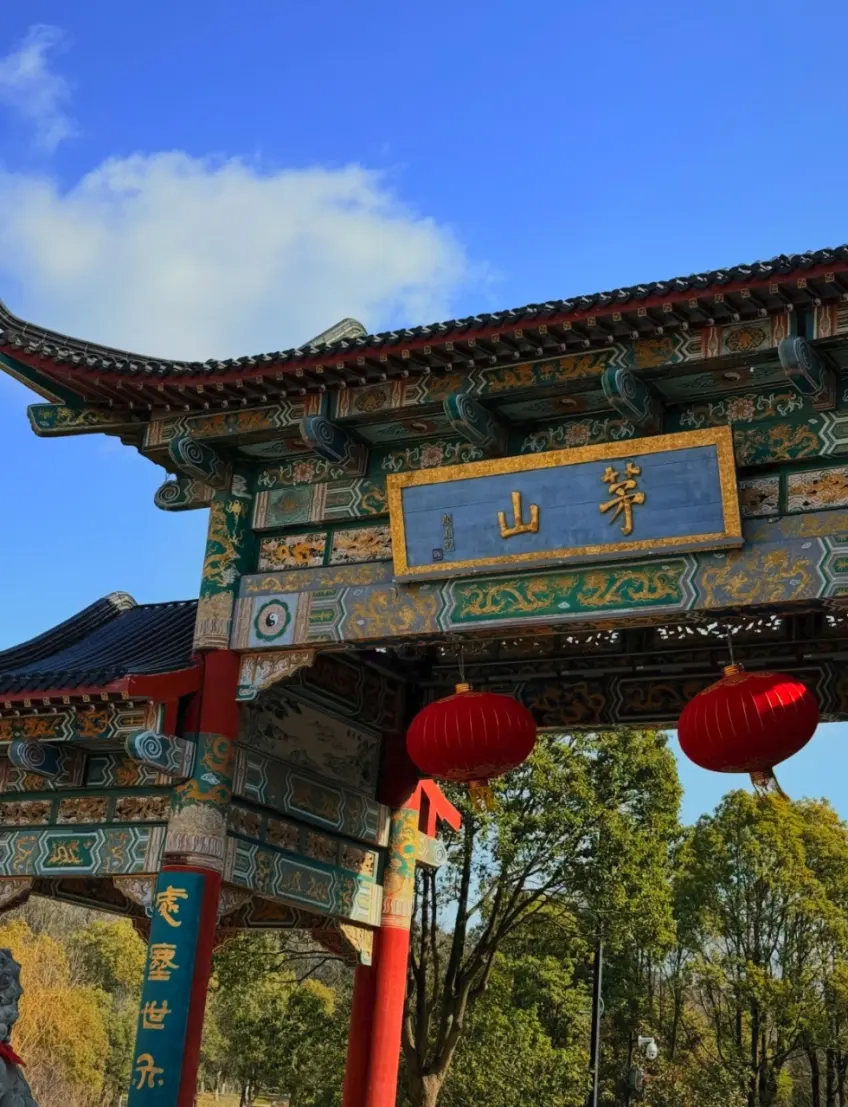
How to get to Maoshan from Nanjing, Shanghai and Zhenjiang
From Nanjing: This is the easiest option. Take a high-speed train to Jurong Station, then a taxi for about 30 minutes to the scenic area. You can also catch a dedicated tourist bus to Maoshan near Xiaohongshan in Nanjing—ideal for independent travel visitors who don't want to transfer.
From downtown Jurong: Take Jurong bus No. 113 or No. 112 toward Maoshan. Check the schedule and last departure time before you go, and don't leave your return trip too late.
From Shanghai, Suzhou or Changzhou: Take a high-speed train to Jurong Station or Jintan Station, then continue by taxi. From Shanghai, the one-way trip plus transfers takes most of the day, so a same-day round trip is very tight. It works better combined with a Nanjing or Changzhou itinerary, or by booking a private car and staying overnight nearby. A more relaxed plan is to spend the night in Nanjing, head to Maoshan early the next morning, see the main sights around midday, and return to Nanjing in the afternoon or continue on to Zhenjiang or Changzhou. That way you won't have to leave Shanghai before dawn or rush for the last train.
Driving: Take the expressway and exit at Maoshan or Xuebu, then follow the signs to the parking lot. The lot fills up quickly on holiday mornings, so arrive early.
The scenic area is far from the city center and public transit runs infrequently, so getting back is where problems usually happen: after the park closes at 16:30, taxis aren't always easy to find. If you're traveling with seniors, children or luggage, book your return ride in advance, or simply choose Nanjing private car or Zhenjiang private car service—you can also arrange pickup and drop-off at the train station.
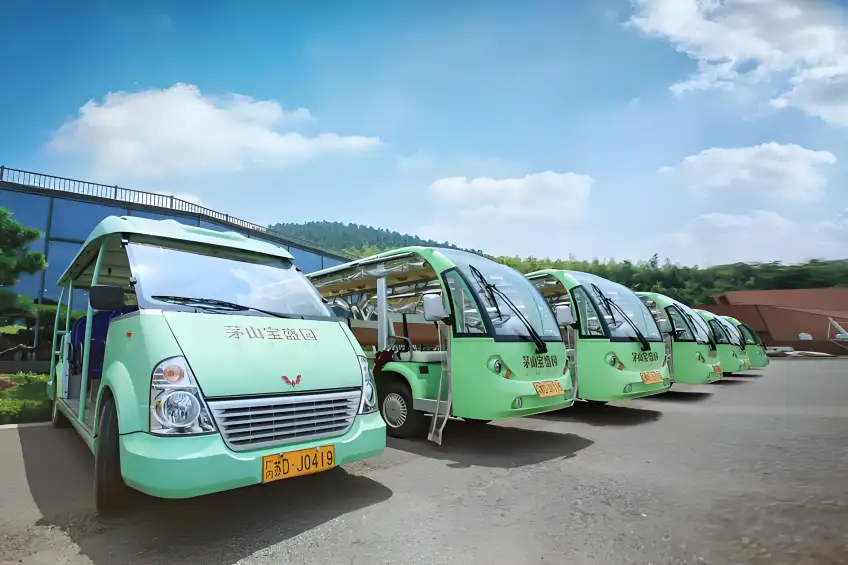
Getting around inside the scenic area: Jiuxiao Wanfu Palace, Yuanfu Wanning Palace and the Laozi statue
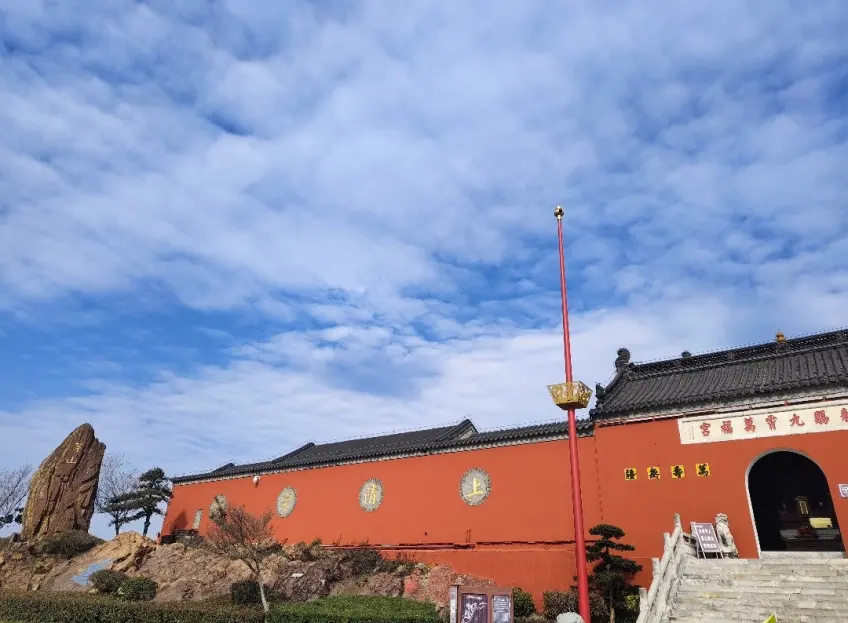
Jiuxiao Wanfu Palace sits atop Damao Peak. Locals call it the "Top Palace." It is Maoshan's main Taoist temple, with red walls, stone steps and tiered halls built into the hillside. Inside, the Three Mao Lords are enshrined. The summit offers wide-open views, and on clear days you can see the surrounding hills and fields.
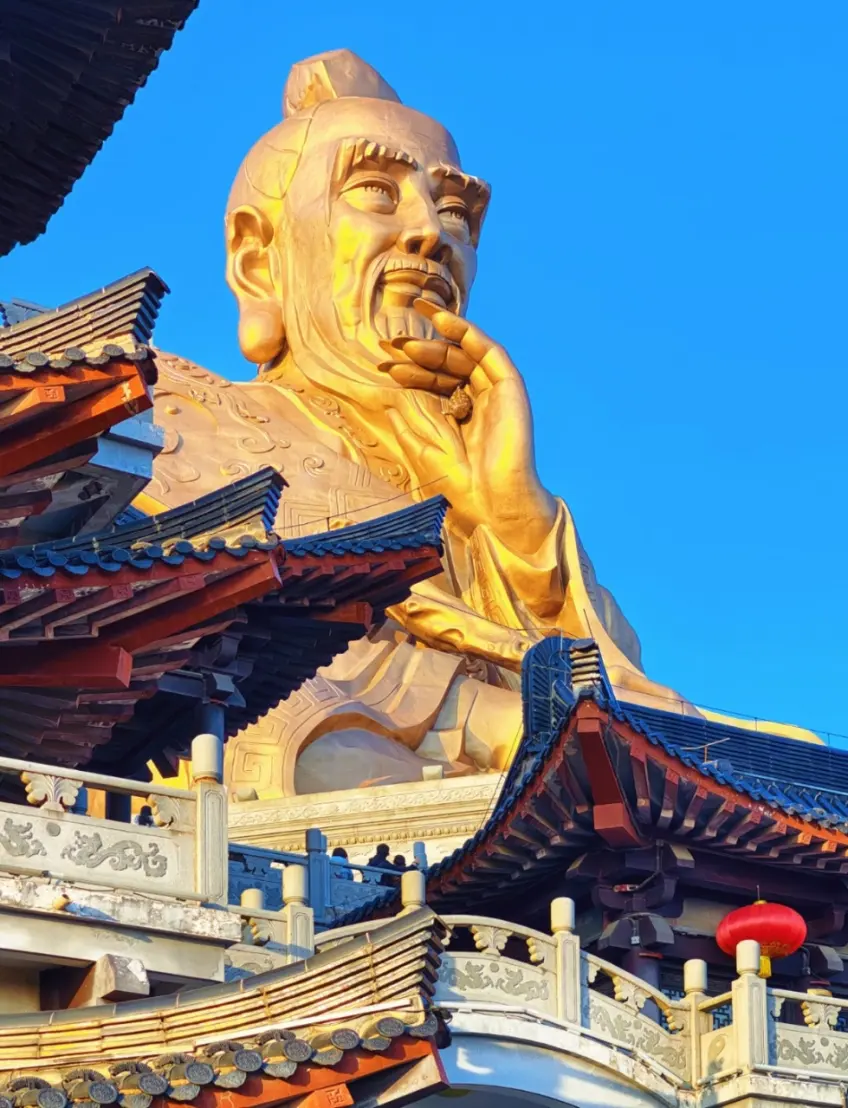
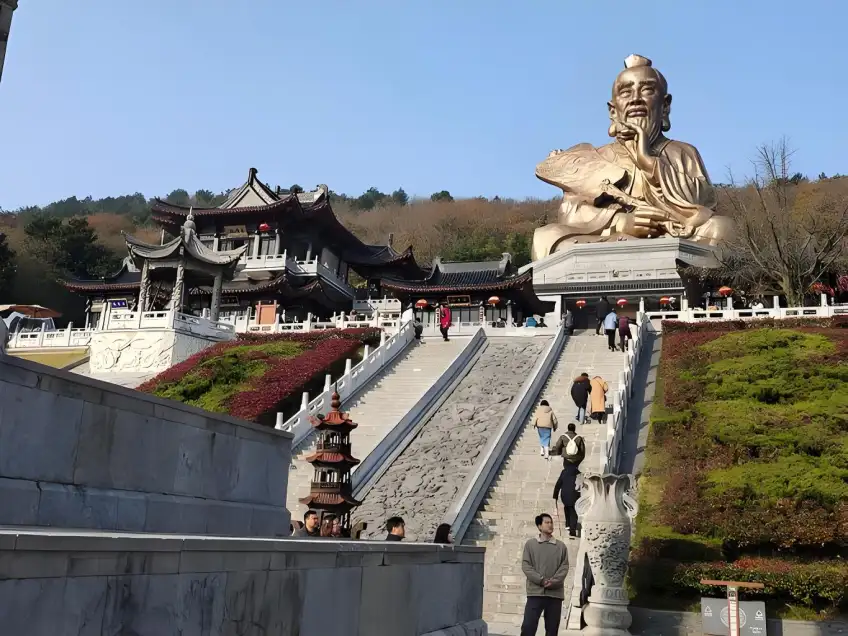
Yuanfu Wanning Palace sits at the foot of the mountain. Locals call it "Yin Palace" (Seal Palace) after a Song dynasty imperial seal once kept here, the "Jiulao Xiandujun Seal." Together with Jiuxiao Wanfu Palace at the summit, it forms what is known as Maoshan Daoist Temple. Most of the halls you see today were restored or rebuilt after the 1980s. The bronze statue of Laozi beside the palace is Maoshan's most striking landmark: 99 feet tall, weighing 106 tons, and cast from 226 bronze panels in the late 1990s. Stand on the plaza in front of it and the scale difference between you and the figure really drives home its size. When introducing it to foreign friends, you might add that Laozi was a pre-Qin philosopher and author of the Tao Te Ching, revered by Taoism as "Taishang Laojun," which is why statues of him are common landmarks on famous Taoist mountains.
The scenic area is large, and first-time visitors often make the mistake of walking back and forth between the different sites, wasting both time and energy. A smoother route is to take the sightseeing bus up the mountain to Jiuxiao Wanfu Palace, then head down to Yuanfu Wanning Palace and the Laozi statue, and finally decide whether you have the energy for Huayang Cave and Xike Spring. Climbing first and descending later makes better use of your stamina. Inside the Taoist temples, pay attention to signs about photography and incense, and keep quiet in the halls. Maoshan is still an active monastery where Taoist priests practice and perform rituals. In the morning you may see priests holding their morning service or pilgrims burning incense. If you come across a ceremony, stand to the side and watch—don't walk through or interrupt, and avoid taking close-up photos of the priests. Designated incense-burning spots are usually set up outside the gates and in the plazas; if you bring your own incense, light it only in those areas.
Maoshan's status in Taoist history owes much to Tao Hongjing of the Southern Dynasties. The Shangqing School emerged during the Xingning era of the Eastern Jin and centered its lineage on Maoshan. In 492, the 10th year of the Yongming era of the Southern Qi, Tao Hongjing resigned his official post and retired to Maoshan, living there in seclusion for more than 40 years while compiling the Shangqing scriptures. Later generations formed the Maoshan School from his work. Emperor Wu of Liang frequently exchanged letters with him and consulted him on state affairs, earning Tao the nickname "Prime Minister in the Mountains". He was also a pharmacologist. His Collected Commentaries on the Classic of Materia Medica expanded the Shennong Bencao Jing to 730 medicinal substances and remains a key work in the history of Chinese herbal medicine.
The inscription "First Blessed Land, Eighth Grotto-Heaven" on the stone archway refers to the Taoist system of grotto-heavens and blessed lands. Taoism classifies mountains suitable for cultivation into Ten Great Grotto-Heavens, Thirty-Six Lesser Grotto-Heavens and Seventy-Two Blessed Lands, a system generally traced to Sima Chengzhen's Tang-dynasty Chart of the Palaces of Heaven and Earth. Maoshan's grotto-heaven is called Juqu Mountain Cave, with the title Jintan Huayang Heaven—Maoshan was known as Juqu Mountain in antiquity, and the name of Huayang Cave on the mountain echoes the "Huayang" title. Knowing these names will give you a deeper appreciation of the steles and plaques you see inside the temples.
Huayang Cave, Xike Spring and New Fourth Army Memorial Sites
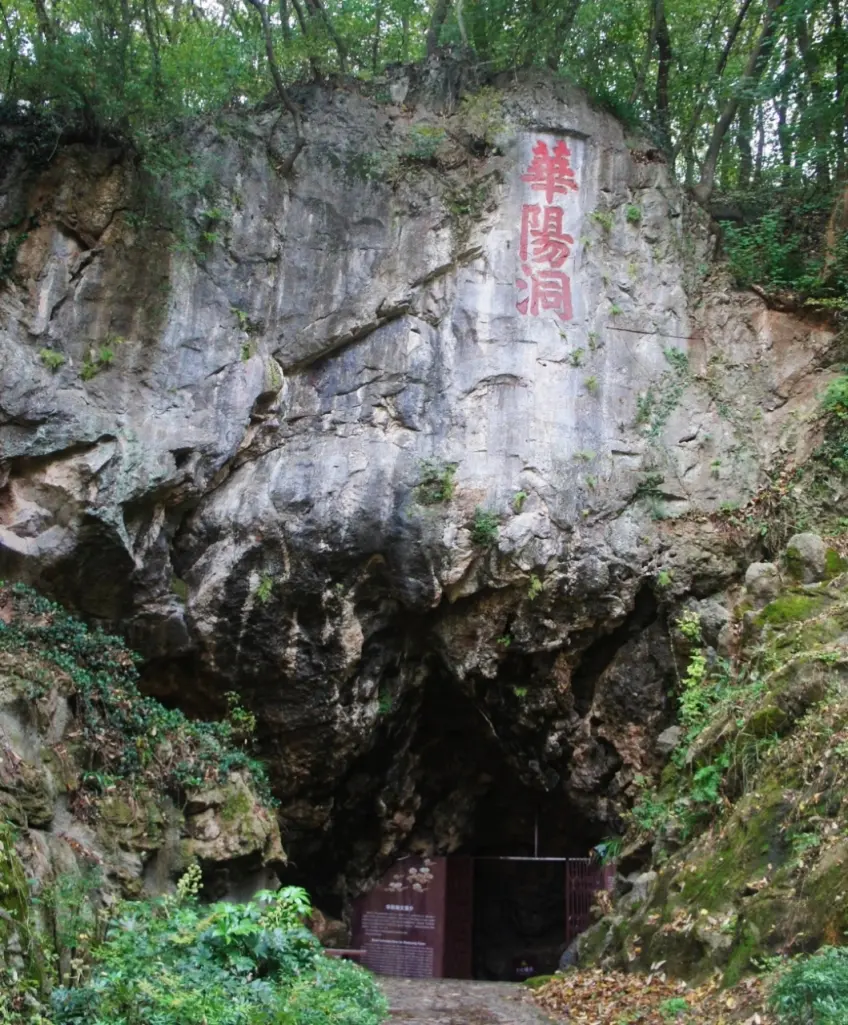
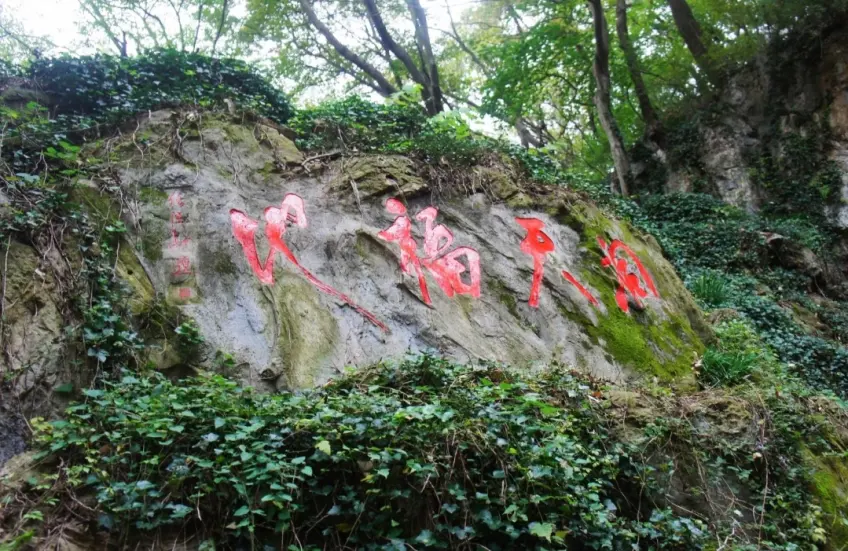
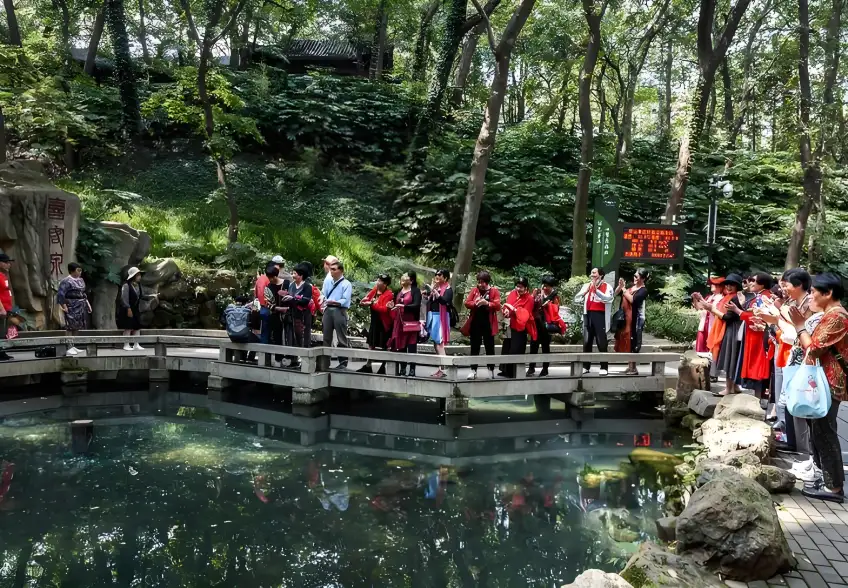
Huayang Cave is the most famous of Maoshan's many caves. The characters for "Huayang Cave" are carved into the cliff at the entrance, and nearby you'll find a cliffside inscription reading "First Blessed Land." Inside, it's dim and the ground is damp, so take your time and wear non-slip shoes. Xike Spring is a spring pool where, according to legend, clapping your hands at the edge makes streams of bubbles rise from the water as if welcoming guests—hence the name. Stone bridges and shaded paths nearby make it a good spot to rest. Tao Hongjing called himself the "Hermit of Huayang," which is why the area around Huayang Cave is often visited by those tracing his footsteps.
Maoshan has another identity as well: during the War of Resistance Against Japanese Aggression, it was one of China's six major mountain anti-Japanese base areas, and the New Fourth Army left over 100 historical sites in these hills. The Southern Jiangsu Victory Monument and the New Fourth Army Memorial Hall within the scenic area can easily be combined with a visit to the Daoist temples. In February 1938, Mao Zedong noted in a telegram that the Maoshan range was ideal for developing guerrilla warfare behind enemy lines. That June, Chen Yi led the First Detachment of the New Fourth Army from southern Anhui into the Maoshan area of southern Jiangsu to wage guerrilla operations. Centered on Maoshan, the Southern Jiangsu Anti-Japanese Base Area was one of the earliest such bases established by the Communist Party behind enemy lines in central China. For visitors interested in modern history, this side of Maoshan is often more compelling than expected—the maps and artifacts in the memorial hall help explain how troops used the hilly terrain to their advantage.
Where to combine with Maoshan
Visiting Maoshan on its own can feel a bit thin, so combining it with nearby cities offers better value. Here are a few popular pairings:
Maoshan plus Nanjing: Nanjing is the closest city to Maoshan. You can visit Sun Yat-sen Mausoleum and the Presidential Palace in Nanjing the day before, head to Maoshan the next morning, and return to Nanjing in the afternoon to catch your high-speed train.
Maoshan plus Zhenjiang: Zhenjiang's Jinshan Temple and Xijindu are in the city center, while Maoshan is out in Jurong, at the other end of the region. To cover both in one day, we suggest visiting Maoshan in the morning, returning to downtown Zhenjiang in the afternoon, and exploring Xijindu in the evening. A private car works best for this route.
Maoshan plus Changzhou: Entering and exiting Maoshan via Jintan is smoother. You can combine it with other attractions in Changzhou for a two- or three-day family trip—the group tour below follows this approach.
No matter which combination you choose, try to schedule Maoshan for the morning. The temples on the mountain are quieter early in the day, and since closing time comes early, an afternoon arrival feels rushed. Temperatures on the mountain differ noticeably from those in the city, so apply sunscreen and stay hydrated in summer, and bring extra layers for the windy summit in winter. There are many steps around the temples, so wear flat, non-slip shoes.
Half day or full day: timing and how to choose
Half day: Visit only Jiuxiao Wanfu Palace and the Laozi bronze statue, taking the sightseeing shuttle both ways. This takes about 3 to 4 hours and works well for a same-day trip from Nanjing. We recommend entering shortly after opening, heading straight to the summit temple, descending to Yin Palace and the statue plaza before noon, and leaving in the early afternoon.
Full day: Add Huayang Cave, Xike Spring, and the Anti-Japanese War memorial site to the half-day plan. The pace is more relaxed, and you won't need to rush out before noon.
Two days: Combine Maoshan with other attractions in Nanjing or Changzhou, or stay overnight nearby. Ideal for travelers coming from Shanghai.
How to choose: If you're comfortable using ride-hailing apps and only want to see the main sights on an independent travel trip, taking the high-speed train from Nanjing plus a taxi works perfectly. If you're traveling with elderly family members, have limited mobility, or want to visit Jinshan Temple and Xijindu in Zhenjiang on the same day, a private car is best—the driver waits outside the scenic area, so you won't need to worry about hailing a ride back. To truly understand the Taoist temples and the origins of the Shangqing School, consider hiring a Zhenjiang private guide to explain things along the way. You can also check out the group tours below that include Maoshan, combining it with Nanjing, Baohua Mountain, Changzhou, or Oriental Salt Lake City. Transportation and accommodation are arranged by us, making them ideal for families who don't want to plan logistics themselves.
Tips for international visitors: English signage inside the scenic area is limited, and the steles and plaques in the temples are almost entirely in Chinese—without a guide, you may end up "just looking at buildings." Sightseeing shuttles are usually ticketed inside the scenic area, with stops between several clusters of attractions at the summit and the base; ask about the last return shuttle before boarding. Payment is mostly via QR code scanning, so keep some cash as backup. When heading back to the high-speed rail station, you'll need to enter the Chinese station name "Jurong Station" or "Jintan Station" in the ride-hailing app.

Nanjing and Changzhou 4-day 3-night private tour | Sun Yat-sen Mausoleum, Maoshan, Baohua Mountain, Dinosaur Park
A 4-day 3-night private tour with pickup at Nanjing Railway Station: Sun Yat-sen Mausoleum and the night views of Confucius Temple and the Qinhuai River; Maoshan, Qianhua Ancient Village and Baohua Mountain; a full third day at China Dinosaurs Park in Changzhou, great for kids. Includes transportation, guide, 3 nights at an upscale or luxury hotel, and admission tickets. English-speaking guides available.
Yangzhou and Maoshan 3-day 2-night private tour | Ge Garden, Daming Temple, stay at Oriental Salt Lake City
A 3-day 2-night private tour starting in Yangzhou and ending in Changzhou: Ge Garden, Daming Temple and Dongguan Street, followed by the Taoist Mount Maoshan the next day before checking into Oriental Salt Lake City, with free time to explore the resort on day three. Includes transport, guide, two nights at an upscale or luxury hotel and admission tickets. English-speaking guide available.
Zhenjiang 2-day 1-night private tour | Maoshan · Jinshan Temple · Jiaoshan · Xijin Ferry
A 2-day 1-night private tour with pickup at Zhenjiang Railway Station: Day 1 covers Maoshan and Jinshan Temple, with an overnight stay in Zhenjiang; Day 2 visits Jiaoshan, Beigu Mountain and Xijin Ancient Ferry, adding Maoshan and Jiaoshan compared to a day tour. Includes transportation, guide, 1 night at an upscale or luxury hotel, and admission tickets. An English-speaking guide is available on request.
FAQs
How far is Maoshan from Nanjing, and what's the fastest way to get there?
The fastest option is the high-speed train to Jurong Station, then about a 30-minute taxi ride to the scenic area. If you'd rather avoid transfers, take the tourist express bus from Nanjing to Maoshan, or book a private car for door-to-door service.
Does visiting Maoshan require a lot of hiking?
Not at all. The main peak, Damao Peak, is only 372.5 meters above sea level, and sightseeing shuttles connect the summit with the base. Walking is mostly limited to the steps inside the temples, which seniors and children can generally manage. The steps near the summit temple are more concentrated, so companions with less stamina can rest in stages instead of climbing it all at once.
Which city is Maoshan in? Are "Jurong Maoshan" and "Jintan Maoshan" the same mountain?
Yes, they are the same mountain. Maoshan spans Jurong in Zhenjiang and Jintan in Changzhou. The Maoshan Scenic Area most visitors refer to is administered by Jurong, Zhenjiang. Both sides have their own entrances and different attractions. The main scenic area—home to Jiuxiao Wanfu Palace, Yuanfu Wanning Palace, and the bronze Laozi statue—is on the Jurong side, so first-time visitors should head there.
What's the best season to visit Maoshan?
Spring and fall are the most comfortable, with the richest changes in foliage and mist. Summers are muggy at the base, so it's best to enter early in the morning. Winters are quiet with fewer crowds, but the summit is windy and noticeably colder than the city. Around Lunar New Year and traditional festivals, pilgrims flock here and the temples get crowded.
Can I stay overnight near Maoshan?
Yes. There are guesthouses and resort hotels around the scenic area, or you can head back to downtown Jurong or Jintan for the night. On the Jintan side of Maoshan's eastern slopes you'll also find the Oriental Salt Lake City resort. Pairing it with Maoshan for a two-day itinerary is quite popular — the "Praying and Exploring Taoism" group tour mentioned earlier follows exactly this plan.
For more opening hours and transportation info, see the Jurong Maoshan scenic area page.